Saturday, July 26, 2014

The Apes are Slowly Making Their Move Towards World Domination


Dawn of the Planet of Apes is the second episode in a new series of prequels to 1968's classic Planet of the Apes. 

Much like after 2011's Rise of the Planet of the Apes (I saw both of these new ones with Dan), it is still not apparent how these will connect with the original, in which humans annihilate themselves with a nuclear bomb.

In that respect, nothing much happens in the evolutionary course of events with this 3-D movie. It's a transitional piece. 

Caesar was raised a decade ago by a scientist (played by James Franco). He is now leader of the apes in Muir Woods. A plague has since wiped out 499 of every 500 humans, but a few hundred are living in a tower in downtown San Francisco.

When some of them venture into the woods as a last-ditch effort to fix a dam that would provide them with enough energy to survive, the humans and the apes rekindle a relationship that has a bunch of miscommunications that could have resulted in eternal peace but instead ends ominously for what lies ahead when the next prequel is released.

The apes are stunning and, if I had to cheer for a side, it wouldn't be the dumb humans. Barring Charleton Heston in the first couple of original films, humans have never really been the interesting ones in Ape movies. They are particularly unworthy of cheering for in this one. All unlikeable and clueless, even stars Jason Clarke, Gary Oldman (usually entirely reliable), and Keri Russell seem to sleepwalk in the shadow of Andy Serkis, who again plays Caesar with endless heart worthy of Oscar consideration.

I also really miss the music of the original series, which was so creepy in a late 1960s kind of way. (Although the song that comes on at the gas station when the power starts working again does work pretty well.)

The stage is set. The next in this series should be a doozie, and I would say the humans are in big trouble.

**** out of ***** stars


Thursday, July 17, 2014

Tips for Effective Transportation Blogging

Here's an article By Paul Goddin from Mobility Lab that nicely quotes me at the end.

This article was also published by Greater Greater Washington.


Begin with your most important point. Use short sentences and clear, non-jargony language. Remember your end goal.

These were among the tips BeyondDC creator and Greater Greater Washington  (GGW) blogger Dan Malouff imparted at this week’s Lunch at the Lab. Malouff discussed effective blogging and how to get published by websites such as GGW and Mobility Lab.

Among his main points:
    • Put the most important information up front, in the first paragraph, with more specific details and supportive facts following. The glut of information and competition demands clarity and incisiveness.
    •  “Lead with the takeaway,” Malouff said.
    • Inform before you persuade. The best articles use a piece of news or data as a starting point, and then use it to draw conclusions or make an argument. It’s important to explain the context, as readers are not all experts already.
    • Transportation and city planners (not to mention lawyers) like to use jargony language. Blog readers respond better to simple language. Complicated, wordy prose can make an otherwise compelling article unreadable and/or suspicious. Use the rule that easier-to-read is better.
    • Don’t use the passive voice much if at all. If you can insert “by zombies” after the verb, then you are using it. For example, the sentence “The use of passive voice is discouraged” is easy to identify as passive voice since one could add “by zombies” to its end and the sentence would still make sense. Instead, the sentence should read “Don’t use the passive voice.” (Avoid nominalizations, like “the utilization of this grammatical construction leads to complication of the communication,” too.)
    • Keep articles short. A thousand words is typically too long. The “sweet spot” for web writing is 300 to 600 words.
    • Keep the blog post to one main idea. If you want readers to remember more than one big takeaway, then split the article up into multiple posts.
    • Mobility Lab Communications Director Paul Mackie facilitated the lecture. He called blogging an inherently democratizing medium. He said that institutions such as the New York Times are no longer the gatekeepers of information. Anyone with a keyboard now has a voice. Mackie described blogging as a way to “become a thought leader.”

(Author’s note: This article is 374 words long and, therefore, perfect.)

Saturday, July 12, 2014

Anchorman 2 Sucker Punches Ratings-Inspired Cable News Coverage

I’m glad I skipped Anchorman 2: The Legend Continues when it was released several months ago. Letting the overwhelming hype and crass over-commercialization die down gave me more reasonable expectations.

Of course I heard that it received very mixed reviews, and several people have flat-out told me not to watch it. But in the end, I’m a sucker for Ron Burgundy and his brand of wacked-out humor.

The biggest problem I have with the movie is its slow start. The worse choice by the filmmakers was to make it so unfunny for so long. I counted to the 17-minute mark before laughing, which happens when Paul Rudd enters as a cat photographer.

Rudd actually doesn’t garner many laughs after that. Steve Carell plays, for me, the most consistently funny role as Brick the off-the-wall weatherman. His relationship with similarly nuts Kristen Wiig is endearing, his “pre-funeral” is kind of creative, and his laughing fit in the RV as the gang gets reacquainted on their way to big new cable-TV jobs in New York is equally laugh-out-loud for the viewer.

The worst parts of the movie are when it drifts into Spoils of Babylon-like family drama. It’s no coincidence that those first 17 minutes are heavy with Christina Applegate, who has no chemistry with Will Ferrell as his newscaster wife. Every star in the universe appears in the climatic news-personality fight scene, which again doesn’t work that well.

However, most of the main characters are likeable enough to spend a couple hours of your life with. The social commentary on the rise of ratings-at-all-costs media is insightful. And the 70s yacht-rock soundtrack (from Christopher Cross to John Waite to Kenny Loggins and much more) makes Anchorman 2 a slice of media pleasure.


*** out of ***** stars

Wednesday, July 2, 2014

Take a Bikeshare Ride This Fourth of July, Let Freedom Ring

I took a bikeshare ride in Boston on Sunday and, with Americans feeling less free these days, it makes me sad to know that one solution that is so obvious and simple is sitting right in front of our eyes.

The one thing that struck me above all else as I wheeled along the cobbled streets of South Boston, comforting breeze in my hair, was how free I felt. I was able to take a two-and-a-half-hour tour on Hubway, Boston’s excellent bikeshare system, for a total of $6. In the old days, it would have easily cost $30 or so to take a bike tour of any city.

Before I left, I printed a map of sites to see on bikeable roads. I loaded the Hubway app on my iPhone, which I especially love because a compass arrow appears that points you to the nearest bikeshare station, of which there are plenty in Boston. And I took out five different bikes over 150 minutes in order to keep each bike rented for less than 30 minutes, thus avoiding any extra fees.

There is clearly no better way to experience a city, and in a way so equitably for all. You could barely see any sites in that timeframe riding in a car. And you wouldn’t see nearly as many if you walked.

Having never been to Boston before, it was heartening to see a city truly in love with bicycles. Lots of bike lanes. Hubway. Clearly tons of infrastructure geared to cyclists in Cambridge around Harvard University. Dozens and dozens of bikes parked at the Beacon Hill Whole Foods and various other bustling spots throughout the area.

The route I took would be ideal for any bicycle tourist. I started between Faneuil Hall and the Inner Harbor, went up through the North End Italian district, to the beautiful greenways along the Charles River, around Fenway Park, past the brownstones of South Boston on Rutland and Concorde squares and the SW Corridor Path, and ending near Boston Common.

Gratuitous photo of my baby daughter next to Larry Bird's shoes.
Nothing against the many Duck tours that circle through the city loaded with tourists, but there is something distinctly “unfree” about being stuck on those tours – fun as they may be, from a different perspective.


Yes, if there’s one thing Americans can do this Fourth of July to reclaim our freedom, it’s hop on a bike … or a bikeshare.

Thursday, June 26, 2014

Chang-Rae Lee Bores Us Endlessly with Tedious Future Worlds

The description on the sleeve and in critical reviews made Chang-Rae Lee's new novel On Such a Full Sea a dead ringer for something I wanted to read.

I should have stuck with reading just the sleeve and the reviews.

Because that's all I enjoyed upon reading the full book. Lee is no doubt a talented descriptive writer, but the story and plot of Full Sea are such non-entities that the whole thing felt like a monumental waste of time (I can't wait to get back to reading the much more entertaining Rum Diary by Hunter S. Thompson that I put down for this high-art claptrap).

The before-mentioned sleeve describes a world we will venture into that has never been imagined before. And indeed, the premise is immaculate: Chinese cities of the future becoming uninhabitable because of pollution and entire populations being moved over to form new colonies in U.S. cities. The book never really goes into what happened to the people who used to live in the U.S. But the focus is on the newish settlers B-Mor (formerly Baltimore).

The people of B-Mor are North Korea-like workers for the common good and protected for their services (albeit never do much more than sit around and smoke). Their job is to cultivate seafood for rich people out in villages walled off from unruly and deadly free-roaming states throughout the rest of the country.

Fan, the protagonist, is a 16-year-old pregnant girl who mysteriously leaves B-Mor in search of her older brother and boyfriend, who have also mysteriously left. The novel is told from the voices of B-Mor citizens who form a (ridiculous) mythology around Fan. She bounces from place to place (or, as the sleeve will entice you: magical worlds) where truly nothing much happens. This goes on and on.

I kept expecting something to happen, but it never did. For anyone who enjoys a good yarn, this is definitely not the place.

** out of ***** stars (because I'm feeling generous today)

Friday, June 20, 2014

My Acoustic Version of Blake Babies' Sicko Classic "Girl in a Box"

Zoey, my 11-month-old, loves to climb into a cardboard box of toys that currently lives in our living room. It reminded me of one of my favorite Blake Babies' songs.

I like how "Girl in a Box" is super sweet but seems to be told from the viewpoint of a serial killer, and is based on a really sick true story that happened in California. It's one of the rare Babies' songs anchored by the singing of John P. Strohm rather than Juliana Hatfield.

Father-Son Treatment with Jeff Tweedy in Baltimore


Getting to see Wilco's Jeff Tweedy is always a treat. Add his 18-year-old son, Spencer, on drums and it sweetens the deal even more.

The set the family played at Meyerhoff Symphony Hall in Baltimore recently was a mellow affair. It's always strange to hear songs you've never heard before. And the band (with mostly guys who seemed about the same teen age as Spencer, and probably just said, "sure, our band can go on tour with your rock star dad") played the Sukierae album, slated for September release, presumably straight through. I've since listened to the bootleg-live versions of the songs online several times and love their vibe.

Dad Jeff took the stage for a while to play solo acoustic versions of Wilco songs and, probably my highlight, Uncle Tupelo's "New Madrid," before the band came back out to join in for the encore.

I think the Baltimore City Paper's reviewer summed up the father/son dynamic well:
Spencer Tweedy’s lanky adolescent arms may have given doubt to his drum playing abilities, but the kid was pretty impressive with his sticks. Maybe not Glenn Kotche of Wilco impressive, but then he’s got years to practice. Certainly the audience didn’t seem to mind the slight quality sacrifice from the generational pairing, as evidenced by their enthusiastic reaction when Tweedy introduced Spencer. His voice full of paternal pride, he announced halfway through the show,“That’s my boy on the drums,” and the audience erupted into applause and cheers. Still, Jeff and Spencer Tweedy proved last night that they are more than just a family-oriented, Hallmark-y, gimmick: they’re also two talented artists who make great music together.
**** out of ***** stars (saw the show with Rachel, Mandy, and Jason)


Saturday, June 14, 2014

Three Brothers Isn't Quite Swinging, But It Is Sixties London

Peter Ackroyd has written a long list of books that take place in and around London. 

London: A Biography, London Under: The Secret History Beneath the Streets, Shakespeare: The Biography, and now Three Brothers: A Novel. 

I wanted to read Three Brothers because I've always been fascinated with the London of the late Sixties. Austin Powers. Rolling Stones. The Beatles. The swinging times of the sixties. However, this novel delivers a little bit more of the Charles Dickens/Geoffrey Chaucer side of the city. 

Harry, Daniel, and Sam are three brothers who grow up in Camden Town and drift apart as one goes into big business, one becomes a newspaper executive, and one doesn't really do much at all. They're each linked together through different characters that make London seem like a small village.

Their mom disappears and their father dies. Um, nothing much actually happens, but it still is a compelling read even if it wasn't exactly what I thought I was getting myself into. 

***1/2 out of ***** stars

Sunday, June 1, 2014

Are Fearful, Lurking Parents a Reason for Uninspired Transportation Choice?

This article was originally published at MobilityLab.org.

I’ve been enjoying danah boyd’s book titled It’s Complicated: The Social Lives of Networked Teens.

She is a researcher from Microsoft, New York University and Harvard who toured the country for the past several years interviewing teens about why they seem so addicted to social media and whether they are destroying their brains and their lives in the process.

Her findings are basically that the kids are alright and it’s probably the parents who are crazy.

What does this have to do with alleviating traffic congestion by promoting better transportation options? Well, while the parents are aggrieved over their kids’ technological addictions, they are often pushing their children towards having virtual relationships due to their clamp down on the mobility freedoms most of us probably enjoyed in our own youth.

From boyd’s book, on page 90:
From wealthy suburbs to small towns, teenagers reported that parental fear, lack of transportation options, and heavily structured lives restricted their ability to meet and hang out with their friends face to face. Even in urban environments, where public transportation presumably affords more freedom, teens talked about how their parents often forbade them from riding subways and buses out of fear. At home, teens grappled with lurking parents. The formal activities teens described were often so highly structured that they allowed little room for casual sociality. And even when parents gave teens some freedom, they found that their friends’ mobility was stifled by their parents.

Parental fear of letting kids have freedom to move around seems pretty irrational. According to Bureau of Justice Statistics, violent crime against youth declined 77 percent from 1994 to 2010. In 1994 and before, we were all undoubtedly biking around town with our friends and swimming unsupervised at fishing holes that would unquestionably be off-limits today.

Teens have apparently been brainwashed. They do a lot of self-policing of their mobility as well, according to boyd:
Teens regularly echoed parental fears, also arguing that today’s world is much more unsafe than it previously was.

It doesn’t help that public spaces – almost as if they are actual people – can practically be seen frowning upon kids when they try to enter. Policymakers have enacted countless freedom-crushing curfews and loitering laws. My old McDonald’s parking lot in Edwardsville, Illinois – where I spent countless hours socializing as a teen – will never be the same. Businesses as well ban teens, some even going so far as to install sound technology that emits high-pitched sounds only young people can hear.

Independent travel on public transit is often forbidden by the parents of teens boyd interviewed. “Even in cities, many teens never ride public transit alone except to take a school bus to and from school,” she writes.

In 1969, 48 percent of children in grades kindergarten through eighth grade walked or biked to school compared to 12 percent who were driven by a family member. By 2009, those numbers had reversed; 13 percent walked or bicycled while 45 percent were driven. In a safety-obsessed society, parents continue to drop off and pick up students well into high school.

[Along with implications for childhood obesity,] walking or biking to school historically provided unstructured time with friends and peers. Even when teens commuted alone, they often arrived early enough to get some time with friends before heading home. This is no longer the case in many of the schools I observed.

We have to remember that when you’re younger, you always want to be older. Kids see adults in places like bars, clubs, restaurants, and even public transit where they are not allowed. Somehow within that mix, we, as a society, have to do a better job of helping our children go through the coming-of-age process in ways that will create the local and global communities for them that we once had as kids ourselves.

Photo by TheeErin

Tuesday, May 27, 2014

Guided By Voices Relives Its 1990s Heyday

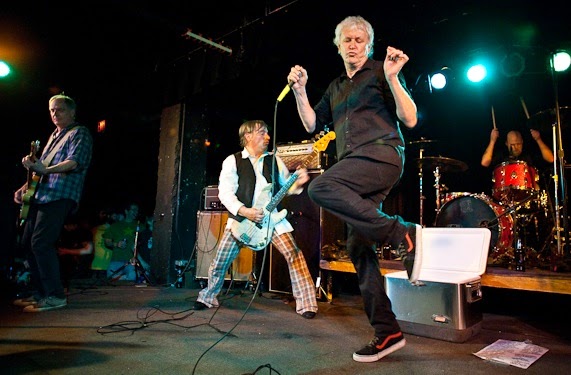
My second favorite rock band of all time rolled in to the Black Cat on Saturday night and proved that, even after all these years, they've still very much got it.

I was a little surprised to see so many young fans up front singing the words to all the new songs GBV played early in its two-plus-hour, 43-song set. As leader Robert Pollard said in his onslaught of comedic comments, "We have 72 albums." So it's not easy to know lyrics (and that doesn't include the dozens upon dozens of side projects for Pollard).

From the minute Rachel and I walked in the door (we later connected with Francis Chung, who took this iconic photo along with many others for DCist), there was a special buzz in the air. We saw old friends before moving up front to witness Obama Press Secretary and GBV mega-fan Jay Carney hanging around backstage. After a solid set from the majestic former GBV lead guitarist Doug Gillard's new band, Carney announced GBV, "one of the three best things ever to come out of Dayton, Ohio."

Pollard was in excellent spirits all night, even if he didn't seem to drink the fish tank of alcohol he has during the several dozen other times I've seen GBV in concert. Some of the feel of the show and his banter were captured nicely by Valerie Paschall of DCist:
A significant chunk of the set was comprised of their most recent release, Cool Planet, and Pollard delighted in pointing out that they were now touring off three albums: Cool Planet, Motivational Jumpsuit and classic album Bee Thousand which turns twenty this year. 
"We're not like the Rolling Stones," said Pollard. "We don't release one song every 15 years." 
Mick & Keith weren't the only target of Pollard's slurring vitriol and he also took stabs at Bruce Springsteen, ("If he's the Boss, I quit"), the record industry in general ("I don't want to make 6 percent!") and Radiohead. Also, unlike the stint in 2010, he let the audience finish off his handle of tequila, so his barbs were more discernible. 
Although the first hour of their set showed more audience enthusiasm during the Bee Thousand tracks—"Gold Star For Robot Boy" was an early spark plug — the show really took a turn when opening act and latter-era GBV guitarist Doug Gillard joined the band for "Teenage FBI." Even the rest of the band seemed to enjoy Gillard's presence onstage—guitarists Mitch Mitchell and Tobin Sprout played the song within two feet of each other and Mitchell gleefully mouthed along with the words despite the cigarette that did not leave his mouth.
The beer flew around over the crowd just like those amazing shows 20 years ago. The audience, including me, pogoed and moshed just like 20 years ago. Pollard and "the classic lineup" kicked around like the showmen they were 20 years ago. What was not to love?

***** out of ***** stars