Showing posts with label Sports. Show all posts

Wednesday, June 19, 2024

RIP Willie Mays

I didn’t go baseball crazy until the late 1970s, so I missed all the hoopla by a handful of years. But anyone who knows a little about the game knows that one highlight of Willie Mays sprinting straight towards the outfield wall with the #24 on his back facing directly to home plate. The ball somehow magically drops in straight over the back of his head and into his waist-high glove.

Perhaps most pertinent here, Mays was a fixture in pop-culture commentary, by the likes of Woody Allen, Peanuts, and songs “Say Hey (the Willie Mays Song)” in 1954 by the Treniers and “Talkin’ Baseball (Willie, Mickey, and The Duke)” in 1981 by Terry Cashman.

Here’s the line on Mays, who has passed away at the age of 93 in Palo Alto, California, from heart failure:

  • He played in the Negro League as a teen and then from 1951 to 1973 for the Giants, first in New York and then when the team moved to San Francisco. He missed time from 1952 to 1954 for his stint in the Army.
  • A case can be made that he’s the greatest baseball player ever, including the full package of speed, arm strength, excellent fielding, home-run hitting, and hitting for average.
  • He was the oldest living member of the Baseball Hall of Fame.
  • His nickname, “The Say Hey Kid,” was based on his optimism and his love for the game.
  • Mays had a lifetime .301 average, with 660 homers and 3,293 hits. He was named to 24 All-Star teams and awarded 12 Gold Gloves. Ridiculous numbers.
  • He finished his career third overall in home runs at the time behind only Babe Ruth and Hank Aaron.
  • He made more than a few of those over-the-shoulder catches but that famous one was in the 1954 World Series against Cleveland, and that was his only championship.
  • Mays came along four years after color-barrier-breaking Jackie Robinson, which was fortuitous for Mays because Americans were getting TVs en masse so he became an even more massive superstar than would have been possible just a few years earlier.
  • While Robinson became an outspoken hero of civil-rights causes, Mays laid low on that front and, in a different way, did his part to bring whites and Blacks together, if only because so many white fans enjoyed watching him play so much.

Saturday, June 8, 2024

"Winning ugly" in tennis is all about finding your opponent's weaknesses

Since I've whole-heartedly gotten back into competitive tennis, former pro Brad Gilbert's classic Winning Ugly: Mental Warfare in Tennis and Lessons from a Master has been a book at the top of my list to read. I'm going to sum up the most interesting bits in this three-part series. Here's part 1. 

First published in 1992, when Jim Courier and Monica Seles were each number one in the world, I'm finding the advice to be timeless, even through the Nadal/Federer/Djokovic era and into the modern Alcaraz/Sinner/Zverev one.

Gilbert was a winner when he played on the pro tour not because he was a better athlete than his competitors but because he thought a lot between points and matches. Timothy Gallwey’s philosophies, which I recently wrote about, are on the intuitive processes while Gilbert’s is on the analytical processes. Gallwey focuses on the inner game while Gilbert focuses on seeing what’s in front of you and doing something about it.

He says that by using the advice given in Winning Ugly, tennis players’ chances of winning each match will go up by 20 percent. 

Gilbert prepares for 10 minutes on his way to matches by trying to answer what weaknesses of his opponent to exploit. This will determine how he will serve, what parts of his own game he should rely upon, and where he wants to place himself most often on the court.

Exploiting opportunities is key, and Gilbert says it's even easier at the recreational level than the pro level. Only once or twice out of every 10 matches will you encounter another player who isn’t lazy and is actually thinking about a game plan before the match. Players usually just show up to play, but you can get a step up on them if you review your notes on that player (if you have played them before), arrive at the courts early and stretch to loosen up, hit around with anyone else who might be there for some light warm-up, and work on your serve before the match. That should almost be an assurance to win the match over your opponent, Gilbert writes. "Recreational players are usually long on running and short on thinking." 

I sometimes play guys who, two hours into the match, ask if I have any extra water. That should be a sign that they aren’t too serious, Gilbert claims. Therefore, the tennis bag checklist is crucial:

  • Why do some people have seemingly way too many rackets? There’s good reason. If control is proving to be a problem on any given day (or even just over the course of the past three or four games), go to a more tightly strung racket (which will be a higher number). If I’m getting overpowered and need more power myself, I can go with a racket strung looser (which will be a lower number). I've always found stringing confusing. Go here for how it's done.
  • Take tape and band aids. I could have used some in my last match when a toenail got crunched halfway through. 
  • Along these lines, take two Advil or Tylenol or whatever pain medicine before and after a match and bring some in your bag. And bring pain rubs. 
  • Even just a few minutes of stretching before a match will pay off. Opponents often just warm up their arms and hands. Focus on your legs. Running in tennis movements back and forth and up and back in the court, and kicking your butt as you run, will get the legs ready. "Gradual, gentle, smooth stretching, never strain," and especially stretch the groin. Finally, don't forget to stretch after matches before cooling down. 

In the warmup with the other player: 

  • Continue stretching. 
  • Get your eyes and body working together. 
  • Begin to assess your opponent. 
  • For defrosting your strokes in the short warmup, volley for a few minutes and stay on the balls of your feet, work on hitting deep with your baseline strokes and try to work on your weaker stroke (typically the backhand), hit a few overheads to help practice your serve, and practice tossing the ball 4 or 5 times before actually warming up your serve.

What to watch for when warming up with your opponent, especially if you’ve never played them before:

  • When he's at the net warming up his volley, hit a surprise lob to see whether his footwork is quick or clumsy.
  • When he's at the net, hit a ball near his feet to see if he bends his knees or drops his racket with the lazy man’s volley.
  • When warming up at the baseline, hit the ball down the middle to see whether he favors the forehand or backhand. And does he hit slices or other unusual shots, does he have big looping strokes or compact ones? The strokes that are the prettiest in warmup are ugly in a match, so never be impressed in the warmup.

To deal with pre-match nerves: 

  • Practice taking deep breaths, like you have asthma.
  • To avoid heavy feet, stay on the balls of your feet, not only in warmups but in the important parts of a match. Tell yourself “toes not heels.” This works on your opponent's mind too. 
  • Try to read the label on the ball as it comes to you. This will take your mind off your nerves and onto a pleasant distraction, even if you can't truly tell whether the ball says Penn or Wilson.
  • Sing a song.
That should be enough for a while. I'll report back with more of Gilbert's advice after I've read another third of his classic.

Friday, May 31, 2024

RIP Bill Walton

Bill Walton was mostly before my time in the worlds of college and pro basketball, but he was so much bigger than life that it was impossible not to feel his presence long after his playing days.

Memories of Walton for me were mostly when I was obsessed with the Chicago Bulls in the 1990s and his playing days were winding down and he was starting anew as an NBA color commentator. He would always do hilariously weird things in his tie-die shirts like rubbing dirt all over his body, making casual references to how much he liked doing drugs, being part of the Grateful Dead culture, eating birthday cakes and cupcakes with the candles still lit, and bringing fun-hearted spiritual-hippie presents to his colleagues.

Walton, who passed away this week from cancer at age 71, was a winner. He won 49 straight games and two high-school championships in California. He won 88 straight games at UCLA and national championships in 1972 and 1973. He was picked first in 1974 by the Portland Trail Blazers. He was league MVP in 1978 and won championships with the Blazers in 1977 and Boston Celtics in 1986.

Also passing away this week was Amy Winslow, who was once the manager of my second-favorite band Guided by Voices. She also worked with Yoko Ono, Surfer Blood, Kiwi Jr., and helped launch the Rachel Maddow Show. The cause was breast cancer at age 59.

And Tony Scott, who played for six years through the end of the 1970s into the 1980s for the St. Louis Cardinals, passed away at age 72. He stole 87 bases during that period as the Cards' centerfielder. 

Thursday, May 9, 2024

RIP Steve Albini, Bob Avellini, and ELO guy

I know a lot of rock'n'roll hipsters like to proclaim the greatness of producer/musician Steve Albini, and while I can appreciate a certain rawness in music, his style bordered on overly abrasive - in both production and commentary - for me. Even when I was younger and way more snarky, Albini's snark was too much for me. For years, I thought he probably held back Nirvana's In Utero from being as great an album that I thought it could have been.

In hindsight, he probably made that band's farewell as great as it was supposed to be. But I’ll never be totally sure about that. Albini, who passed away at age 61 this week from a heart attack, worked with some of my favorite bands, including Pixies, the Breeders, Urge Overkill, Slint, King Kong, Superchunk, the Cribs, and even Jimmy Page and Robert Plant. But his work for all those outfits was oddly and consistently among my least favorite stuff by them all.

But come on, what kind of person do you have to be to turn on a band that made your name - Nirvana - by calling it "R.E.M. with a fuzzbox." I'm not sure if he meant that as an insult, but it actually sounds like the second-best thing to R.E.M., which to me would be a high compliment. I think I never forgave him for saying that one of my favorite album's, The Replacements’ Let It Be, was "a sad, pathetic end to a long downhill slide." If Albini's bands like Big Black and Rapeman could hold a candle to the innumerable great bands he loved to trash, then I might have taken him and his artistry a little more seriously. 

Also lost too soon at the age of 70 from cancer was Bob Avellini, who I profess to having been too young to see much at all on TV. But I still own many of his football cards. His biggest claim to fame may be that his 75-yard pass to Walter Payton was the legendary running back's longest career touchdown.

Another notable death this week was Richard Tandy, who was hardly Jeff Lynne in terms of importance to Electric Light Orchestra. However, notable about Tandy, who passed away at age 76, was that he rocked the protagonist's voice in perhaps my favorite ELO tune "Mr. Blue Sky." His wild keyboard playing helped anchor that song and many others with the band's signature Beatles-meets-disco brilliance.

Tuesday, April 23, 2024

Serving in tennis is tough, but it can at least be a little easier with good advice

It's downright strange that serving is so difficult in tennis. I mean, I almost never miss a serve in volleyball and I almost never play volleyball. But I play tennis all the time and the serve remains at least a partial mystery and I view it as a lifetime goal to improve it.

I can rocket my first serve but it often has a low percentage, so it’s not great. I used to dink my second serve instead of swinging hard through from the 7 o’clock to the 2 o’clock positions to get good spin and action. At least I'm doing that now and realize that swinging slow is a recipe for a double fault. 

I’ve been getting coached and watching and reading a lot about serving in recent years and I think my serve is finally becoming a weapon, which is an ultimate goal for someone at the 4.0 level like myself.

Returning your opponent’s serve is also part of this equation. I tend to think I'm fairly decent at reading my opponent's body language to anticipate where the serve is going to go. But I don't think I've ever consciously watched the toss to get clued into where it will go. This article online at Feel Tennis has some good pointers along those lines. The advice is also helpful in showing where I should be tossing the ball myself depending on whether I'm serving flat, with a slice, or with a kick/topspin (see image above).

For match play, the serve begins right at the coin toss. It’s been assumed forever that if you win the toss, you elect to serve. But Ian Westermann, in his, well, essential book (and website) Essential Tennis, says electing serve is the right choice “for about 20 percent of the tennis-playing population. If your serve is a weapon and you can consistently get it in, then by all means, serve!”

He says that if you are a skill level of 3.5 or below, always let your opponent serve. Even at 4.0 and higher, let your opponent serve unless: 
  • your serve is a weapon
  • you’ve had a chance to fully warm up your serve, and 
  • you’re “on” and feeling great before the match starts.
Also, if you lose the toss and your opponent elects to serve, choose the side for yourself that will have your opponent serving into the sun to start things off. 

In a recent scenario, I played a guy who only took six warmup serves and I had gotten there before him and taken a couple dozen warmups, so I knew he didn’t need much warmup and would just get his serve in no matter what, plus I was warmed up, so I made the easy call to serve first.

On the actual serve itself, Westermann recommends stopping trying to serve your brains out on the first serve, which, as mentioned, I’ve done most of my life. He logically says to find the serve that gives your opponent the most trouble, which will be different from player to player, but that a kick serve that the returner has to try to hit at head level may be a good option for many servers. 

For a second serve, he preaches “up and away,” meaning to keep a quickness in your motion and a slice spin (moving your racket from 7 to 2 o'clock). Slowing down your motion, even though it seems like the right thing to do, is never the answer. I’ve been working on that a lot over the past year, trying to eliminate my tendency to dink my second serve, and I can vouch that this is absolutely the right advice. It just takes a little getting used to after a lifetime of having a bad habit.

Westermann says players are only as strong as their weakest link, which is often the second serve. His recommendations for getting rid of the dink - what he calls the pattycake - second serve are:
  • to practice rolling the tennis ball on your palm with your racket up above your head where you would be hitting the serve (see the photo to the right), which will in turn give you a sense of feel for how you'll be putting spin on the ball
  • then nice and casually flip the ball off your hand and turn your racket so the side that was rubbing the ball is flipped to facing the wall or fence behind you and the court, and
  • then continue further on and have the racket go down around in front of your legs, so that your motion has completed almost a full circle.
Westermann says that after getting comfortable with all those individual parts of the full motion in his "curve the serve" technique, try performing an actual serve with that motion. The full swing should be mostly parallel to the baseline rather than towards the opponent and that you should hear an aggressive "clicking" or "brushing" sound rather than a flat "thud" sound. Once you see that your second serve is clearing the net by 4 or 5 feet, then you can start getting more aggressive with it since you know you have so much room to work with.

Westermann also recommends playing a set with an opponent and making it a rule that you both only get one serve each time. This will help both of you to make your serves tougher to return and more accurate at the same time.

Wednesday, April 17, 2024

RIP Whitey Herzog

If you grew up in the St. Louis area in the 1980s like I did, then chances are you'll never have a more favorite Major League Baseball team than those St. Louis Cardinals ones from the early to the middle part of the decade. Likewise, you probably don't have a more cherished manager than Whitey Herzog.

"The White Rat" took the "Runnin' Redbirds" to three World Series over a span of six years and while he only one won of them, he was the perfect mix of old-school militant leader - with a perfectly square head and buzzcut - and innovative playcaller of "Whiteyball" who valued offensive speed and defensive craftiness over brute home-run power. 

Whitey Herzog has passed away at age 92. 

His Cardinals won the World Series in 1982 and those were some thrilling games. Even though they weren't champions, the 1985 and 1987 teams may have been my favorite teams. I don't think I ever watched more baseball that I did in 1985 with Jack Clark, Tommy Herr, Vince Coleman, Willie McGee, Terry Pendleton, Ozzie Smith, Andy Van Slyke, Joaquín Andújar, John Tudor, Bob Forsch, and Todd Worrell. Meanwhile, the 1987 team with many of the same players went back-and-forth until the very end in losing to the Minnesota Twins in seven games.

Whitey always felt like one of Cardinal Nation's own, which may have helped because he grew up near St. Louis in New Athens, Illinois.

Some interesting facts about Herzog:

  • His real name was Dorrel Norman Elvert Herzog.
  • A broadcaster covering his games in the minor leagues nicknamed him "Whitey" because of his light blond hair. 
  • He was in the Army Corps of Engineers for two years.
  • Herzog was mentored by iconic New York Yankees manager Casey Stengel as a Yankee minor leaguer and said, "Instead of thinking about girls, I would be thinking about what the hell he talked about all day. Casey broke it down into the hundred little things that would make the difference. Once I began coaching and managing, I kept passing them along to my own players. In Casey, I had an Einstein."
  • He played eight seasons in the majors, with the Washington Senators, Kansas City Athletics, Baltimore Orioles, and Detroit Tigers.
  • He didn't last a full season in his first MLB managerial stint with the Texas Rangers in 1973.
  • Before joining the Cards, he was hired to manage the Kansas City Royals and lost to the New York Yankees three years in a row in the AL Championship Series.
  • Royals fans are not likely to forget Whitey either. He surpringly called his 1977 team the best he ever coached, and they finished 102-60 in the regular season and featured Darrell Porter, Frank White, Amos Otis, George Brett, and Dennis Leonard.
  • Bruce Sutter, the Hall of Fame closer on that 1982 Cardinals team, told The New York Times, "How many managers can you blow a game for and go out fishing with him the next morning?"
  • He was the second-oldest living member of the Baseball Hall of Fame behind Willie Mays.

Thursday, April 11, 2024

RIP (sorta) O.J. Simpson

I was just a little too young to watch O.J. Simpson during his prime Buffalo Bills era, although I still have some cards from when he was on that team. But from a very early age - while I might not have seen him running wild in his white, blue, and red uniform - I distinctly recall Simpson in his fancy suits flying through the airport walkways in his Hertz rental-car ads.

I did eventually see plenty of football highlights of "The Juice" and, wow, was he great. He also had an infectious personality later on as an NBC Sports game-time announcer and the detective who flies out of his wheelchair from the upper deck of a stadium in the first of three Naked Gun films in which he appeared.

But those were just the bright-side warmup to O.J.'s approaching dark-side pop-culture legacy. I can still remember being on vacation near the beach in Alabama when my eyes were glued to the TV on June 17, 1994 as that white Ford Bronco led the police on a chase across Los Angeles. It would be the beginning of the entire nation getting more O.J. than they had ever wanted. It took me a long time to finally see him as the cold-blooded murderer of his wife rather than the friendly-eyed TV personality I had grown to love.The drama took us all the way to the innocent verdict date of October 3, 1995 and way beyond. In fact, I can't believe the car chase and the trial took less than a year-and-a-half. It seemed like forever. Of course, Simpson was found liable in civil court in 1997 for the deaths of Nicole Brown Simpson and Ron Goldman. 

O.J. Simpson has died of prostate cancer at the age of 76.

Some other interesting Simpson nuggets of note:

  • He was born in a housing project in San Francisco.
  • He blamed a lot of his later troubles on having an absent father after his parents separated when he was 5.
  • When he was little, he had rickets and bowed legs that caused other kids to make fun of him.
  • He won the Heisman trophy as college football's top player while at USC.
  • Simpson was the first NFL player to surpass 2,000 yards rushing, which he did in 1973.
  • He met Nicole Brown way back in 1977 at a Beverly Hills nightclub.
  • He spent nine years in prison for trying in 2007 to steal O.J. Simpson memorabilia.
  • He had clearly started to lose his mind in his last years with his rambling video posts on X but to his credit at least he mostly stuck to football commentary.
What a run he had!

Saturday, April 6, 2024

Concentration, breathing, and thinking differently about competition are some keys to tennis improvement

I summarized some of the helpful hints from the first half of the classic tennis self-help book, The Inner Game of Tennis: The Classic Guide to the Mental Side of Peak Performance, by Timothy Gallwey. It begins to repeat itself quite a bit as it enters its second half. There is lots of interesting but repetitive mumbo jumbo about the Self 1 and Self 2 (conscious and unconscious). 

That said, there really might be something to not worrying so much about the “external” score of your tennis matches or how far you make it in the tournament but rather focusing on what’s important to you in your “inner mind.” These may be things like overcoming anxiety or nervousness before a match, achieving a fun time on the court, or any number of other inner accomplishments. Here are some of the more interesting tennis tips I gleaned: 
  • Play around with your grip style to see if you are holding the racket the right way for you. I’ve never been able to keep track of the different ways many teachers have instructed me to grip the racket. For many years, the Eastern grip dominated, and it’s still the United States Tennis Association’s approved style. It’s when you basically hold the racket as if you were shaking someone’s hand. But a lot of competitive players are nowadays using the “semi-Western grip,” in which a right-handed player will turn the racket a quarter turn back so that the wrist is bent up in the direction of the elbow a bit. I tried that for a while but I’ve basically gone back to a pretty Eastern grip style, which is not to say I shouldn't still always experiment.
  • Go out and videotape yourself in a match. Then analyze the tape to see where your feet, your hips, your shoulders are on good shots and on bad ones. Observe where your backswing is. Where is the ball on your racket at the time of impact, and what is the angle of your racket at the point of impact? Is there any hesitancy in the follow-through? How is weight distributed from the start to the end of the follow-through?
  • Counterintuitively, tightening the muscles of the arm and the wrist on the serve reduces power, so it’s important to find the right level of muscle tension. There is no one right way, which is obvious when noting that no pros' serves look the same.
  • Whenever you discover you have a bad habit, don’t work to break it but rather try new habits and see how they go. See if you can get in the groove. The thing with tennis is that you don’t need to try to do everything like your favorite pro player because everyone is different and things work differently for different people.
Pretty much every stroke and improvement follows the same process:

Don’t
  • Criticize or judge past behavior
  • Tell yourself to change, instructing with words
  • Try hard and make yourself do it right
Do
  • Observe existing behavior non-judgmentally
  • Picture desired outcome
  • Let it happen
  • Continue to observe and learn
For better concentration, try focusing on the seams of the ball. Not just the ball. Not just watching the ball. Really get engrossed in how the ball spins, and watch it this way from the time it bounced off the opponent’s racket. I am suspicious of this hint, but I will try it nonetheless. To help, try saying "bounce" out loud when the ball bounces and "hit" when your racket hits the ball. Likewise, listening to the sound of the ball off your racket can be illuminating, perhaps even more than watching the ball. Once you hit the ball right in the sweet spot of the strings, you might find great satisfaction in often trying to replicate that sound. Flat, slice, and kick serves will each produce different sounds. And there may be no more satisfying sound than that of a volley performed perfectly. 

Relaxed concentration is another tactic Gallwey uses. He will often cheat forward to return a serve soon after its first bounce then attack the net. It not only confuses an opponent but it builds quicker and more accurate reactions over time. “Concentration seems to slow time down.” In order to stay focused between points, “focus on breathing … observing breath going in, going out out, going in, going out in its natural rhythm.” 

Competition is another part of the equation in the book - and Gallwey makes the point that tennis can be both competition and cooperation between the two opponents. For example: 
  • Instead of hoping the other player double faults, you can hope it lands in the service court so you can have a better mind state for the return shot. 
  • If your opponent has a weak backhand, hitting it to his backhand will be a nice thing to do in helping him improve that shot. 
This book gets a 4.5 out 5 stars. After I try many of the tactics, I'll have a better sense of whether it should be 5 out of 5 or something less.

Wednesday, April 3, 2024

Mountain biking in Moab, Utah is a dream come true

I've always loved mountain biking. I don't do it anymore as much as other activities like tennis and road biking, but when I do, I always have a blast (even when tumbling bike over heels down cliffs, which seems to happen way too often to me).

So knowing that about me, you can guess that Moab, Utah has been a place I've wanted to visit for a long time. It's known as the mecca of mountain biking in the U.S. I took about a three-hour ride on Saturday with my family and didn't do anything too daring, but it was an exciting taste of what the area known for Arches and Canyonlands national parks has to offer. 

We rode in Dead Horse Point State Park, which is located on a mesa (a flat-top mountain) high above many breath-taking views of the Grand Canyon-like sandstone cliffs of Canyonlands National Park and the Colorado River.

It seemed like we barely explored the 17-mile mountain-bike trail system located in the park. It takes a long time to go a little way over such rocky trails, especially with our 10-year-old in the mix. That said, she was able to conquer the many obstacles along the way and this is a really good option for other families with young kids (and bike rentals, although pricey, are available right there in the park at the trailhead alongside a handful of camping yurts).

Other points to note:

  • Dead Horse Point allegedly got its name from many horses dying there from exposure to the elements high on the mesa (it was a very windy ride, at least on this day).
  • It has provided a set for many movies and TV shows, including Con Air (1997), Joe Dirt (2001), MacGyver (1985), Mission: Impossible 2 (2000), Westworld (2016), and, most famously, the ending scene in Thelma & Louise (1991).


Tuesday, March 26, 2024

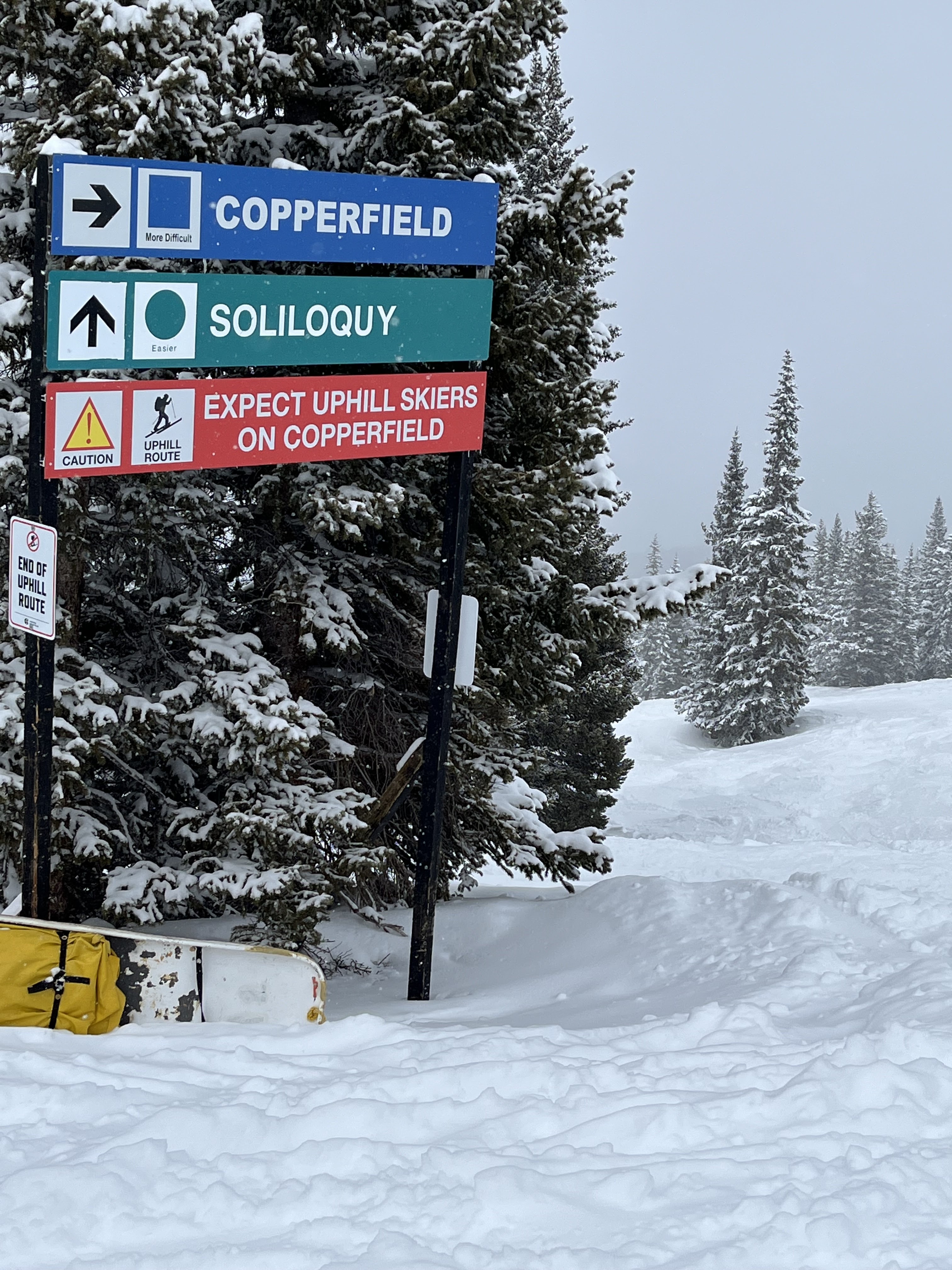
Mountain powder makes skiing contagious

Skiing in powdery snow must be what flying feels like to a bird. Instead of each wing, it's each leg - left then right then left - swooshing, gliding really, through the show. 

It’s been many years (maybe in Park City, Utah or Lake Tahoe) when I last skied in such fluffy conditions as I have this week at Copper Mountain, which is about 50 miles west of Denver.

Each night, as we sit in the hot tub soaking our sore thigh muscles after a full day of skiing, there has been snowflakes falling into our hair. A light dusting of 2 to 5 inches of fresh snowfall each night has made the mountain our paradise.

If the people I’ve seen attempting to learn how to ski back East at some of our local-ish Pennsylvania places like Whitetail and Liberty were learning in this powder, they would not be dropping like flies and falling on their faces into the unforgiving snowcone mush and slush that is very difficult to navigate.

It’s so easy here. And I’m probably skiing the best I ever have in my life. Such ease and control. My old skis are still not very fast, but I’m now confident in much tricker spots and through the forests off the main runs that my daughter loves to take me into. The two of us took a wrong turn the other day down a steep, rocky, bumpy path. We eventually made it out, even agreeing it had been a fun if slightly foolhardy challenge. Years ago or maybe even just a year or two ago, that would have been a much trickier predicament.

I’m really glad the enthusiasm for skiing from my family has worn off on me. Even if it’s at Whitetail and Liberty. But when possible, the West is the best.

Tuesday, March 19, 2024

Andre Agassi hit his lowest lows in the mid-1990s. Could he redeem himself?

This is part 3 of my series on Andre Agassi's Open: An Autobiography, a must-read for tennis fans. Part 1 covered his epic 5-setter at the 2006 U.S. Open against Marcos Baghdatis, his upbringing by a violent father, an incident in Washington D.C.'s Rock Creek Park, and his rise in the junior ranks. Part 2 covered his rise to sports greatness and falling in love with celebrity Brooke Shields.

The second half of tennis legend Andre Agassi’s brilliant bio Open begins with him finally ascending to number-1 in the world, taking the place of Pete Sampras, who has held the honor for the previous 82 weeks. That said, Agassi didn’t feel anything. He wanted to feel something, but he didn't. To have something to keep going for, he set a goal to win the French Open, which would give him championships at all four of the major tournaments. 

Agassi also read in the papers that Boris Becker was trash talking him to reporters, and 1995 became "the Summer of Revenge" as the two will inevitably play each other. Agassi won tournaments by beating Stefan Edberg in D.C., Sampras in Montreal, and Michael Chang in Cincinnati, but he wanted Becker. At that year’s U.S. Open, he finally got his chance - in the semis, with the winner to play Sampras in the final. Agassi told the security guard in the tunnel to keep him and Boris apart. Down by two sets, Becker wanted to rattle Andre and began blowing kisses to Andre's girlfriend, Brooke Shields, in the stands. Agassi ended up winning the match in three sets but would he be completely spent 18 hours later for the final? It turned out he wasn't spent. He had injured a rib, but played Pete anyway, losing in four sets.

The loss semeed to slowly destroy Agassi. As he failed to secure the number-1 spot above Sampras, Shields rocketed to further stardom and landed a plum supporting role on Friends - the number-1 TV show in the world. They went to L.A. together and Andre met the whole Friends crew but something irritated him while watching Brooke lick Joey’s hand in a scene. He walked out, drove all the way back to Vegas, and smashed all his tennis trophies and rackets. Brooke was incensed that he left, which she said destroyed her concentration for the rest of her scenes on set. They made up, but the writing already seemed to be on the wall for their eventual demise as a couple. Regardless, Agassi proposed to her on the beach one night and she accepted while he instantly had the thought that they were moving too fast. 

In 1996, Agassi appeared to be losing his mind to everyone watching him on the court. He knew it was happening as well. At one point, he gave a bunch of money for college to someone who worked at his favorite restaurant in New York City and it seemed to click that he felt much better about helping other people than he did about helping himself. This is underlined by how he won the gold medal for his country that year in the Olympics (and also had an unmatched record in Davis Cup team play) but then he returned immediately to the tennis tour in Cincinnati where he was “playing for myself again … smashing my racket in a fit of rage.” 

Back home in Vegas at his bachelor pad, one afternoon he was sitting around with his assistant Slim, who talked him into trying crystal meth. Andre continued to struggle on the court. Meanwhile, Brooke became obsessed with wedding planning and taped a photo onto the fridge of how she wanted her body to reach perfection for when the time came to put on the wedding dress. The photo: Steffi Graf.

Andre and Brooke two got married in a swelteringly hot - with sweat dripping down Andre’s forehead - church in Monterey in April 1997. He was stressed, miserable, and mortified about his sweat outbreak throughout the weekend’s festivities. The capper was when he hurt his wrist shooting bow and arrows and would have to pull out of the French Open, adding that clay is the toughest surface for a tender wrist

Andre continued being miserable, doing drugs in Vegas while Brooke was in L.A., helping friends who has child-medical emergencies, and then coach Brad Gilbert talked him into coming back for Cincinnati, where he was beaten by one of my favorite players ever, Gustavo Kuerten, in 46 minutes. Andre made it that fall into the round of 16 at the U.S. Open, losing to the red-hot Patrick Rafter. After yet another first-round loss, at Stuttgart, Gilbert had a heart-to-heart with Andre, telling him he needed to completely start over - get back in shape and then start playing lowly challenger matches. 

Then a doctor called to tell him he would be suspended for three months because the USTA found the crystal meth in his system. Andre lied in his letter that he didn’t intentionally take the drugs. Regardless, his trainer Gil, dealing with his daughter’s recent broken neck, jumped in with his usual gusto to get 27-year-old Andre back in shape for the first time in years. Gilbert got him ready for his first challenger tournament, which Andre lost in the final. The coach needed to start researching some technique for his fallen player. “Every shot is an educated guess. You need to retrain that muscle with which a tennis player decides in the heat of battle that this shot is the right one and this shot is the wrong one.” 

This comeback - if that’s what it was - was keeping Agassi busy. He hardly ever saw Shields, who was working 12-hour days on her new hit TV show Suddenly Susan. She didn’t watch his tennis and he didn’t ask about her show. He did however take the time to start a foundation for kids at risk, which included a 25,000 square-foot Boys and Girls Club. It started as tennis courts and a computer lab, but Andre wanted to do more and he caught wind of how forming a charter school could align with his vision. 

Fresh back from a visit in South Africa with Nelson Mandela, Andre woke up on New Year’s Day and decided 1998 would be his year. He made it to the fourth round of the Australian Open. Next he beat Sampras in the final of the San Jose Open. He won Scottsdale but not Indian Wells. The main thing was that he started to feel like he really wanted to win again, especially for his new team at the Andre Agassi College Preparatory Academy. He also received a call that the USTA had accepted his explanation and would not suspend him for the crystal meth, but karma for that lie may have come in the form of a hurt shoulder at the French Open. He missed two weeks and actually, during that time, unusually missed tennis. After a loss at Wimbledon, he and Brooke finally took their honeymoon to a private island in the Caribbean. Brooke wanted to keep busy with things like scuba diving and Andre wanted to relax in the room; they headed back home three days early, never getting in synch. 

At Legg Mason in D.C., Andre started a process of waking up early and writing out his goals for the day. He won the final in 50 minutes 6-2, 6-0, for his fourth D.C. title. He kept winning and again beat Sampras, knocking him out of the number-1 ranking and placing himself all the way up to number 9. He failed to win the U.S. Open but got back to work building the Academy in the worst neighborhood of West Las Vegas. Andre didn’t even really notice when Brooke didn’t show up for the groundbreaking. They decide to separate for three weeks, but when Andre suggested they go to therapy together instead of separately, it became clear that Brooke didn’t want to try to help Andre with all his struggles. He sold his wedding band at a pawn shop and donated the money in Brooke’s name to his Academy. And he said he wanted the “fastest divorce in the history of divorce.”

This book has it all, and I'm looking forward to reading how much Andre can redeem himself in the end. Stay tuned for my final report.

Thursday, March 14, 2024

After a lifetime of cheering for the Tarheels, I finally get to see them live

I've been a fan of the University of North Carolina's hoops team since I was a pre-teen, when Michael Jordan was pouring in buckets and wagging his tongue. Nobody has ever surpassed MJ as my favorite Heel (see this 2009 list of my 33 favorites), but this year's team is exciting and RJ Davis and Armando Bacot are already among Chapel Hill's long list of legends.

In all these years, I'd somehow never seen UNC live, but that streak ended today when the Tarheels visited Capital One Arena in Washington D.C.'s Chinatown. I've been attending Georgetown games at this arena for many years and have become disillusioned by the overall experience at the venue. The combination of years of abysmal play by the Hoyas and the lack of any good food and drink vendors bothering to show up during those low-rent basketball displays has tainted my opinion on CapOne, but the place was alive and hopping for the Atlantic Coast Conference Tournament's quarterfinals.

Little Miner Taco was miles above the basic options at Georgetown games. The two tacos I had with a side of corn hit the spot for an early lunch, starting the event out right and avoiding any day-destroying, fried-food hangovers. 

My seat in the nosebleed upper deck was only $20 after fees and I enjoyed the perspective surprisingly quite a bit. The tourney’s #9 seed Florida State kept the game close for the first 10 minutes or so, then top-seed Carolina gradually built a bigger and bigger lead, winning 92-67, with Davis and Bacot dominating and the rest of the team turning in a really scrappy performance, including lots of time for the talented second- and third-team players. The Heels have already won the ACC regular season and look primed for further success in this tournament and then March Madness.

Sunday, March 10, 2024

A little “green” tennis wisdom

The Little Green Book of Tennis Wisdom, edited by Julie Ganz, is a breezy quick read of great quotes about tennis. Here are my the ones I found most interesting.

From the section on the history of the game:

  • The word “tenes” went through 24 transformations before it became the word “tennis.”
  • Henry VIII was a world-class player.
  • Before the Open Era in the U.S., tennis was “hidden away from the great unwashed behind Ivy-covered walls,” according to Bud Collins.
  • Rod Laver had no show of emotion. He was “like a good plumber.” He won all four majors in one year - an almost-impossible accomplishment.
  • Bjorn Borg was bigger than the game. He was like Elvis.
  • The optic yellow ball of the early 1970s “helped transform tennis from a country club pastime to a billion-dollar sports enterprise.”
  • Andre Agassi brought in the MTV generation and the Hollywood elite.
  • France dominated tennis from 1925-1935, Australia in the 1960s, the U.S. In the 1990s, and Spain around the early 2010s.
From the section on advice:
  • John McEnroe says the most important quality of a winner is desire and the ability to keep at it when not playing that well.
  • Martina Navratilova says she prefers creative players way more than cookie-cutter players.
  • Lleyton Hewitt said many matches are won and lost in the locker room.
  • Rod Laver said the best volley is a short stiff jab, with almost no backstroke. “You’re blocking the ball, not stroking it.”
  • Serena Williams said she had never met a tennis player who hates sushi.
  • Author Timothy Gallwey noted that tennis can help you learn to trust yourself, which is far more valuable than learning how to hit a forceful forehand.
  • Tennis can be a little dull unless there is some pizzazz, Nick Bollettieri said.
  • Author David Foster Wallace called the sport the most beautiful one and the most demanding.
From the section on the Grand Slams:
  • It’s not right to compare the four slams. That’s why you don’t see pundits doing it. They are all great and valuable in their own ways.
  • Roger Federer said he thought players were the most inspired at the Australian Open, perhaps because it’s the start of a new year.
  • Navratilova said winning Wimbledon is like a drug that you just want to do again. Andre Agassi also said something along those lines. 
  • Andy Roddick said his footwork on the French Open clay was awful.
  • Novak Djokovic rightly noted that the U.S. Open is about the night session with the rowdy crowds interacting with the players.
  • Roddick said the adrenaline rush of the first 30 seconds after winning a match is like no other he experienced before starting to play tennis or that he expects he’ll ever feel again. 
  • Nadal said he plays every point like his life depends upon it.
  • Jim Courier said the dumber you are on court, the better you’ll play. 
In the section on doubles:
  • The masters make others feel foolish or simply tempt them to beat themselves.
  • It’s a game of subtlety, touch, and deft hands at the net.
  • One doctor said that you can tell if a couple should stay together when you watch them play mixed doubles.
  • Mixed double and regular doubles can make you better because you learn to relax a little. It’s  also a great way to polish net skills.
A worthy ending inspiration comes from the ping pong section: Keanu Reeves is, of course, apparently really good at it.

Thursday, February 29, 2024

RIP Golden Richards and more

For me, Golden Richards was the epitome of the pretty-boy Dallas Cowboys of the 1970s. I also think Richards, the talented wide receiver who passed away in Utah this week at the age of 73, played a role in helping my beloved Pittsburgh Steelers become the team of that decade.

Seems like a funny thing to say, right, about someone who caught a total of zero catches in the four Super Bowls the Steelers won, and the Cowboys were the victims in two of those championships? 

Let me explain. Richards' best years were 1974 through 1976, when he consistently averaged about 450 yards and four touchdowns per season. Not bad for the pre-fantasy, pre-pass-happy NFL. But even though the Cowboys made the playoffs all four seasons from 1974 to 1977, he didn't catch any passes in two of those four playoff runs. 

Richards had a good playoff stretch in the 1975 season, but didn't have any catches in the loss to the Steelers in Super Bowl X. His Cowboys won Super Bowl XII against Denver, and Richards had his career highlight in that game, catching a fourth-quarter, 29-yard touchdown pass from fullback Robert Newhouse. 

Early the next season, Tony Hill essentially took Richards' job and the golden one was traded to the Chicago Bears. A few months later, the Cowboys lost Super Bowl XIII to the Steelers.

Hence, Golden Richards played a bit of a role in helping the Steelers become so dominant. For that, I will always be grateful.

It's been a tough week in the obituary department:

Comedian Richard Lewis, who has been a valuable contributor to Curb Your Enthusiasm, died at age 76 of a heart attack.


Jose DeLeón was one of my favorite St. Louis Cardinals for a while, especially in 1999 when he led the National League with 201 strikeouts. He finished with a career record of 86-119, but he was an electric and entertaining performer much of the time. He passed away from cancer at age 63 in his native Dominican Republic.

Sunday, February 25, 2024

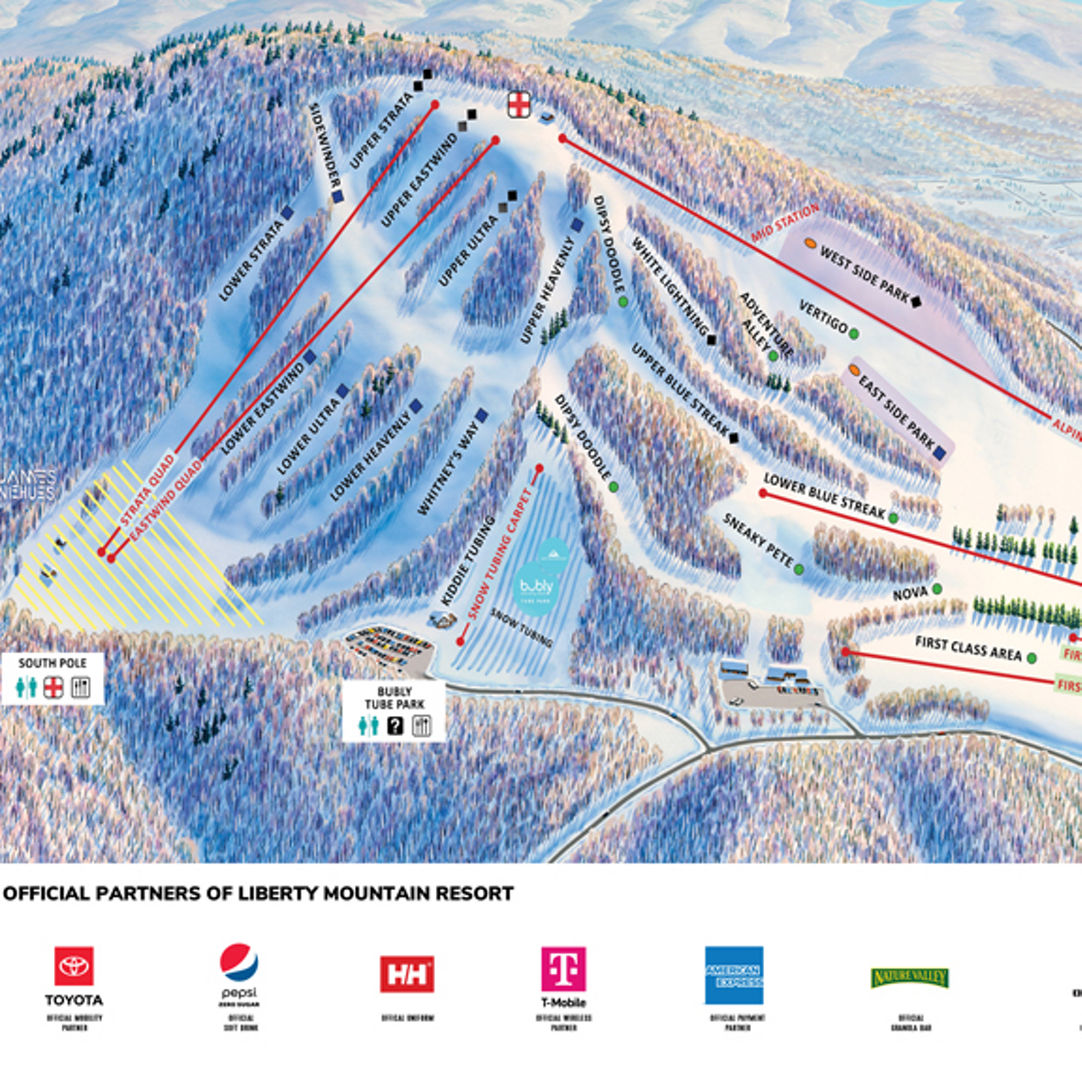
Liberty offers a nice semi-local ski option

Yesterday, I enjoyed my first trip this season to Liberty Mountain Resort for a day of skiing with my son and two of his friends. Despite temperatures in the mid-40s, the snow was slushy in the morning but pretty nice and powdery (by East Coast standards) all afternoon. 

It feels like a small miracle to get any skiing in nowadays with such noticeably short winters, but at least I’ve been to Copper Mountain in Colorado for five days, Whitetail also in Pennsylvania for one, now Liberty, and have another Copper trip planned in the coming weeks.

Liberty is just past the northern Maryland border in Pennsylvania and is typically packed on the front side with little tots learning to ski and all kinds of other people seemingly risking life and limb. I stay away from there but the kids like to ride the rails in the terrain park. There used to be a half pipe but it was difficult to cover it with main-made snow and wasn't open much, so it was removed. 

On the back side, there are two fun double black diamonds and a good handful of moguls. It’s amazing to see the amount of people taking brutal falls on those. No wonder there was an army of ski patrol lining some of the runs. There seems to be far more crashes than out west, with people falling left and right. One girl took a total face plant into the snow next to me. That might be ok in Colorado, where the powder could even feel refreshing to the face, but not at Liberty with this harder snow.

The East Coast resorts are definitely don't offer the same workout as ones in the Rockies. By comparison, the longest run is about a mile downhill at Liberty, with the longest one at Copper being three miles.

Also, Liberty's history is interesting. Itb was developed in the 1960s with big hopes to become a pretty massive destination. But it was bankrupt in the 1970s, purchased by a new owner and renamed Ski Liberty, which it remained until taking its current name in the 1990s. It has a 100+-room lodge and is a popular golfing spot in the summer, and it's now owned by Vail Resorts. The way the weather looks - warming up over the next couple of weeks - people may be golfing soon and not skiing much more at all this season. 

It's a very close call, but I like Whitetail just a little more than Liberty. Either way, it's nice to have ski options within a couple hours from home.

Wednesday, February 7, 2024

Breaking bad habits - not an easy task - is key to improving in life and in tennis

I was recently watching some footage of Rafael Nadal playing tennis as a kid, and it was amazing to see how similar his game then was to what it has been throughout his career. It's clearly an example of someone who built good habits from early on. That meant he didn't have to change much when he was older, and he used all that extra time and energy not tinkering with or worrying about the fundamentals that he had already baked in as good habits. Most of us build bad habits over a lifetime and then it becomes very difficult to break out of them, change, and improve ourselves.

To improve in tennis, it helps to break bad habits, but it also helps to have the right perspective, notes Ian Westermann in his 2022 book Essential Tennis. Part of the right perspective, he writes, is to realize that winning every point and reaching perfection should never be the goal

An interesting stat in professional tennis is that, over the years, the person who is number-one in the world averages winning about 55 percent of the total points. Even Nadal, who has won pretty close to 100 percent of his matches at the French Open still is around that 55 percent mark in terms of actual total points won at Roland Garros. It’s part of what makes his competitive fire so impressive. He seems to win the most important points, but he loses plenty along the way. So when your opponent hits a great lob winner or aces you, Westermann advises not to change your game plan or throw a fit but to instead say out loud to yourself, “I guess that was just one of the 45 percent of points they were supposed to win.”

Another important takeaway from the book is that deciding you want to get better at an aspect of your game doesn’t always help. Say you want to work on improving your backhand, so you buy a ball machine and hit backhands with it every day. What might happen is that you reinforce your bad habits. 

I took lessons this weekend from my neighbor who is an excellent coach and he taught us some new and awkward drills that I think is relate to finding new ways to push yourself and improve. He had us consciously step across the line on the court with our front foot as we were hitting the ball, causing us to focus on our footwork rather than the act of hitting. This felt weird but I could already feel the power growing in my shots. Also, he had us jump step with our front foot as we were hitting approach shots. This too felt awkward and is hard to do (at least until it becomes a habit), but the power and control of having good footwork (and consciously thinking about where our feet are and how they’re adjusting to each shot) very well might be a better improvement tactic than hitting a shot that you’ve done all your life (possibly not that well) over and over. Serena Williams’ forehand isn’t as perfect as can be because she’s hit it so many times but rather because she got it right, it became her habit, and now she’s got free time to think about all the other things in life, like testing out a bunch of rackets to make sure she’s using the ones she likes best. 

In terms of my personal tennis improvement, I’ve been working on my serve (especially my second serve) for a long time and I’m finally pretty happy with where it’s at. I think I won’t double fault much anymore. I've put a spin on it and it consistently gives people trouble. There's not much more someone at my level of play can want.

So now I think I have time to work on other aspects of my game that have been long-time bad habits and I don't need to worry about my serve so much anymore. My serve has definitely been taking up an inordinate amount of my time, when you consider how many other important elements there are to having a strong tennis game. 

Net game and backhands are areas I should think about going forward in terms of forming some better habits. My net game has always been a strength. But I’ve been missing too many shots - mainly overhead slams - lately, and I’m also not getting to the net as quickly or as often as I once did. Like many people, my backhand is not as powerful as my forehand and sometimes I don’t make the passing shots with it as well as I would like.

And Westermann importantly notes that these improvements don’t have to always happen on the courts. I use an Eastern grip for my serves and forehands. He writes that I could hold my racket at home sometimes in a Western grip. I’m not sure how he means that will make me better, but it sounds interesting from a muscle-memory perspective. I can also improve my footwork while watching a match on TV by doing a split step - while sitting or standing - every time the player at the top of the screen hits the ball. That will build muscle memory to take into the courts in terms of better footwork.

Sunday, January 21, 2024

Sports Illustrated, Pitchfork, and skiing provide great examples of the need to adapt to an always-changing world

News this week that Sports Illustrated has fired its entire staff and Pitchfork has been folded under GQ's operations is not exactly shocking, but it is very sad and yet another sign that mainstream, reliable journalism will get just a little bit harder to suss out. I had read SI since I was a little kid, always looking forward to the brilliant long-form journalism that "illustrated" so many compelling sports stories.  

The news reports have not been framed as total endings of these two esteemed publications, but the writing is clearly on the wall. And it's a big problem, especially because, for example, kids are getting their knowledge from often suspect social-media accounts and adults are internalizing and espousing information from their Facebook feeds and elsewhere that is from unknown or unreliable sources.

Those are examples of the many, many needs for the U.S. to implement media literacy in school curriculums so that, for example, we can all be spouting a lot less questionable misinformation to each other all day every day.

Another thing that is dying a bit in this country - like once-reliable media - is skiing, because snow has become so sporadic as weather patterns become different and more unpredictable. But that was not the case Saturday, when our family drive our kids and some of their friends to White Tail in Mercersburg, Pennsylvania near the Maryland border. It's about 90 minutes from home, and then it took us an hour in traffic for the last mile just to get to an over-full parking lot. I waited in the car for about another hour after that to wait for a parking spot to open up (and to deal with a dead battery in our friends' minivan that we borrowed) while the others got out and started skiing. The lift lines were nuts and it truly seemed that everyone in the D.C.-Maryland-Virginia-Pennsylvania area had shown up to hit the slopes. Once getting past the base lift, however, it was pretty fun on the side mountain with the shorter lift lines and the more difficult runs, especially as the afternoon wore on. The crowds thinned because it was bitter cold and the Baltimore Ravens were playing in the football playoffs. 

The world and humans evolve very slowly, and we've moved slowly in the face of many difficult changes. Ski resorts will look very different in 100 years because of climate change. There will no doubt be some difficult times in the years ahead as those industries figure out how to adapt to changes in snowfall patterns and locations. Likewise, media and journalism has gone through monumental change in recent decades and we as humans have not figured out how to consume a much faster, voluminous, and constant flow of information yet. 


Monday, January 15, 2024

Essential Tennis looks like THE guide to making necessary improvements

The top roadblocks keeping people from playing their best tennis are time, age, athletic ability, and money. (It can cost $50,000 annually to raise a top-level junior player!)

But the biggest obstacle of all - according to Ian Westerman, the author of 2022's Essential Tennis: Improve Faster, Play Smarter, and Win More Matches - is likely the ball! That’s because our obsession with focusing on hitting a good shot with the right arc and speed and to where we want can keep us from focusing on having good movement and swing techniques. Focusing on results and the ball also tightens us up. 

His coaching philosophy is that, “for every aspect of tennis, there is one element that’s more important than any other. If you can make even a tiny improvement in that element, you will become a better player much faster than if you focused on other things.” He notes, for example, that there are a dozen things to do to make your forehand better, but instead try to pick one element to focus on. For example, you can notice when your opponent is out of position and don’t change technique but rather hit the ball into the open court.

(Bonus advice to me from Coach Matt at College Park JTCC is to, on my second serve, swing faster and keep my head up to keep it popping. This has been working and my second serve looks better and more accurate than ever before. It's also helping my first serve, which I can now rely upon to be a true weapon and hit it harder and more accurately than ever, without tightening up worrying that I'll make double faults.)

Back to Westermann, he writes that self assessment is essential to any hopes of improving. To that end, setting up a camera while playing is really helpful to finding where improvement is needed, otherwise we’re just guessing. Along those lines, keep a journal while playing and jot down objective notes about what went well and what needs improving. Also take a few notes about your opponent, his strengths and weaknesses and how you would approach playing him the next time.

All of this advice comes from just the Introduction in the book. I can’t wait to keep reading it (and writing about it) because I’m already suspecting it’s the best tennis-instructional guide out there. In my past several matches, I’ve implemented the bit about focusing only on hitting the ball where my opponents aren’t and I’ve notice my serve getting better and my shots getting more powerful and successfully mixed. I haven’t lost. 

Tonight I’ll be playing "match play" in this league at the JTCC, on chalky clay courts, where we usually play about one set of doubles or singles before rotating to the next opponent. It’s a lot of fun, and I’ll add that I haven’t lost any singles matches since I started absorbing the advice of this book.

Saturday, December 23, 2023

Seeing it first-hand, scootering is becoming a big-time sport

Jackson at the Troy skatepark
It’s been a bit of a journey in my mind to fully appreciate my son Jackson’s commitment to the sport of scootering. I played non-stop as a kid at team sports, especially soccer and baseball, and while Jackson did make the JV baseball team last year, he decided not to play because his heart was not into six practices for many, many hours per week. He needed time for his true love of scootering.

On our winter trip, everywhere we’re staying is based on proximity to skate parks. At least that’s the case when we’ll be traveling nearly the length of California. Visiting my parents first in Edwardsville, in southern Illinois, there is a great park in nearby Troy. But today we’re at Ramp Riders, in Soulard, just south of the St. Louis Arch. It’s a cool cavernous old warehouse (a lot like Charm City in Baltimore) that helps display how far this individual sport has moved to legitimacy. There’s even a strong push to get it into the 2028 Olympics in Los Angeles.

Jackson at Ramp Riders
Skateboarding, which Jackson also enjoys, was essentially the only choice for skate kids until about the turn of the century. But then the Razor came along from Micro Mobility Solutions, creating a generation of interested kids. Now it’s progressed to big business, with trick scooters being made by many companies and diverse investments and sponsorships for many scooter riders. Jackson has been to the famed Woodward skate and scooter camp in Pennsylvania Amish country for the past three summers, and storied pros regularly visit to teach and mentor the campers.

Those early razor scooters were prone to breaking and really were only best used for transportation. But the trick and kick scooters of today can take a royal beating, even if Jackson is constantly replacing pricey parts. Fenders, wider wheels, bigger bearings, and better grips are among the many recent advances.

Back in 2005, the first scooter competition was held, in Switzerland. Since 2012, scootering world championships have been happening each year (other than the 2020 Covid year) and there are three categories: men’s park, men’s street, and women’s park. Lucas DiMeglio of France was named the rider of the year in 2022 and 2023.


Tuesday, December 19, 2023

RIP Eric Montross

The years 1993 to 1997 were my most sports-crazed years as an adult. I worked as the sports editor at The Alestle, the student newspaper of Southern Illinois University at Edwardsville. I also was a frequent guest on my buddy Wayne Frazer’s local-cable TV college basketball and baseball shows. Then I went on to be a sports reporter for two years at the daily newspaper the Centralia (Illinois) Morning Sentinel.

I couldn’t get enough of sports, and I couldn’t really get away from sports either. I eventually decided I couldn’t be a sports reporter if I was going to continue loving following sports. Since I was about 12, I had loved college basketball, namely the North Carolina Tarheels. So when center Eric Montross led them to the national championship in 1993, I was deep into my sports love affair, so those Heels will always hold a special place for me. It’s really sad that Montross had recently been diagnosed with cancer and died this week at the age of 52.

His Tarheels team is among my all-time favorites, led by Coach Dean Smith, forward George Lynch, and sharp-shooting guard Donald Williams. North Carolina knocked off #3 Michigan 77-71 in the NCAA championship in part due to a timeout called by Michigan’s Chris Webber when his team didn’t have any timeouts. 

Another memorable game (pictured above) was when Montross played Duke with blood streaming down his face, leading to his nickname Bloody Montross. That made sense because he really did fight tooth and nail for his team at all times. The 7-footer went on to be drafted by the Boston Celtics and played eight years in the NBA.

Bonus basketball RIP also goes to former Philadelphia 76er George McGinnis, who died this week at 73 and helped usher in a trend of big men being able to handle the ball throughout the rest of the court.