Showing posts with label Bicycle. Show all posts

Monday, October 2, 2023

Want to be inspired or even gain an altered consciousness? Ride a bike

I love my bikes. My e-bike might be my favorite. It gets me to the office and back in 20 minutes each way with almost no variables and is also great for errands. My road bike was one of my first loves and therefore I love to have it, even if it’s just taking up space in my basement. Whenever I glimpse it, I can’t help but gaze in wonder at it for a few seconds. And my mountain bike is pretty sweet too because, when I get out to mountain bike, it is always a powerful and thrilling feeling.

I’ve been meaning for a while to read Two Wheels Good: The History and Mystery of the Bicycle, by Jody Rosen, since its release last year. Here are some things I learned about bikes in the introduction, titled “Bicycle Planet:”

  • There are approximately one billion cars in the world and about twice as many bicycles, mostly produced in China.
  • Believe it or not, worldwide, people travel on bikes more than any other form of transportation.
  • From their very beginning, when velocipedes were banned in London in 1819, there have been class battles. Carriage riders and pedestrians did not like bikes, which were largely adopted by wealthy and fashion-conscious riders.
  • The fight still rages. A 2019 Australian study found that 49 percent of non-cyclists regard cyclists as “less than fully human.”
  • A Dutch anarchist group, the Provo, wrote a manifesto for the world’s first bike-sharing plan, in the 1960s.
  • Adolph Hitler, as one of his first acts upon taking power, recognized countercultural and nagging bike riders by smashing Germany’s cycling union. Even in 2016, women in Iran became prohibited from riding bikes in public as to not attract male attention or expose society to corruption (?).
  • Of course bikes have a more complicated history than just Hitler’s nitwit methods and outrageous Iranian fatwahs, and bikes and cars aren't truly at as big of odds as it sometimes seems. In fact, the car magnates at the dawn of the automobile age were often the same people who had earlier played key roles in the introduction of bicycles. Roadways too were envisioned and built by the Good Roads Movement, “a political crusade led by cyclists.”
  • The bike is obviously an agent for good, at least speaking environmentally, as a way to do much less harm to the planet than is done by driving a car. Rosen notes that millions turned to riding bikes when the COVID-19 pandemic hit, but I think the data is yet to be determined on how much this behavior is continuing forward.
  • This equation had never occurred to me: “On a bike, a person moves four times faster than on foot while expending five times less energy.”
  • Rosen writes that bike riding is a way to reach an altered consciousness. It’s “better than yoga, or wine, or weed. It runs neck and neck with sex and coffee. It’s also, in my experience, an antidote for writer’s block.”

Friday, September 28, 2018

E-bikes: An exciting alternative

This article originally appeared in the Sierra Club's newsletter.

It’s too early to tell if electric bicycles hold the secret to grand pronouncements such as “the
future of transportation.” But there’s definitely something interesting happening.

Anecdotally, I researched e-bikes for years before I felt comfortable enough to buy one as a
way to improve my mobility options in a ridiculously congested place like the Washington D.C.
region. There weren’t enough retailers who would also be able to make necessary repairs,
something this is more complicated than with traditional bicycles. The battery technology
wasn’t good enough to carry a charge decent enough to get back-and-forth across the city.

The first e-bike I bought ended up being too difficult to get repaired and I returned it,
thankfully (after lots of headaches), for a full refund from the German company, with a
California wholesaler and a D.C. retailer.

But earlier this year I tried again. After test riding many e-bikes and researching online (and,
despite the excellent Electric Bike Reviews site, with so many manufacturers and models, it’s
still an intimidating purchase decision), I purchased an excellent Magnum Metro from Hybrid
Pedals in Arlington, Va.

I’ve never met anyone who didn’t agree that, after riding an e-bike, it changed their life. The
problem is that so few people have actually ridden e-bikes. The U.S. market grew by 25
percent in 2017, to 263,000 e-bikes sold. At that rate, it will take a long time to make much of a
dent in the still-small percentage of people who bike for utilitarian purposes like getting to
work, going to eat, or meeting friends.

Some of the good news is that new and trendy options like Uber, Lyft, e-scooter shares,
dockless bikeshares, and soon autonomous shuttles may slowly be getting people out of their
century-long drive-alone mindset. In an increasingly crowded and polluted world, e-bikes could
play a valuable role in being a gateway to switch from this bad habit to these healthier, more
sustainable, more affordable, and just plain fun choices.

If all bikes today - every single bicycle in the entire world - were suddenly thrown away and
replaced with e-bikes, that wouldn’t be good for the environment. Obviously.
But e-bikes are good for the environment in a somewhat surprising way: because riding an ebike
is less physically demanding than a regular bike, making it easier to climb hills and go
longer distances, people might ditch cars for e-bikes.

Sounds far-fetched, but research says otherwise. An extensive survey of more than 1,800 ebike
users in the United States by the National Institute of Transportation and Communities
earlier this year found that most participants switched to e-bikes to reduce car use.

“What stood out, however, is how many motives involved eliminating driving hassles,”
Bicycling’s Selene Yeager wrote of the study. “Twenty-eight percent of respondents said they
bought an e-bike specifically to replace car trips. Others pointed to craving a more car-free
lifestyle, such as using e-bikes to carry cargo or kids, avoid parking and traffic woes, be more
environmentally minded, and have a more cost-effective form of transportation.”

But Americans are buying e-bikes at much lower rates than people in China and Europe. In fact,
the Wall Street Journal quoted a transit expert in 2016 claiming that 60 percent of all battery
production in China was for e-bikes. That’s a lot of batteries.

So how can we fix this? We can educate people on the benefits of e-bikes (and make sure they
know that riding an e-bike is still good for your health). We can advocate for better bike
infrastructure, which is proven to increase rates of bicycling across the board.

The research holds for me personally as well. I definitely bought my e-bike to maneuver more
easily and efficiently through D.C.’s stressful traffic. My car trips have gone way down, and
now my 17-mile roundtrip work commute is often the best part of my day.

Thursday, December 14, 2017

Auto shows are dead, bring on the personal mobility device conventions

This article by me originally appeared at MobilityLab.org.

Auto shows are so 1999.
We’ve come a long way since then. Although most of the U.S. public is still heavily wed to personal autos, various industries – including the auto industry – are positive that the future will look different.
Such a future was on display last month at LA CoMotion, held in the Arts District of Downtown Los Angeles (Mobility Lab was a media sponsor). In many ways, it was just like one of those old auto shows, but instead, it was all about the variety of transportation choices now offered by “personal mobility devices.”
Attendees and exhibitors were convinced that, sooner or later, everyone will want a specialized device that will be perfect for their specific needs of getting around town, going to work, running errands, and reducing the time they need to be stuck behind the wheel.
One major hurdle for now: “Streets aren’t really designed for all these little devices we have out here,” said Katherine Perez-Estolano of the planning firm Arup, motioning towards the test tracks and exhibits outside the conference’s main speaking area.
She even (only half-jokingly) suggested that autonomous kayaks would be a great addition to the nearby L.A. River.
“That little ball that’s rolling around outside is real. This is all happening now,” suggested Stephen F. Smith from Carnegie Mellon University, in reference to the event’s omnipresent Gita, which acts as a kind of robotic luggage.
Sasha Hoffman, chief operating officer of Piaggio Fast Forward, which created the Gita (pronounced jee-tah), said the little round robot uses camera technology to recognize a person’s leg and then follows the person everywhere, carrying whatever – as long as it’s 45 pounds or less – that person needs for the day.
She pictures it being a feature of, say, a conceirge desk at a hotel or in high-rise or retirement communities, where people can unlock it with their smartphones, cart their stuff around as needed, and then return it for the next users.
The Gita was really the one product at LA CoMotion that most embraced good old walking. Most everything else seemed to recognize the one recurring, ultimate trait of humans: laziness.
Don’t want to walk to transit? Take this. Don’t want to use up your daily allotment of brainpower navigating to work through traffic in your own car? Take this.
Perhaps the personal mobility device that seems the furthest along in having a shot at altering the way many of us move around is the electric bike – which almost seems a little old-fashioned by now compared to many of the other products at LA CoMotion.
Bosch, along with making auto parts and dish washers, is now churning out perhaps the world’s best e-bike motors, which basically repurpose car tech for bike tech. Bosch-powered e-bikes rolled out in Europe about eight years ago and did the same in the U.S. about three years ago.
Demand for mid-drive, pedal-assist e-bikes is increasing at around 30 percent growth each of the past several years, according to Jonathan Weinert, sales and marketing manager for Bosch eBike Systems. 
“The really nice thing about pedal assist is that people love to bicycle but they hate the hills and the sweat. You still have to do some work with pedal assist, but it’s more like a moped. The barrier to cycling goes down because it flattens hills and shrinks cities.”
Weiner said e-bike companies originally saw older adults as the prime market, but now Millennials are showing more interest, families are buying cargo e-bikes, and younger people are using them for commuting and mountain biking. He said he thinks e-bikes will increase ridership for transit as well.
“The toughest thing is to get someone to throw a leg over an electric bike. Once they do, they’re sold on it,” he said. And by the thrilled looks on the faces of riders on the LA CoMotion test tracks, he’s correct.
The same could be said for those testing e-scooters. While not as fast as e-bikes, these devices have advantages such as taking up less space on streets and in storage. One of several that were featured at LA CoMotion was the folding urb-e, and it actually is pretty zippy. You may recall Silicon Valley TV star Thomas Middleditch riding (and struggling) around the office on one in a recent Verizon Wireless commercial.
Simon Caballero, an urb-e sales manager, said the Pasadena-based company sold 3,000 in its first year of operation five years ago and hasn’t looked back since.
“We partner with Metro and Metrolink in Southern California as the only electric vehicle allowed on their systems,” Caballero said about the scooters, which range in price from $900 to $2,000.
For those a little less comfortable enjoying the wind in their hair, the future will probably offer a world filled with driverless shuttles to take you from home to the subway, from one end of town to another, or along a sightseeing path.
The one available for test rides at LA CoMotion was courtesy of Transdev, an Illinois-based company that mostly has its eyes set on becominga solution for people whose walk to transit is a little further away than ideal.
But the vehicles could also be used at airports, business campuses, universities, amusement parks, and other places, according to Neal Hemenover, North America chief information officer for Transdev.
The company is currently working on some test pilots in Europe as well as San Ramon, Calif., which he said are similar to the Las Vegas pilot underway in that city’s busy tourist corridor.
Watch Hemenover explain further as he took me for a ride, and how the vehicle senses its environment:
Similarly, SAE International was on hand to give people test rides in a driverless car. Here’s what it felt like to ride in the passenger seat:
There was certainly a lot more on display at LA CoMotion (how could I forget drones? see below) – and it will be fascinating to watch which of these products catch on and which are relegated to the junk heaps of history.
But for now, another exhibitor was not offering a product but rather information, with a new website called Have A Go that helps people decide which personal mobility devices are right for them.
Photos and videos by Paul Mackie for Mobility Lab.

Thursday, October 13, 2016

Pittsburgh emerging as a transportation leader, still has work ahead

This article was originally published by Mobility Lab and parts of it were republished by Streetsblog as well.

Pittsburgh’s time to shine has come. The city has been thrust into the national spotlight, viewed by many transportation leaders as one of the nation’s promising blueprints for how cities can finally do transportation well.

But while visiting Pittsburgh last week, I had the chance to put Pittsburgh in context with what people outside of town think.
The positives:
  • Mayor Bill Peduto is a real mover-and-shaker, something any city that wants to retrofit its car culture must have.
  • Pittsburgh made it into the final seven for the U.S. Department of Transportation’s Smart City Challenge (which was awarded to Columbus, Ohio).
  • Mayor Peduto is hiring for a director of the just-announced city Department of Mobility and Infrastructure, which will think more holistically about the ways Pittsburgh uses its streets and public spaces.
  • Pittsburgh has become a testing ground for Uber’s autonomous vehicles. It’s unclear so far how much the citizenry actually embraces this, but you have to hand it to Peduto and city leaders for trying something – anything – that’s an improvement over our current car culture.
The challenges:
  • That car culture is certainly alive and kicking in Pittsburgh. Anecdotally, at least compared to the rapidly improving Washington, D.C., region, there seems to be considerable amounts of honking, unsafe maneuvers in crowded areas, and a general animosity towards people on foot and bicycles.
  • Several times, I walked along Forbes Avenue – a major one-way thoroughfare that runs east from downtown to the University of Pittsburgh and Carnegie Mellon University. Walking along on the sidewalks or waiting at bus stations feels terrifying, with fast-moving buses and cars passing dangerously close by. This is a street loaded with college students, who are the keys to our future and arguably one of the city’s greatest calling cards. Wouldn’t Forbes Avenue be better served as a red carpet of sorts for tourists and students to see what a great city it is they are entering? Traffic-calming measures, better and more creative sidewalks and bus stops, and protected bike lanes are all desperately needed. (The same holds true for the parallel, westbound and equally as dangerous Fifth Avenue.)
  • I loved the 28X bus that takes visitors straight from the airport to downtown. But apparently not many other people love it, which is a shame. It only runs every 30 minutes and the buses I rode had passengers, but they were not so full that anyone had to stand. More frequent buses and some sustained marketing could help make it more popular, because once you arrive in downtown or Oakland, it can be really beneficial not to have a car.
  • Healthy Ride launched as Pittsburgh’s bikeshare system just over a year ago and has been successful enough to see pretty phenomenal expansion, from 12 stations to 50 and growing still. As a tourist, I enjoyed the system and was able to quickly register and take $2, 30-minute rides throughout my stay. The challenge for Pittsburgh is its hilly topography. The city could install inexpensive wayfinding signage for the hills, similar to San Francisco’s The Wiggle, which directs riders to the easiest route around several hills.
I have a lot of hope that these challenges will be met. Pittsburgh is a hotbed of talented minds thinking about the city’s transportation issues.

In my time there, I was lucky enough to represent Mobility Lab and Arlington, Va., in presenting to two groups about how to identify and influence the decision-makers who can get things accomplished, and initiating little things, like pilot projects, that can add up to successfully changing resident’s perceptions.
First, I spoke to students and faculty at Carnegie Mellon University as part of a speaker series hosted by Traffic21, a group focused on transit technologies that is probably as close as Pittsburgh gets to having its own “Mobility Lab.”
Then, I spoke at the 4th Annual Oakland Transportation Fair to transportation experts from throughout southwestern Pennsylvania. The fair, at the University of Pittsburgh, had exhibits featuring fascinating tools and products, free rides in an autonomous vehicle, and was organized by the Oakland Transportation Management Association, which is itself directed by one of the city’s transportation leaders, Mavis Rainey.
Forbes Avenue doesn’t seem to be as dangerous through the Carnegie Mellon campus as it is around the University of Pittsburgh. But it’s encouraging that CMU’s chief campus architect Bob Reppe told me all about the plans for that stretch of roadway. PennDOT is renovating it as acomplete street, with features that recognize the existence of pedestrians and cyclists. Where once there was an underused parking lot, there will soon be a much more attractive welcoming space to the campus, and parking will be placed underground and out of sight.
It won’t happen overnight, but for rebuilding a city that’s better for everyone – drivers included – there is a formidable braintrust in place to keep Pittsburgh heading in the right direction.
Photo: A bike lane on Clemente Bridge, installed in 2015 (David Kent, Flickr, Creative Commons).

Thursday, August 11, 2016

Improving safe routes to school through champions for open data


The following post is based on my presentation to a Safe Routes to School National Partnership webinar, “Harnessing the Power of Data to Support Kids Walking and Biking.” My slides and a recording of the webinar can be found here.
In the United States, cities build all kinds of new infrastructure when it’s time to host a Super Bowl or the Olympics. But at most schools, where missing sidewalks and bike lanes are routine, they continue to look away – often with very little planning or thought – and force kids, year after year, to enter and exit strictly by either bus or car.
These schools still don’t have the buy-in from:
  • Traffic engineers, who often create roads that prioritize the movement of cars over people moving about who aren’t in cars,
  • Planners, who are often more concerned about the buildings themselves than how those buildings connect with the surrounding landscape,
  • Teachers and staff, who often say they need to carry too much material to bike, walk, or take transit (which is usually not that accessible anyway), meaning the issue isn’t particularly a priority, or
  • Parents, who have plenty else to do and usually don’t have children at any one particular school for more than a few years, meaning the time investment may not be worth the effort.
So how do we make it easier to walk and bike to schools, gaining all the societal positives such behavior would bring?
One answer could be data collection and analysis, and the ways we can become so much smarter when we build our neighborhoods around what we learn from it.
Five years ago, we didn’t have this much smartphone data, Waze, or Google’s Sidewalk Labs – which is working to track how people move about walkable places. Governments and businesses now have access to much of that information. There should never be another “Bridge to Nowhere”-like debacle. Decisions about which projects to fund have to be made on the facts, and nowadays spending $400 million on a pork-barrel bridge that carries fewer than 100 people a day would not – or at least absolutely should not – happen.
In an article this spring, I quoted Tyler Duvall of McKinsey & Company on the use of transportation data, in which he said it’s “a big departure from where we were for many, many years, when it was largely an engineering decision, people were drawing maps, and it was unrelated to demand or to planning or economics or technology.”
Of course, leaving decisions strictly to the policymakers may not exactly be the answer either. If it were, safe routes to school would be the norm. You need champions, and some of the most promising champions are citizens, hackers, writers, artists, and others who know how to take data and turn it into compelling stories that inspire actionable pilot projects, advocacy, and even funding and policies.

Champions are civic hackers

Our own Transportation Techie group was founded by Michael Schade (a true champion) nearly three years ago. It has held about 30 monthly show-and-tell events in which hackers (and many with minimal computer skills) present data visualizations and discuss trends in transportation they’ve discovered by digging into data sources such as open transit data feeds. In one meetup last year, presenters shared projects related to capturing and analyzing walking data, such as measuring the state and usability of sidewalks.
The Techies group has grown to 1,700 members, a testament to the widespread interest in transportation data. There could be similar meetups just about anywhere, which could mean more data turned into stories, in turn creating action from that data.

Champions are friends and family

Most people don’t really know how long biking or walking to school will take or what kinds of variables go into navigating landscapes outside of the confines of the personal car. But there’s something any towns, individual schools, or groups can organize to generate their own data – Radius Rides.
As Mobility Lab contributor Randy Cole wrote, Radius Rides are:
“…organized events in which a group of cyclists starting from the same location, like a high-school parking lot, library, or shopping center take routes away from there. This actual ride data is then valuable for showing the local public how far one can get on a bike in five, 10, or 15-minute intervals from the selected starting point. The rides are relaxed-speed group rides – not races – for the purpose of recording data to plot on maps.”
Schade, of our Techies group, took the data compiled from one such Radius Ride in Alexandria, Va., and turned it into a full-motion graphic, which could then be communicated understandably to stakeholders. This effort had the added benefit of showing that bicycling for everyday trips and errands is often the best transportation option by many measures. Along with cool graphics, this kind of fact-finding is invaluable for messaging, marketing, and advocacy purposes.

Champions are information bearers

TransitScreen was born as part of Mobility Lab’s tech fellowship program in 2011. Since then, it’s come a long way in the marketplace, expecting to have screens and displays in 5,000 locations in 40 cities across 10 countries, and in 10 languages, by the end of the year. Even in a world where so many people have transportation information on their smartphones, real-time information on a billboard-like display is crucial in training people to think about their many options.
That kind of brain training will get school kids practicing active transportation. And wouldn’t a TransitScreen in every school be great for helping kids hop on the subway or the city bus on their way home?

Champions are partners

All that said, it is ideal when real champions eventually wind up including the top decision-makers. In Arlington County, Va., the public schools are working with county employees and the county’s commuter bureau on a transportation demand management plan, a first-of-its-kind program for schools. A report fully outlining the TDM plan will be released later this year, and will feature extensive survey information showing biking, walking, and driving rates along with data on the number of active-transportation programs at all Arlington public schools. The report also will include relatively aggressive targets for improvement by 2021.
Data for these initiatives needs to be comprehensible, as noted in a recent Safe Routes to Schoolreport. And the report highlights several excellent projects around the country, but these too often remain the exceptions. As generations younger and older alike begin to understand the possibilities by having the facts in hand and the tools to make them clear and actionable, better decisions will begin to happen in many communities.
Schools won’t be built at the end of highways, strong infrastructure like protected bike lanes will connect neighborhoods to their schools, and parents will understand that driving their kids to school every day isn’t necessarily the best decision.
Open, accessible data, and the communication tools and wide-ranging partnerships they will help create, will ultimately make students’ routes to school more safe – and even fun.
Photos: Top, students walk to school in Arlington County, Va. (Sam Kittner for Mobility Lab, www.kittner.com). Middle, a presenter at August 2015’s Walk Hack Night (MV Jantzen, Flickr).
This article originally appeared on Mobility Lab.

Portland’s new Biketown bikeshare proving popular and easy to use

The brand-new Biketown system in Portland, Ore., is already taking off, and a tour of its offerings shows a unique system that improves the transportation options of locals and visitors alike.
It’s great for transportation geeks because it automatically provides detailed data about one’s rides. It’s great for those who want to sightsee because stations are already plentiful. And it’s great for those new to bicycling because it’s designed to be safe and simple.
Sure, there are still a few hiccups in the 1,000-bike system, which opened two weeks ago. But several rides I took recently throughout the downtown and across the bridges of the Willamette River while visiting for the Association of Commuter Transportation annual conference proved to reinforce Portland’s status as a top bicycling city in the U.S.
Generally speaking, Portland’s drivers proved less aggressive than back home in Washington, D.C. (not that they’re especially bad in the District’s urban core, where many have learned to share the road as bicycles became a more regular sight in recent years).
Of course, with Biketown’s blaring orange paint job, it would be pretty impossible for a motorist to not see one. Another benefit of the color is that it’s easy to find a neon orange station as riders look to park their bikes.
What differentiates Portland’s system from bikeshare in similarly-sized cities is that it follows a “smart-bike” model, rather than a “smart-dock” one, meaning the technology to check out bikes, log rides, and display information is all attached to the bike’s rear fender. Previously, smaller cities and campuses (see: College Park, Md.) have opted for smart-bikes, while larger urban areas (Seattle, Boston, New York, D.C.) have installed smart-dock systems.
Signing up is easy, but requires a tiny bit of forethought: I filled out a form online in about two minutes and reserved a bike down the street. To unlock it, I just punched in my membership number and PIN in the on-bike electronic system and was off on my way.
A rare hiccup: a rider forgot to take their U-lock with them.
A rare hiccup: a rider forgot to take their U-lock while biking.
On the hiccup side was that a fair number of bikes were in repair mode and unavailable for use, although the easy digital readout on the back of the bike made it clear that this was the case. I also used a bike in which the seat kept falling down and a few I used had glitch-y gears, which could be the result of the bikes having eight speeds, unlike Capital Bikeshare’s three. As a first-time user, I didn’t initially realize that I could self-report repairs at the end of my rides, and clearly many other users are also not yet aware of this feature.
The price is certainly right and is competitive with other forms of transit. The $2.50, 30-minute single ride or $12 day pass options (which can, important to know, only be used for a total of three hours over a 24-hour period) gives tourists some nice options, while locals can buy annual passes for $12 a month. Annual passes provide users with 90 minutes of ride time across unlimited trips, each day.
Biketown opened July 19, and “ridership so far is stronger than expected,” according to Dani Simons, director of communications & external affairs for Motivate, the system’s operator.
Ryan Rzepecki – founder of Social Bicycles, who provided the technology and design behind the system’s smart-bikes – noted during the Mobility Lab-sponsored Transportation Techies special Portland edition that there have been 28,351 total trips in Biketown’s first two weeks, an average of about 2,000 trips per day.
After my personal test runs (left) of the Biketown system, I reached out to Simons with a few lingering questions:
Mobility Lab: Looking beyond these first couple of weeks, what will be considered success for Biketown?
Simons: Success will be continued strong ridership and also getting folks who have never tried biking, or have never tried it beyond recreational biking, to give it a whirl.
What do you think was the secret to getting the city and Nike to embrace just doing it, meaning putting the system in?
The City of Portland has wanted a bikeshare system for some time now. But they wanted to get it right. Patience means they get a system where the taxpayers bear no ongoing risk for operations and one with a proven operator in Motivate, and a world-class partner in Nike.
What are the top keys to getting people to use the system?
First, good station planning (making sure stations are in locations where people want and/or need to go). Second, a few different membership types that meet a variety of needs (including a single-ride pass that encourages new people to try bikeshare on the spur-of-the-moment), and lastly, providing great service.
Is there anything exciting or unique about Biketown’s marketing and communications strategy to get people to try riding?
Right now we’re focused on building a brand that is fun, easy, accessible, and authentically Portland. I think the Biketown Instagram feed is a great example of that. Also, across all Motivate-operated systems, we’re focused on building strong member communications that welcome, educate, and engage members, to encourage folks to make the most of their memberships, and we hope, over time, renew.
With GPS on each bike, it shouldn’t be long before we see some detailed looks at exactly how Biketown is taking off in Portland. While some questions remain to be seen (will monetary rebalancing incentives ease the cost of moving bikes around?), it seems poised to become a key element of Portland’s already-famous bike infrastructure.
Photos: Top, a Biketown hub in the Pearl District (Adam Russell). Middle, an abandoned U-lock at a hub in downtown Portland (Adam Russell). Bottom, the author at Willamette riverside.
This article originally appeared on Mobility Lab.

Wednesday, February 24, 2016

Mental Health Suffers When We Surrender to Car Culture

Here's my latest article, originally published in the first issue of the Urban Design and Mental Health Journal.


Maria Hernandez, from Montgomery County, Maryland was always afraid she wouldn’t know how to use public transportation. But since deciding to learn, she rejoices in being “able to relax, read a book, and enjoy the scenery – which you really can’t do when you’re driving.” No doubt Hernandez is onto something that has been very difficult for most throughout the U.S. to muster since the auto industry began seducing us into its lifestyle nearly a century ago.

Of all the many things we surrender when we commit to making most, or all, of our trips by car, the most important may be the most difficult to measure: our mental health. Mental health, our state of well-being in which every individual can realize his or her own potential, allows us to cope with the normal stresses of life, work productively and fruitfully, and make a contribution to our communities. When mental health suffers, the damage can manifest in many ways, from depression to eating disorders to suicide. But our transportation habits – formed long ago but with endless opportunities to change– is one of the greatest tools we have to make sure our mental health remains sharp into old age. We can walk or bike to places and – bingo – that officially counts as regular physical activity. That means these behaviors are associated with improved attention, memory, and cognitive speed across our lifetimes.

What does the research say?

While numerous studies have documented the effect of physical activity on academic performance, extensive research on the connections between transportation and mental health is more difficult to find. Some of the most intriguing evidence includes:

  • Danish study that intended to explore the effects on school children of the food they ate for breakfast and lunch ended up discovering that the way they traveled to school was far more crucial. Those who bicycled or walked performed much better on tests than those who rode in a car or on public transit.
  • British study found that physical exercise and “active leisure” of a person aged thirty six had a significant effect on the levels of memory decline for that same person later on between 43 and 53 years of age. 
  • In a study on walking and cognitive function, researchers found that older women who walked the equivalent of an easy pace at least 1.5 hours per week had significantly better knowledge, attention, memory, judgment, reasoning, problem solving, decision making, and comprehension, and less cognitive decline than women who walked less than 40 minutes per week.
  • Many studies have found that being a frequent user of transit can affect mental health, from reducing emotional stress by improving people’s access to education and employment to providing an option that many people consider less stressful than driving. “These mental-health benefits are difficult to quantify but potentially large,” said Todd Litman, a researcher for the Victoria Transport Policy Institute.
  • Italian researchers found that just simply living near transit lines could be good for the mental health of older residents in Turin.
  • Other studies have shown that bicycling helps ward off Alzheimer’s, depression, Parkinson’s, and attention deficit hyperactivity disorder (ADHD). Bicycling has also been proven to make people happier (and, one could assume smarter, since Albert Einstein supposedly came up with his theory of relativity while riding his bicycle).
  • Mobility Lab lists several other studies linking active transportation to improved mental health.
Picture
Photo credit: Sam Kittner, Mobility Lab
 What should we do about it?

There are many things we can do to become more active in our travels. And one positive sign that we may get help from high up is the recent announcement that the U.S. Department of Transportation will reward $40 million (with Paul Allen’s Vulcan company pitching in an additional $10 million) to the mid-sized city that figures out how best to fix its transportation system. After all, once our crumbling and disconnected infrastructure is improved, cities can get down to the business of making it easier for people to choose the healthier, sustainable, and more productive ways of getting around town. All of this would lead to not just wealthier individuals, but wealthier communities. Cornell University found that, for one, “unwalkable communities cost Americans $190 billion a year in health-care costs.”

It all starts – or should start – at the top. And the federal government has taken at least one positive recent step. As part of its massive new Every Student Succeeds Act, children will not be prohibited from “traveling to and from school on foot or by car, bus, or bike,” as long as the parents have given permission and it’s allowed by local law. It may be sad that we actually have to write that into federal law, but it also may help bring back the good old days when kids were much more active in getting to school.

At the local and regional levels, leaders need to do something completely different than what has been done for decades: prioritize people who walk, bike, and use transit over people in cars, according to Chris Hamilton of Active Transport for Cities. He recently wrote at Mobility Lab, “If we make our streets more people-centered, and if we help make it easy for more people to walk, bike, and take transit, our cities will be more green. More prosperous. More physically healthy. And yes, more mentally healthy.”

Wednesday, October 7, 2015

D.C. Metro Officials Would Be Wise to Encourage Bikeshare Connections to Their Service

I'm quoted throughout an article published today in The Washingtonian Magazine. It's a good article and highlights how the leaders of D.C.'s Metrorail and Metrobus are struggling to understand how they fit into the fast-changing transportation network of the city. If they think this way about Capital Bikeshare, what must they think about Uber and Lyft?

Here's the full article, and here are a few of my quotes:

Metro Can Blame Bikeshare for Lost Passengers, but Bikeshare Is Just Going to Get Bigger

“You’re going to start seeing Bikeshare in places where Bikeshare stations were too far apart,” says Paul Mackie, the spokesman for Mobility Lab, the Arlington-based transportation think tank. “There are going to be stations every three or four blocks.”

That kind of Bikeshare concentration, along with additional bike infrastructure like marked lanes or protected cycle tracks, could actually put a big dent in Metro’s ridership. But instead of pushing back on bikes, Metro should working with Bikeshare to attract people who might actually rely on both modes of transportation for their commutes.

“They have got to allow Bikeshare stations on all their property,” Mackie says. “It would make bike-riding so much better, it would make riding Metro so much better.”

----------

Deficit or no, though, Bikeshare is not going to back off just because it’ll make things easier for a struggling mass-transit system, and Mackie says Metro discourages Bikeshare membership at its peril.

“For Metro to be discouraging any kinds of trips to its stations is real backward thinking,” he says. “That should be common sense.”

Tuesday, September 8, 2015

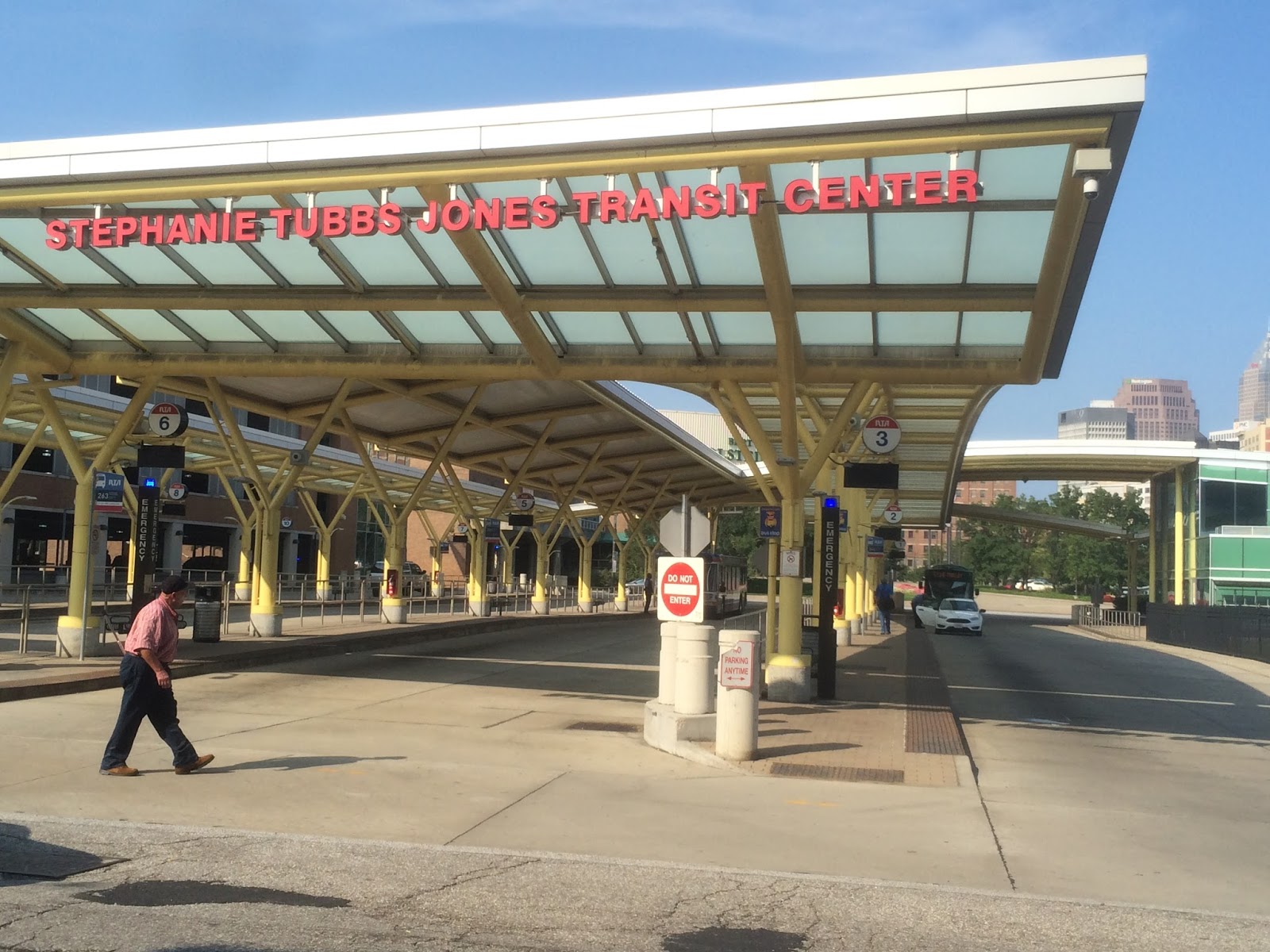
Bicycling in Cleveland is Easy, Fun, and Something Everyone Should Try

What do General Motors, Samsung, and Duke and Ohio State universities all have in common?

They have each launched bikeshare systems in the past year brought to them by Zagster, a private, venture-funded startup that launched as CityRyde back in 2007 in Philadelphia.

Visiting Cleveland, Ohio this week for the Content Marketing World conference, I got my first taste of Zagster, which opened last summer in the city. I knew nothing about this company or that Cleveland had a bikesharing network. I simply stumbled upon a small stand of white bikes as I wandered around the city’s Warehouse District to the west of downtown, where my hotel and the conference are happening.

It couldn’t have been easier to download the app and sign up for Zagster on my phone. I didn’t even know if there were any other stations than the one I had seen, but it seemed worth the minor effort.

(I had planned to rent from The Bike Rack, which is also a very cool effort from the Downtown Cleveland Alliance. It welcomes downtown bicycling “with the convenience of secure bicycle parking and fulfilling everyday commuting needs with individual shower/changing facilities, lockers, bicycle rentals, and minor bicycle repairs.” And the rental prices are great at $5 per hour or $25 per day. But frankly, it is tough to compete with Zagster’s price of $3 an hour.)

Turns out there aren’t that many stations yet in Cleveland (according to the app, it looks like there are eight total). In fact, I didn’t see any other ones on my two-hour ride, but I wasn’t actively looking for them.

I wanted to know whether Cleveland is a bikeable city. And what I found, which is what I find everywhere, is that people should get over their irrational fears of this amazing form of travel. Cleveland is highly bikeable, even though it lacks much of any kind of truly progressive bike infrastructure.


The wind was in my hair. The sun was on my arms and face. The roads and sidewalks are ridiculously large through most of downtown, which makes riding feel spacious and extremely safe. (On the other hand, more importantly, the spaciousness makes the over-paved city ripe for the construction of protected bike lanes, sharrows, cycle tracks, and other bike infrastructure.)


In two hours on a bike, I saw a handful of sites it would take two days for others to explore. My route out of the Warehouse District took me through Tower City-Public Square east along Euclid Avenue through the Playhouse Square theater district and Cleveland State University’s campus, then back west through Erie Street Cemetary and around the baseball Indians’ Progressive Field and basketball Cavaliers’ Quicken Loans Arena.


The Bob Hope Memorial Bridge has wide bike and walk access and beautiful views of the city and Cuyahoga River below. After biking through the Tremont neighborhood, I had lunch at Town Hall, a very popular and tasty restaurant on West 25th Street near the West Side Market.


In Washington D.C., there are so many Capital Bikeshare stations that riders always quickly return the bikes to a station before having lunch or going to their meetings. But here, I simply opened my Zagster’s lockbox to get the key for the U-lock that comes with each rental. I locked the bike to a parking meter in front of Town Hall and ate my lunch.

I finished my ride by biking north on 25th, which has the nicest bike lane (although not protected) that I witnessed anywhere in the city, and east across the Detroit-Superior Bridge back into the Warehouse District. Upon returning where I had started, there were only four bikes at the station. One had a bad flat tire and another was not locked.

Time will tell if Zagster will be a success in Cleveland. But there is no doubt that this system is about as easy as it gets for anyone to use. In the brave new world of on-demand-shared transportation, Cleveland and Zagster appear to be working out the kinks in what appears to be a major can’t-lose societal trend.

Tuesday, April 21, 2015

How Capital Bikeshare Members Use System is Becoming Clearer

Here is my article published by Mobility Lab, and subsequently covered by CityLab, DCist, WTOP, and others.

Since Capital Bikeshare’s previous surveys in 2011 and 2012, members of the Washington D.C. region’s bikeshare program have grown a little older, become more widespread throughout the region (rather than simply being from the urban core), and become more prominently affluent white males.

This latest survey (see the full survey and executive summary here) – issued to Capital Bikeshare’s nearly 28,000 members, completed by 16 percent (4,314) in November 2014, and released publicly today – shows a lot of other interesting trends related to things like:

  • significantly contributing to the region’s economy and business
  • encouraging changes in commuting and general traveling behaviors, and
  • considerably increasing economic savings for members.

Who uses Capital Bikeshare?
In 2011, 14 percent of members were 45 years or older, but in the new survey, 20 percent fill that age range. Seventeen percent lived outside of D.C. in 2011, but now 25 percent do, perhaps not surprising, with recent expansions in Virginia and Maryland.

The most striking increase in the average member profile is that 39 percent claimed $100,000 or more in household income in 2011, while now a full 50 percent state that as their current household income.

Two other intriguing findings are that members increasingly have their own bicycle and are members of carshare programs. In 2011, only 29 percent of members had their own bicycle, but 52 percent have one now. And only 9 percent had car2go or Zipcar memberships. That number has increased to 39 percent.


How are people joining Capital Bikeshare?
“Growth in membership numbers has been steady since the program launched in August 2010,” said Lori Diggins, owner of LDA Consulting, who performed these surveys and conducts transportation research for Commuter ConnectionsgoDCgoCapital Bikeshare, Mobility Lab and others.

Simply having all the stations throughout the region has been the number-one marketing tool for attracting new members – 30 percent said that’s how they became aware of the multi-jurisdictional public program. Word-of-mouth referrals (26 percent) also play a key role.

Social media and news articles about Capital Bikeshare have played a decreasing role in raising awareness about the system. However, that is likely due to the sheer increase in stations and riders around the region that are doing the “heavy lifting” on promoting the benefits of bikeshare.

Why are people joining Capital Bikeshare?
This reasoning hasn’t really changed much for members over the years. Ninety-four percent were motivated to join because it’s important that they be able to get around “easily and faster,” 84 percent say it’s important they have a “new and one-way travel option,” and 77 percent say it’s important they have a “fun way to travel.”

It also is generally clear that younger members are motivated by the ease of getting around and saving money while older members tend to be more interested in exercise, health and helping the environment.

How are members using Capital Bikeshare?
On average, members take 13 rides per month on the system. Fifty-nine percent make six or more trips and 24 percent take Capital Bikeshare 20 or more times monthly.

Seventy-four percent of members use Capital Bikeshare to get to or from work at least once a month. However, the biggest use is for entertainment purposes or socializing with friends (85 percent).

“The longer people are Capital Bikeshare members, the more uses they are finding for it,” Diggins said.
It’s clear that bikeshare has entrenched itself as a key cog in the D.C. transportation network. Sixty-four percent of members use it at least once a month to access Metrorail as a first-mile, last-mile option. However, far fewer are finding it useful in linking to buses or commuter rail.


How is Capital Bikeshare impacting the local economy?
For starters, 49 percent of members said they made trips on Capital Bikeshare during the month prior to taking the survey that they would not have made otherwise – a phenomenon called “induced trips.”

Further, businesses are simply more attractive to Capital Bikeshare members when they are near bikeshare stations. A whopping 82 percent said they are either “somewhat more likely” or “much more likely” to patronize a business, restaurant, or shop if they are accessible by bikeshare.

“Some even said they would not go to these places – period – if there is no Capital Bikeshare station nearby,” Diggins added.

How is Capital Bikeshare impacting traffic in the region?
Eighty-four percent of members said they increased their bicycle use since joining the program. Eight percent sold a household vehicle and didn’t replace it, with 76 percent of those people saying Capital Bikeshare played an important role in the decision. More than half of the respondents who reduced their household vehicles now live in “car-free” households, having eliminated their only vehicle.

On average, members reduced 158 driving miles per year. That equates to 4.4 million miles of driving eliminated annually from the region’s roads.

Even when Capital Bikeshare members aren’t using the system to get to and from work, only 11 percent said their primary mode was driving alone. That’s pretty astounding compared to the regional average of 68 percent who primarily drive alone to work.

How much money do Capital Bikeshare members save by using the system?
On average, members save $13.65 per week on transportation costs. That equates to $710 per member per year. For members who make 11 or more trips per month, the average monthly savings ramps up to $1,002.
Collectively, members save $19.6 million per year on personal travel costs.

So, what’s next?
Ninety-one percent of members are interested in a single-card system that would allow them to check out bikes and ride public transit.

And a high percentage of members would like more docks at existing stations, more stations in residential neighborhoods, and expansion in areas where Capital Bikeshare is already operating.

To sum it up: yes, you are seeing more big red bikes these days. The expanding Capital Bikeshare system is helping people take notice that bikeshare is rapidly becoming a key element in building the transportation network of the future.

See more about the survey in Mobility Lab’s Research Catalog. Photo by Elvert Barnes. Charts courtesy of LDA Consulting.