Showing posts with label Mobility Lab. Show all posts

Tuesday, March 12, 2019

My quotes in the Washington Post about Metro failing to promote itself

The Washington Post's Kery Murakami decided to dig deeply into data about growth patterns of people moving into spaces within a half mile from Metro stations throughout the DC region.

He contacted me (representing Arlington's Mobility Lab) because our expertise is on how important initiatives other than infrastructure are to the transportation choices that people make. Sure, running safe, reliable trains on time is really important, but it straddles the line between infrastructure and the education aspect we focus on.

In places like DC where the transportation grid has been built out about as much as possible, the only way to go is to win people's admiration and loyalty to various ways of moving around. The good news is that it can often be effective (if done well, which it often isn't), and it's a heck of a lot less expensive than building new highways and train stations.

Anyway, this is a good article, with excellent reporting and (I think) some pretty great quotes from me! :-)
But even though that meant 38,000 more people were living near a station, ridership didn’t grow. According to Metro’s figures, it fell. Weekday boardings in the District dropped by 13 percent between May 2011 and May 2018 — or by an average of about 57,000 boardings daily — while all those people were moving in around stations.
That was “absolutely” a lost opportunity, said Paul Mackie, research director of Mobility Lab, the research arm of Arlington County Commuter Services. “It doesn’t help that the SafeTrack repair program has led to a general decline in both service and loyalty to Metro,” he said. “But Metro needs to promote itself harder, especially in light of competition from other options like Uber, Lyft, carpooling, e-scooters, bikes and bikeshare, and the rise in teleworking.”
Mackie also said Metro hasn’t done enough to reach out to all the additional people moving in around stations. 
“There is a huge TransitScreen on the marquee at Gallery Place/Chinatown that lists when the next trains are leaving,” he noted. “Why aren’t those signs in every neighborhood and bar and restaurant and library and hotel promoting transit?"
I was also quoted in a separate Post article titled, Data shows areas near Metro stations remain havens for the rich.
“We’re seeing the rich get richer – in both wealth and quality of life – and low-income people having to keep fighting to stay afloat with everyday tasks – like getting to work or daycare,” said Paul Mackie, research director for Mobility Lab, an Arlington transportation research center funded by local and federal governments.

Thursday, January 17, 2019

My reflections on TransportationCamp

This article originally appeared at MobilityLab.org.
It’s always fascinating to see what topics are trending at our yearly TransportationCamp DC unconference – where almost all of the sessions are picked that day by attendees themselves.
Last Saturday at Catholic University, about 520 fans of transportation braved the cold to dig into the weeds on topics and burning questions that they wanted to workshop and take back in 2019 to further solve.

Which topics were popular?

At TransportationCamp DC a year ago, Campers’ favorite modes to discuss were bikes and trains, with busses and walking next. There was a surprising lack of interest in autonomous vehicles, ride-hailing, and ride sharing.
But, from my back-of-the-envelope calculation based on the session titles (all listed here, and with full notes of most sessions), this year was pretty different. Of the 56 sessions throughout the day, 5 were primarily focused on scooters – which definitely proved to be in most of the day’s conversational thread. As far as modes, busses were the next popular with 3 sessions. Bikes dropped down to 1, airplanes 1, carpools and vanpools 1, and transit in general with 1. Unlike last year, there were no sessions focused primarily on rail. And AVs, which were less the talk of the town last year, seemed to bump up in interest, with 3 sessions.
Outside of mode, the popular topics were definitely data (9 sessions), planning (6), equity (3), policy, such as a session I moderated with Washington, DC’s Transportation Director Jeff Marootian, nicely covered here by Greater Greater Washington (3), and the public (7). Many people told me they loved the behavior-economics bent – trying to understand how people make their fundamental transportation decisions – of many of the sessions, especially the kind offered in a featured session in the Hannan auditorium by Duke Professor Maura Farver. (She also works at The Center for Advanced Hindsight.) Farver’s session was titled, “Your blueprint for mapping people’s transportation behavior and habits.”
And data appears to finally be having its day in the sun. After years of knowing that the transportation industry has mega-loads of data, it may now actually be doing something with that data. TransitCenter, one of Camp’s sponsors, was in the midst of releasing its Open Transit Data Toolkit, which helps even the least tech-nerdy people figure out how to analyze where and how people are traveling. And TransitScreen, another sponsor, announced that it’s working with OpenMobilityData to archive transit data feeds from cities all over the world as a way to help software developers make cool tech that will help people discover transit.
There were a handful of topics that had 2 sessions, including: partnerships, the environment/traffic congestion, transit cost and payment options, safety, and “fun” – meaning there was a session to play the planning card game Cards Against Urbanity and another for yoga.
The other topics that got just 1 session included parking, rural issues, and communications (down a bit in focus from previous DC Camps).

A handful of key insights from the Camp’s notetakers

One highly provocative session questioned whether there should be bike lanes at all in our streets. Session leader Mark Egge noted that infrastructure money is scarce, there are unclear safety benefits, they supposedly don’t attract new riders, and they’re often poorly planned.
Session leaders from the Central Maryland Transportation Alliance discussed the need for a “transportation report card, like that produced on the state of the Chesapeake Bay. Some metrics suggested for such a report card included convenience, seat utilization, FHWA and INRIX congestion data, satisfaction levels, access during “free flow” versus congestion (Minnesota Accessibility Observatory), cost, and safety.
Do you know what could fit in a 22 x 10 parking space? 75 people standing! That and other amazing tidbits and lists were discussed in a session titled Curb Appeal on what to do with our curbs.
Some of the solutions for scooters and bikeshares discussed in a session on broadening the user base focused on giving more access to teenagers and forming partnerships with high schools.
Among the bad habits that started to break in 2018 were the smugness of experts in thinking the public will instinctively adore autonomous vehicles, not demanding enough from transit data, and not realizing that cities need mobility managers. Those were in the featured session that included Calvin Thigpen of Lime, Tiffany Chu of Remix, Katherine Kortum of the National Academies, and Laramie Bowron of Swiftly.
And projects we should be excited about in 2019 include shipment tracking via SafeShift; Ford’s City of Tomorrow; pilots to find new and interesting uses for curbs; the public-private data clearinghouse called SharedStreets; Zipcar’s carsharing partnerships in New York City; equity-based decongestion pricing policy; the Alaskan Way Viaduct in Seattle; and Streetlight Data for pedestrian, bike and transit flows. Those predictions came from featured panelists Chris Forinash of Nelson\Nygaard, Sabrina Sussman of Zipcar, Allison Wylie of Uber, and Courtney Ehrlichman of The Ehrichman Group.

Other perspectives

We’ll know a lot more after next week’s post-Camp survey goes out to attendees, but thought you all might like this early, and, as I mentioned, back-of-the-envelope content analysis. Along with our own coverage of TransportationCamp, TransitScreen and Street Justice also had some perspectives.

And a big thanks

From our venue Catholic University to Arlington County’s staff (largely consisting of Mobility Lab’s close partners at the Destination Sales & Marketing Group) to the note-taking volunteers provided by Young Professionals in Transportation and the student discounts courtesy of the American Association of State Highway and Transportation Officials (AASHTO), we thank you.
And to Andrew Glass Hastings of sponsor Remix, who helped lead The Human Spectrogram exercise (look for more analysis and dissection on that soon) and sponsor Zipcar, whose Sabrina Sussman helped us secure Marootian for a featured session (her story about how everyone needs to tell their stories about why they care about transportation may have been the event’s highlight), we thank you.
And to Leib Kaminsky, who helped Mobility Lab (remember, we’re researchers and communicators, not event planners) secure our best-ever group of sponsors, we thank you. And we thank the sponsors themselves: Uber, Zipcar, TransitCenter, Lime, Lyft, car2go, Remix, Bird, Noblis, the American Public Transportation Association (APTA), Swiftly, the Washington Area Bicyclist Association (WABA), Young Professionals in Transportation, TransitScreen, the American Bus Association (ABA), Kimley-Horn, the American Association of State Highway and Transportation Officials (AASHTO), and Nelson\Nygaard.
And last and most important, thank you to all the attendees. We think you’re taking transportation to another level!
Photos of me on stage as master of ceremonies, Campers brainstorming, and Campers discussing which sessions to attend at “The Board” all by M.V. Jantzen/Flickr.

Friday, December 7, 2018

McDonald’s attracted talent by making its headquarters transit accessible

I wrote this post originally at MobilityLab.org.

CEOs and business leaders could do a lot to improve terrible traffic. Quite a few businesses are starting to understand this concept.
But what’s missing is a sustained, large-scale effort to assure businesses that a focus on improving the transportation habits of their employees is good for their bottom line. Perhaps even better for those CEOs and businesses to hear is the message that getting non-driving customers into the store is a formula for success.
Chicago’s Metropolitan Planning Council recently released an impressive report down this path entitled Transit Means Business. It features case studies of efforts by McDonald’s, Caterpillar, Bosch, Method, Revolution Brewery, MB Financial, Motorola Solutions, and other businesses and universities throughout Illinois to locate near transit as a way to survive and compete.
McDonald’s had been headquartered in the Chicagoland suburbs for 40 years before making the decision to relocate to the West Loop earlier this year.
“McDonald’s couldn’t get people to apply for jobs anymore. Ninety percent of their employees were driving to work. They moved downtown in May to help people take transit. Now 90 percent of their employees take transit,” said Audrey Wennink, transportation policy and planning director at the MPC, during a roundtable discussion this week at Transportation For America’s Capital Ideas conference in Atlanta.
From the report:
McDonald’s planned only 295 parking spaces in its new building for its 2,500 employees and employees must pay to park. Before the move, employees were encouraged to drive downtown at rush hour one day to experience the commute by car. While before the move only one-third of employees planned to ride transit to work, now more than 90 percent of workers arrive via non-auto modes, mostly Metra and CTA.
And it’s not just companies moving their headquarters to a new, transit-friendly location. Take State Farm Insurance, which closed up tons of small offices across the country to consolidate into bigger spaces near transit in Atlanta and other cities, said Steve Davis, who leads communications for T4A and Smart Growth America.
It remains a mystery why McDonald’s and others have waited so long with their corporate moves. After all, they know their storefronts do really well near transit, so why wouldn’t they consider also placing their headquarters there? According to a former McDonald’s senior director, the consistently top-performing U.S. and international locations are the “Rock & Roll McDonald’s” in downtown Chicago and Moscow’s Pushkin Square. It’s no coincidence that those are extremely transit-friendly places.
To hone in on helping businesses embrace transit-oriented strategies,Wennink said that communicating about “return on investment” hasn’t seemed to resonate; hence, the MPC’s strategy to produce a beautiful, glossy report with real-world business examples of success that others can emulate.
McDonald’s is already attracting larger numbers of high-quality job applicants since its move to the West Loop. Company officials have called its discovery of the wonders of transit “a culture change.”
Photo by Thomas Hawk on Flickr’s Creative Commons. 

Friday, November 16, 2018

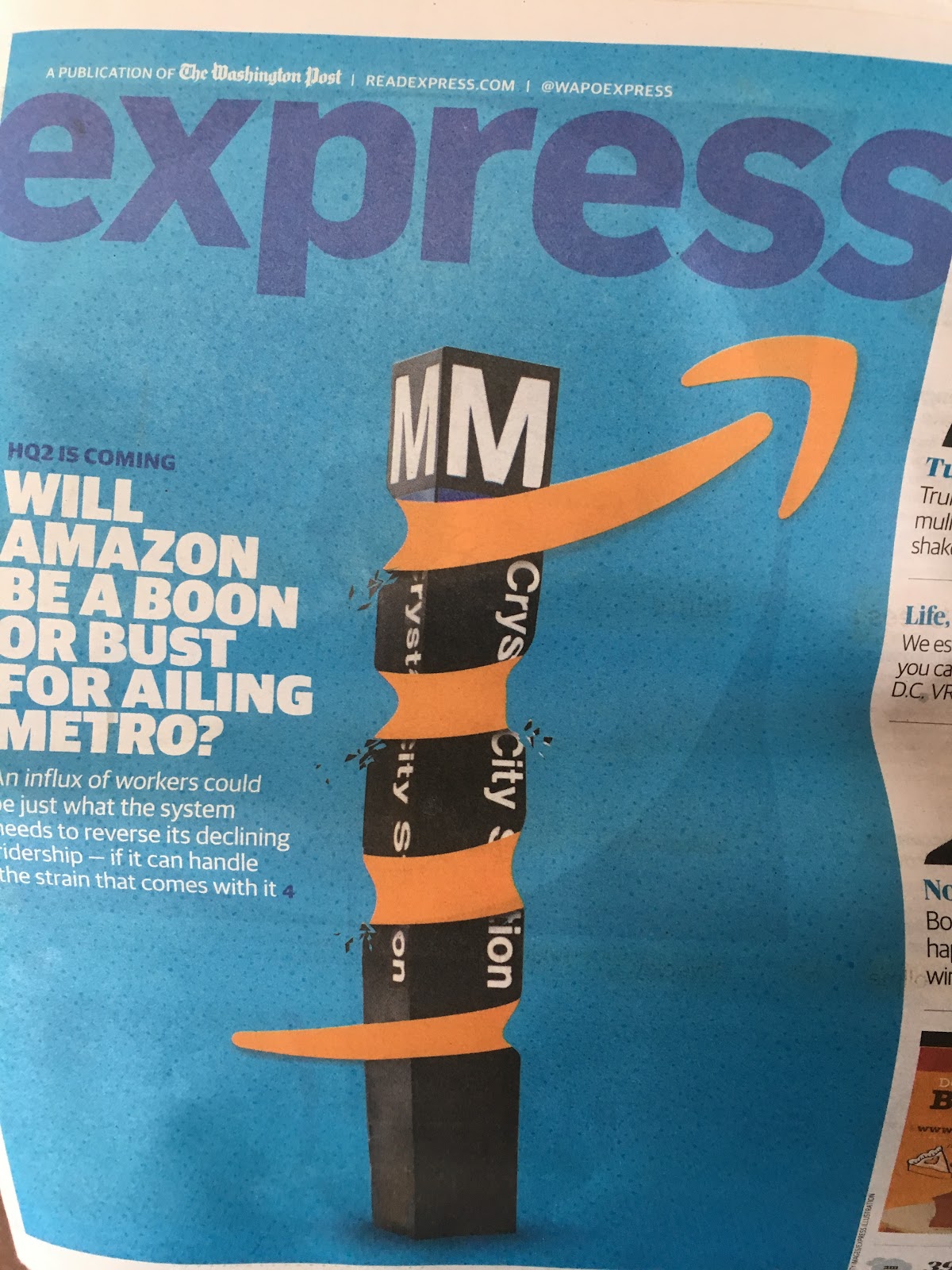
What will Amazon mean for Metro riders?

I was quoted in a Washington Post article (it was also the cover story in the Washington Post Express) about Amazon's announcement to open one of its second headquarters in the Washington DC region.
The article about it is excerpted from MobilityLab.org.
A key part of why Amazon, the world’s second trillion-dollar company, chose Crystal City in Arlington, Va., today as a second headquarters location is transportation.
The office-park neighborhood is supported by Metrorail, Metroway (the Washington, DC region’s only bus rapid transit route), plenty of bus routes, and National Airport.
This is a great opportunity for Metro to boost its declining ridership. But with Metro’s sometimes poor reliability and Uber and Lyft’s growing prominence, there’s no guarantee that Amazon employees and their families will choose Metro.
My quote in the article:
“Metro has to make itself really attractive to get [Amazon employees] to choose Metro over any of the other options perhaps people are finding more attractive at this point."
Some observers predict that Amazon will attract high-earning millennials to the DC region. This might not bode well for Metro, as this is the demographic reducing its ridership the most. 
Luckily, there’s a good chance that Amazon will provide unlimited transit passes to employees, as it does for employees at the Seattle headquarters. This strategy is known to both boost transit ridership and increase employee satisfaction.
Yet Amazon’s arrival means that many more people – not just Amazon employees – will be moving to the DC region. For Metro to win those riders too, the agency needs to up its game. That means improving service and making it easier for people to ride Metro, with better signage, real-time information, and marketing.
And for Amazon itself to help improve the quality of transportation options throughout the DC region, it can start by offering its own employees the very best corporate transportation incentives.
Photo of Arlington Cemetary Metro station by Sam Kittner for Mobility Lab. 

Friday, September 28, 2018

Do Uber and Lyft really care about being environmentally sustainable corporations?

In my role as director of Mobility Lab, I got interviewed for this CityLab article. Here are some tidbits:

For Paul Mackie, director of communication and research at Mobility Lab, which studies transportation behavior and policy, the announcements are another sign of how these companies are adopting roles as “societal partners” rather than just ride-hailing services—ones that can change the way public transit is marketed to the masses. In moving into the bike- and scooter-sharing markets, Uber and Lyft are also encouraging more people to ponder driving alternatives, and making it easier for them to change their behavior.

Lyft’s campaign resembles the new subscription service the firm is experimenting with in Salt Lake City, in which participants pay a flat $200 every month for 30 rides. But by integrating bikeshare and public transit, Lyft’s “Ditch Your Car” initiative goes one step further, potentially demonstrating how public transit agencies could benefit from a new payment model. “You think of these other smart industries—like Netflix or food recipe subscriptions—those are working and it's showing that it's what people want,” Mackie said. “Why is public transit so slow to have that model?”

 ... “It would be naive for anyone to think that Uber and Lyft aren't thinking about what’s best for their bottom line,” said Mackie. The two companies also want a seat at the policy-making table, with both ramping up their lobbying spending over the last few years. (Uber’s backing of congestion pricing, as CityLab previously reported, could be a win-win for both company and city.) Uber is still scrubbing its brand after the multiple scandals associated with former CEO Travis Kalanick, while its smaller competitor Lyft is sticking with its famous “better boyfriend” strategy, donating to the ACLU and giving voters free rides to the polls.

But the companies are still leaving out the one thing cities really want: data. Uber’s gift to SharedStreets may be a gesture toward handing over more of this precious resource, and Mackie thinks this could be another win-win for both sides. “Cities have curb space and parking—things that could really help Uber and Lyft,” he said. “We like to think that if they did share their data, then the governments can work with them to make cities much nicer working grounds.”

 And Mackie also credits Uber and Lyft with encouraging more people to consider sustainable transit options. Despite the rise of ride-hailing, Americans are largely still holding on to their private cars, and the concept of shared mobility remains novel to many.  “So it’s another thing to be a bit of cheerleader for Uber and Lyft because we want them to incorporate this sharing mindset in all of us,” he said. “It’s a noble experiment in behavioral change.”

E-bikes: An exciting alternative

This article originally appeared in the Sierra Club's newsletter.

It’s too early to tell if electric bicycles hold the secret to grand pronouncements such as “the
future of transportation.” But there’s definitely something interesting happening.

Anecdotally, I researched e-bikes for years before I felt comfortable enough to buy one as a
way to improve my mobility options in a ridiculously congested place like the Washington D.C.
region. There weren’t enough retailers who would also be able to make necessary repairs,
something this is more complicated than with traditional bicycles. The battery technology
wasn’t good enough to carry a charge decent enough to get back-and-forth across the city.

The first e-bike I bought ended up being too difficult to get repaired and I returned it,
thankfully (after lots of headaches), for a full refund from the German company, with a
California wholesaler and a D.C. retailer.

But earlier this year I tried again. After test riding many e-bikes and researching online (and,
despite the excellent Electric Bike Reviews site, with so many manufacturers and models, it’s
still an intimidating purchase decision), I purchased an excellent Magnum Metro from Hybrid
Pedals in Arlington, Va.

I’ve never met anyone who didn’t agree that, after riding an e-bike, it changed their life. The
problem is that so few people have actually ridden e-bikes. The U.S. market grew by 25
percent in 2017, to 263,000 e-bikes sold. At that rate, it will take a long time to make much of a
dent in the still-small percentage of people who bike for utilitarian purposes like getting to
work, going to eat, or meeting friends.

Some of the good news is that new and trendy options like Uber, Lyft, e-scooter shares,
dockless bikeshares, and soon autonomous shuttles may slowly be getting people out of their
century-long drive-alone mindset. In an increasingly crowded and polluted world, e-bikes could
play a valuable role in being a gateway to switch from this bad habit to these healthier, more
sustainable, more affordable, and just plain fun choices.

If all bikes today - every single bicycle in the entire world - were suddenly thrown away and
replaced with e-bikes, that wouldn’t be good for the environment. Obviously.
But e-bikes are good for the environment in a somewhat surprising way: because riding an ebike
is less physically demanding than a regular bike, making it easier to climb hills and go
longer distances, people might ditch cars for e-bikes.

Sounds far-fetched, but research says otherwise. An extensive survey of more than 1,800 ebike
users in the United States by the National Institute of Transportation and Communities
earlier this year found that most participants switched to e-bikes to reduce car use.

“What stood out, however, is how many motives involved eliminating driving hassles,”
Bicycling’s Selene Yeager wrote of the study. “Twenty-eight percent of respondents said they
bought an e-bike specifically to replace car trips. Others pointed to craving a more car-free
lifestyle, such as using e-bikes to carry cargo or kids, avoid parking and traffic woes, be more
environmentally minded, and have a more cost-effective form of transportation.”

But Americans are buying e-bikes at much lower rates than people in China and Europe. In fact,
the Wall Street Journal quoted a transit expert in 2016 claiming that 60 percent of all battery
production in China was for e-bikes. That’s a lot of batteries.

So how can we fix this? We can educate people on the benefits of e-bikes (and make sure they
know that riding an e-bike is still good for your health). We can advocate for better bike
infrastructure, which is proven to increase rates of bicycling across the board.

The research holds for me personally as well. I definitely bought my e-bike to maneuver more
easily and efficiently through D.C.’s stressful traffic. My car trips have gone way down, and
now my 17-mile roundtrip work commute is often the best part of my day.

Friday, August 10, 2018

Stop signs can help us make the world a better place

Originally published at MobilityLab.org.


Americans can take action to slow the decline of civil society simply by focusing on the ubiquitous stop sign.
If you’ve ever ridden a bicycle on city streets, you recognize that there are a ton of people driving while texting. It’s easy to see because a person on a bike can easily see down into people’s cars.
If you’re walking, you know how often people driving won’t stop for you in clearly-marked crosswalks. They either don’t notice you or don’t care, feeling smugly protected in their cages.
Meanwhile, everyone in cars sees people on bikes and foot doing things we deem as reckless (zipping in and out of traffic or not watching what’s in front of them on the sidewalk).
This all fits into a fascinating little brief commentary in the Glendale (Calif.) News-Press that horrifyingly documents the war zone that exists in the vicinity of stop signs.
Do you stop at stop signs? So few drivers do that Glendale posted temporary electronic signs informing drivers to “stop at stop signs.” What’s next: “breathe in and out”?
The other day I pulled up to [a four-way] intersection. Cars were at each of the four stop signs.
To my left was a car making a left turn. The next driver to go was supposed to be me. Just as I released my brake ready to enter the intersection, the car immediately behind the one that made the turn quickly followed right behind so closely that it appeared one car was towing the other.
It was one of those eye-popping “did that just happen” moments. There were at least five other drivers who witnessed that illegal and highly dangerous maneuver.
What was going through the mind of that man behind the wheel? Obviously, he did not give a whit about the rules of the road and was determined to shave off a few seconds from his commute — to hell with everybody else.
In what little research that exists on the matter, there is no correlation between getting moving violations and changing one’s driving habits.
The author goes on to make the suggestion that parents and school systems need to do a better of teaching the increasingly lost art of social responsibilities. Schools are definitely cutting funding for driver’s ed.
That’s one problem. It’s also a sure sign that, if there’s not as much education about how to drive as part of the rules of the road, there is almost certainly not much teaching going on about how young people should operate in an increasingly multimodal society.
Since police forces no longer put much time into ticketing people who run stop signs, one transportation demand management offshoot strategy is to petition local governments for street-calming measures such as speed humps, traffic circles, bike lanes (or, better yet, protected bike lanes), wider sidewalks (or, in many cases, any sidewalks), and many others.
On a hyper-local level, I’m leading a neighborhood charge in my city of Takoma Park, Md. Even though my street already has a nice sidewalk and stop signs that aren’t too far apart, we have noticed more and more of exactly what the journalist in Glendale details. Despite the high prevalence of kids playing and people walking, drivers constantly blow through the stop signs in front of our house. They seemingly don’t care or have lost the muscle memory be able to stop in the name of either the law or human decency.
All my crusade will take is 2/3 of the households on my block and the two adjacent blocks to agree to get the city to install a speed hump in front of my house. That equates to 12 households, which seems like a pretty easy task in the name of perhaps saving the lives of the kids on our street.
Even if my petition fails to get the required signatures, at the very least, I’ve informed my neighbors about the research that shows speed humps are a valuable addition to our transportation spaces.
As always, so much of TDM’s success hinges on getting infrastructure to adapt to new trends. Steps like my petition for speed humps is a perfect example of the importance of TDM, also known as transportation education.


Tuesday, July 31, 2018

Living better often means having calmer mobility options

Originally published at Mobility Lab.

It’s great when journalists dig down deeper into the core, fundamental meaning of the issues.
Alex Marshall of GOVERNING does a commendable job of digging deeper down into the word “mobility.” It is an imperfect word, but it actually gets about as close as possible to defining the way people move around.
Despite not giving an explanation as to why he finds the word mobility “pretentious,” the article lands on some pretty insightful conclusions, including this one, which begs to become a tagline for one of the gazillion new mobility startups:
Sometimes the slower you move, the farther you get.
He points out the communities with all the amenities located in a dense space, like his in Brooklyn, N.Y., have a good thing going, and that avoiding most instances of needing to get in a car (except when you just need that refreshing Sunday drive) creates a much better, happier standard of living.
Then he quotes me:
Paul Mackie … points out that we all have different spheres of mobility – including our neighborhood, our city, our region and the world beyond – and they vary in quality. “In your Brooklyn example, you might have great access to everything by foot in your walkable neighborhood, but your ability to access your doctor on the Upper West Side is limited because driving in the city is difficult and the subways are delayed,” he wrote in an email.
Although I find the term “mobility” pretentious, it may have come into favor because it takes in other options besides personal driving for getting around. And having more ways to travel improves your mobility, by my scorecard. “The mobility mix is getting really interesting now with Uber, Lyft, e-bikes, e-scooters, bikeshare, dockless bikeshare, hover boards, autonomous cars, autonomous shuttles, work shuttles,” Mackie wrote, and people are waking up to that. “They’re not simply sleepwalking into the cars in their driveways in the morning.”
Whatever one’s thoughts are about the term mobility, it’s heartening to know that more journalists are starting to get the memo that transportation and mobility aren’t always about driving and flying.
See our recent article on what mobility means.

Tuesday, June 26, 2018

How Uber and Lyft are scooting their way to global domination of transport

I got the last word in this solid roundup from the San Francisco Chronicle of the latest news on Uber and Lyft's plans heading into the future of transportation.
“Not many people in our country take bikes and scooters for utilitarian trips, for going to work, the grocery store, out at night even though it’s a low-cost healthy way to get around,” said Paul Mackie, director of research and communications at the Mobility Labs think tank. “It’s great that Uber and Lyft are putting money and publicity and building interest in these other great ways to travel. It lends credence to them as mobility companies, not just tech companies.”

Monday, June 18, 2018

The best way to do microtransit? Have transit agencies operate it

This article originally appeared at MobilityLab.org.

We’ve written skeptically about how genuine microtransit services and ride-hailing companies, like Uber and Lyft, are about truly enhancing transit ridership and accessibility.
When I asked four such entrepreneurs what percentage of rides their services provide are “first mile” or to transit, 150 people [in attendance at a recent mobility conference] could hear a pin drop in the silence.
When no good answers or data can be offered in response to such a question, it’s not a long shot to assume the worst. And the worst is? That those entities are actually trying to steal customers from core transit services, like buses and subways, that offer the top societal benefits.
Since microtransit companies talk so much about their services connecting people to transit, it’s puzzling that they so rarely mention specific “first mile, last mile” projects and their results. But with some digging, one can find examples of some good things companies and cities in the microtransit space are attempting.
The Sacramento Regional Transit District (SacRT) just received $12 million from the Sacramento Transportation Authority to begin shuttling people this summer between residential and commercial places that are lacking transit options.
Rides on the shuttles only cost between $1.35 and $2.75 – price points considerably more affordable than taking an Uber or Lyft. And it’s already been working. Since February, ridership has been steadily increasing. (It doesn’t hurt that a commercial hub for riders is the Historic Folsom area, a bustling district billed as “the place where the West came and stayed.”)
Sacramento is hoping people will not only use microtransit to reach the Fulsom business district, but also the nearby train station, which can serve as a major transit artery for the rest of the region.
The city is running their pilot with TransLoc, a North Carolina-based company that builds software to help transit agencies operate their own microtransit services. The company was acquired early this year by Ford Smart Mobility.
Aaron Berdanier, a data scientist who works on microtransit projects for TransLoc, said the project’s target audiences are “people who were not taking the train before because they didn’t have access, and other riders already going to the train station but didn’t have a way to get there.”
TransLoc’s CEO Doug Kaufman added, “SacRT’s success in deploying innovative, on-demand microtransit is a proof-point for the huge potential impact of microtransit across the nation, particularly for riders. We are incredibly excited [that] the success of their pilot resulted in a grant to fund its expansion.”
Berdanier said, “Goals for this pilot were to increase ridership, which they’ve done dramatically, and to plug into this area they didn’t have access for – Citrus Heights. The agency has been very innovative and forward thinking,” he said, noting that this was a great opportunity to enhance Sacramento’s Dial-A-Ride system.
TransLoc also focuses on connecting microtransit to transit hubs in the region between Raleigh and Durham, N.C. In an area with lots of big office parks – including the likes of IBM and Cisco – TransLoc helps GOTriangle make it easy for their riders to use their smartphones to jump on microtransit.
Berdanier said 75 percent of those microtransit riders connect into the regional transit hub there (see the map) and then get on a microtransit vehicle to take that last mile to work.
This is another reason why it is so important for transit agencies to become key microtransit players. When transit agencies are the ones in charge of the routes (rather than willy-nilly routes that people could organically take or that even Waze or Google Maps could algorithmically take them), it’s more likely there will be better outcomes (such as fewer traffic jams, healthier travelers, and less air pollution).
It’s encouraging that Uber and Lyft are also beginning to understand the need for transit to be at the center of multimodality. Detroit and cities along the Brightline passenger railway in South Florida have partnered with Lyft to get people to transit stations. And Uber paid Metro in the D.C. region $100,000 to keep trains running later after a recent National Hockey League playoff game.
Photo of people boarding a DC Circulator bus by Sam Kittner for Mobility Lab. 

Friday, March 9, 2018

For talk I gave in Pittsburgh, they wanted to know about transportation, not the Steelers

I just realized that the video from a talk I gave in Pittsburgh back in October 2016 is posted online.

It was a pretty good presentation to a group of students at Carnegie Mellon's prestigious Traffic21 program. I talked about how, in a time of increasingly scarce dollars available to fix America's transportation ills, there are some better, less expensive ways to think holistically and practically about the issue.

I still use a lot of the material in talks I give for Mobility Lab. Here is the article I wrote about Pittsburgh at the time (Streetsblog also wrote about the article) and below is the video of the full presentation.

It starts off in real clunker style as I tell a little story about football. Then I ask the room how many people like football. And almost nobody raised their hands! In Pittsburgh!! That's when you know you've got a really captive room of transportation geeks. You gotta love it.

Thursday, December 14, 2017

Auto shows are dead, bring on the personal mobility device conventions

This article by me originally appeared at MobilityLab.org.

Auto shows are so 1999.
We’ve come a long way since then. Although most of the U.S. public is still heavily wed to personal autos, various industries – including the auto industry – are positive that the future will look different.
Such a future was on display last month at LA CoMotion, held in the Arts District of Downtown Los Angeles (Mobility Lab was a media sponsor). In many ways, it was just like one of those old auto shows, but instead, it was all about the variety of transportation choices now offered by “personal mobility devices.”
Attendees and exhibitors were convinced that, sooner or later, everyone will want a specialized device that will be perfect for their specific needs of getting around town, going to work, running errands, and reducing the time they need to be stuck behind the wheel.
One major hurdle for now: “Streets aren’t really designed for all these little devices we have out here,” said Katherine Perez-Estolano of the planning firm Arup, motioning towards the test tracks and exhibits outside the conference’s main speaking area.
She even (only half-jokingly) suggested that autonomous kayaks would be a great addition to the nearby L.A. River.
“That little ball that’s rolling around outside is real. This is all happening now,” suggested Stephen F. Smith from Carnegie Mellon University, in reference to the event’s omnipresent Gita, which acts as a kind of robotic luggage.
Sasha Hoffman, chief operating officer of Piaggio Fast Forward, which created the Gita (pronounced jee-tah), said the little round robot uses camera technology to recognize a person’s leg and then follows the person everywhere, carrying whatever – as long as it’s 45 pounds or less – that person needs for the day.
She pictures it being a feature of, say, a conceirge desk at a hotel or in high-rise or retirement communities, where people can unlock it with their smartphones, cart their stuff around as needed, and then return it for the next users.
The Gita was really the one product at LA CoMotion that most embraced good old walking. Most everything else seemed to recognize the one recurring, ultimate trait of humans: laziness.
Don’t want to walk to transit? Take this. Don’t want to use up your daily allotment of brainpower navigating to work through traffic in your own car? Take this.
Perhaps the personal mobility device that seems the furthest along in having a shot at altering the way many of us move around is the electric bike – which almost seems a little old-fashioned by now compared to many of the other products at LA CoMotion.
Bosch, along with making auto parts and dish washers, is now churning out perhaps the world’s best e-bike motors, which basically repurpose car tech for bike tech. Bosch-powered e-bikes rolled out in Europe about eight years ago and did the same in the U.S. about three years ago.
Demand for mid-drive, pedal-assist e-bikes is increasing at around 30 percent growth each of the past several years, according to Jonathan Weinert, sales and marketing manager for Bosch eBike Systems. 
“The really nice thing about pedal assist is that people love to bicycle but they hate the hills and the sweat. You still have to do some work with pedal assist, but it’s more like a moped. The barrier to cycling goes down because it flattens hills and shrinks cities.”
Weiner said e-bike companies originally saw older adults as the prime market, but now Millennials are showing more interest, families are buying cargo e-bikes, and younger people are using them for commuting and mountain biking. He said he thinks e-bikes will increase ridership for transit as well.
“The toughest thing is to get someone to throw a leg over an electric bike. Once they do, they’re sold on it,” he said. And by the thrilled looks on the faces of riders on the LA CoMotion test tracks, he’s correct.
The same could be said for those testing e-scooters. While not as fast as e-bikes, these devices have advantages such as taking up less space on streets and in storage. One of several that were featured at LA CoMotion was the folding urb-e, and it actually is pretty zippy. You may recall Silicon Valley TV star Thomas Middleditch riding (and struggling) around the office on one in a recent Verizon Wireless commercial.
Simon Caballero, an urb-e sales manager, said the Pasadena-based company sold 3,000 in its first year of operation five years ago and hasn’t looked back since.
“We partner with Metro and Metrolink in Southern California as the only electric vehicle allowed on their systems,” Caballero said about the scooters, which range in price from $900 to $2,000.
For those a little less comfortable enjoying the wind in their hair, the future will probably offer a world filled with driverless shuttles to take you from home to the subway, from one end of town to another, or along a sightseeing path.
The one available for test rides at LA CoMotion was courtesy of Transdev, an Illinois-based company that mostly has its eyes set on becominga solution for people whose walk to transit is a little further away than ideal.
But the vehicles could also be used at airports, business campuses, universities, amusement parks, and other places, according to Neal Hemenover, North America chief information officer for Transdev.
The company is currently working on some test pilots in Europe as well as San Ramon, Calif., which he said are similar to the Las Vegas pilot underway in that city’s busy tourist corridor.
Watch Hemenover explain further as he took me for a ride, and how the vehicle senses its environment:
Similarly, SAE International was on hand to give people test rides in a driverless car. Here’s what it felt like to ride in the passenger seat:
There was certainly a lot more on display at LA CoMotion (how could I forget drones? see below) – and it will be fascinating to watch which of these products catch on and which are relegated to the junk heaps of history.
But for now, another exhibitor was not offering a product but rather information, with a new website called Have A Go that helps people decide which personal mobility devices are right for them.
Photos and videos by Paul Mackie for Mobility Lab.

Monday, November 27, 2017

Los Angeles looks for the recipe to someday make itself a great transit city

This article originally appeared at Mobility Lab.

People often say it’s difficult to make a blueprint for how to plan transportation because every place across the world is different.


That may be somewhat true, but certain principles can apply everywhere and, at last week’s LACoMotion conference, there were promising signs that Los Angeles can usher in a more nuanced era than its historical image as the nation’s car capital.
When asked during a panel discuss what L.A.’s mobility revolution looks like, Katherine Perez-Estolano of the planning firm Arup said basic connections still need to be made throughout the region to make it easier to get across town.
“You get out of this area [the Downtown Arts District] just a few blocks and there are no paved sidewalks and [many sidewalks end mid-block]. It is the most interesting laboratory in the world. Everybody’s wondering what L.A. will do,” she said. “I’m kind of past urban transport and mobility, and I’m into a whole different place about how we access space and place.”
Just having that positive and creative-minded attitude alone – which is similar to the one L.A. Mayor Eric Garcetti relentlessly has, including in his keynote address to the conference attendees – are steps in the right direction.
And all the happy talk is backed by reality. Bike lanes are popping up everywhere in the city. The powder-blue Expo Metro subway/light-rail line takes people from downtown to the ocean in Santa Monica in under an hour. Measure M is ushering in a massive transportation plan for the county and funding to support it.
“The number of places served by mass transit is going to more than double in the next 10 to 15 years. We’ll start having transit-oriented communities and people will start walking in those neighborhoods,” said Joshua Schank, chief innovation officer for Los Angeles County Metro.
But L.A. still has a Herculean task on mobility
There are so many good things happening in the City of Angels that it feels a little harsh to constructively criticize.
But one of those criticisms: Despite all the bike lanes in downtown and elsewhere – not to mention the increasingly excellent bikeshare system that ideally will continue expanding outwards from downtown – L.A. still feels very different than, say, Washington D.C. In the District, most drivers have come to expect other types of road users. In L.A., from my recent experience of biking and walking over the course of six days, the cars mostly rage past at significantly uncomfortable speeds. People on bikes are supported by stripes and sometimes green paint on the roads, but little else to prevent the creeping feeling of imminent doom.


Two, take the above-mentioned powder-blue Expo Line, most of which is above ground and offers good views of the passing neighborhoods. There is almost no transit-oriented development all the way to the coast. That will become necessary to get people out of their cars, and right now it looks like a major uphill battle since it’s almost all single-family households immediately adjacent to the line. I’m not convinced that the route was very thoughtfully or creatively planned. But then again, L.A. is pretty jam-packed with sprawling households everywhere, and there may not have been much else of a choice.
Three, there’s the Metro Red Line, which opened in 1993 and carries impressive amounts of passengers between Union Station downtown out to North Hollywood. Buses lines expand the transit system from all the stations, but those buses take an often-prohibitive long time. I disembarked at several Metro Red stations, but they are really spread far apart and are no doubt unattractive to the many people who have jobs near the halfway points between stations.
There’s another real concern that truly does speak more specifically to L.A. – and California cities in general – and that’s the shocking and sad degree of homelessness. Governor Jerry Brown was recently quoted saying that his state had succeeded at getting about 74,000 of the 75,000 people with mental-health problems released from prison. He noted that the new problem is that about 1,000 still remain behind bars and the rest are living on the streets because there is nowhere else for them to go.
This affects public transportation greatly. It’s no stretch to imagine a lot of people simply won’t ride transit because they’ve had uncomfortable or even unpleasant run ins with mentally-ill people. They were sleeping in every station I visited and riding every train I took, and sometimes this can add to the appearance of dirty or unsafe trains and buses. And compared to many systems around the world, L.A.’s transit is indeed dirty.
Some of L.A.’s expansion of transit will need to address these issues to truly make a dent in car culture. As it stands, according to the L.A. DOT’s general manager Seleta Reynolds, “You can get to 12 times as many jobs in L.A. by car as you can by transit. Not having a car can be tough in L.A.”
How to make a mobility future happen in L.A.?
Perez-Estolano again made a great point: that people will need to almost be tricked into using “transportation options” without knowing they are having to do so.
“There’s power in allowing people to be engaged and participating in things when they don’t even know they’re being engaged,” she said, citing the CicLAvia events that close iconic and busy Wilshire Boulevard for hundreds of thousands of people only on bikes and foot.
And don’t forget about marketing. If there’s one thing we can count on L.A. doing well besides miserable traffic, it’s entertainment. The city is the best transit advertiser in the U.S. – albeit with a ridiculously low bar, but still notable.
“It’s really a lot about marketing,” agreed Gabe Klein, the former leader of both D.C. and Chicago’s DOTs. “In Copenhagen, you get off the plane and there’s a giant picture of a bike and how to use your transit card.”
All transit agencies could be better at making the case for whatever positive claims-to-fame they might have. Klein noted that it’s faster to use Divvy bikeshare for most trips in downtown Chicago than to use the train. Jay Walder of Motivate said the same is true for Citi Bike over yellow cabs in Manhattan. Those notable claims, along with many others, should be better publicized.
No matter where you live, one thing does remain the same. “People are lazy,” said Sean Rhodes of the design firm frog. “People bike in Copenhagen not because gas is $10 a gallon or for health. They bike because it’s the fastest way to get around. As that becomes the situation, you’ve still got to be safe and comfortable, and it’s got to be super easy. We’re energy conserving and lazy and that’s just the way it is. We’re not going to change that.”
Rhodes added another funny sidenote: “People in Denmark say they don’t exercise. But they ride eight miles to work. We need to make the healthy sustainable options the default.”


L.A. is no great transit city yet. The percent of people who take transit in L.A. is equivalent to the percent of people who do so in Buffalo, N.Y., said Gina Trombley from Bombardier Transportation.
But again, the city’s leaders may truly end up setting the agenda for the rest of the country on how to reimagine a world of transportation options that will align with the needs of young and future generations. Many of the speakers at LACoMotion expressed the right mindset – pretty simple stuff, really – as they get started.
“I hope there are mobility hubs where people congregate and create happy neighborhoods,” Reynolds said.
Photos by Paul Mackie/Mobility Lab.