I wrote this review of the most interesting nuggets in Joan Didion’s book of essays, The White Album, a few months ago and never published it (you should see my long draft list of material intended for publication here). Now seems like a fitting time to release it. RIP Joan Didion, who has died at age 87.
In 1968, author Joan Didion was evaluated at a Santa Monica psych ward as losing touch with reality, when in fact she was suffering from vertigo and nausea. This was shortly before she was named Los Angles Times “Woman of the Year.” While not mentally ill, she does indeed have gripping insights into the time period of 1966 to 1971, while living in Hollywood.
She describes sitting in the studio with The Doors as one of the most boring scenes imaginable, with unresolved conversations and faraway eyes all around.
Didion talked to Huey Newton, the famed Black Panther who was shot and could barely talk his way into Kaiser Hospital, of which he was in the enrolled members program. The rage of being Black in America was apparent during this time in the 1960s, as it has been ever since Black people set foot on this land.
When she got the news, while sitting poolside in Beverly Hills, about the Manson murder of Sharon Tate and friends, Didion said the misinformation coming out was intense and she remembers that nobody was surprised because there had been jitters and tension throughout L.A. that 1969 summer.
She interviewed the Manson Family’s Linda Kasabian in her women’s prison after the murders and they never discussed the case, always leaning more towards the prisoner’s high-school romances, her concerns for her children, and her dream to open a restaurant/pet shop.
Many of the rest of the essays cover other California oddities, like the aura of the governor’s mansion, the Getty Museum, and the Caltrans L.A Operations Center.
Didion closes the book as she leaves Malibu in 1978, when the regular fires and floods nearly consumed the family’s house. It seems like a good way to end the story of California in the 1960s era. Although that era seems to live on, in many ways, with perhaps growing intensity.
We’ve come a long way since then. Although most of the U.S. public is still heavily wed to personal autos, various industries – including the auto industry – are positive that the future will look different.
Such a future was on display last month at LA CoMotion, held in the Arts District of Downtown Los Angeles (Mobility Lab was a media sponsor). In many ways, it was just like one of those old auto shows, but instead, it was all about the variety of transportation choices now offered by “personal mobility devices.”
Attendees and exhibitors were convinced that, sooner or later, everyone will want a specialized device that will be perfect for their specific needs of getting around town, going to work, running errands, and reducing the time they need to be stuck behind the wheel.
One major hurdle for now: “Streets aren’t really designed for all these little devices we have out here,” said Katherine Perez-Estolano of the planning firm Arup, motioning towards the test tracks and exhibits outside the conference’s main speaking area.
She even (only half-jokingly) suggested that autonomous kayaks would be a great addition to the nearby L.A. River.
“That little ball that’s rolling around outside is real. This is all happening now,” suggested Stephen F. Smith from Carnegie Mellon University, in reference to the event’s omnipresent Gita, which acts as a kind of robotic luggage.
Sasha Hoffman, chief operating officer of Piaggio Fast Forward, which created the Gita (pronounced jee-tah), said the little round robot uses camera technology to recognize a person’s leg and then follows the person everywhere, carrying whatever – as long as it’s 45 pounds or less – that person needs for the day.
She pictures it being a feature of, say, a conceirge desk at a hotel or in high-rise or retirement communities, where people can unlock it with their smartphones, cart their stuff around as needed, and then return it for the next users.
The Gita was really the one product at LA CoMotion that most embraced good old walking. Most everything else seemed to recognize the one recurring, ultimate trait of humans: laziness.
Don’t want to walk to transit? Take this. Don’t want to use up your daily allotment of brainpower navigating to work through traffic in your own car? Take this.
Perhaps the personal mobility device that seems the furthest along in having a shot at altering the way many of us move around is the electric bike – which almost seems a little old-fashioned by now compared to many of the other products at LA CoMotion.
Bosch, along with making auto parts and dish washers, is now churning out perhaps the world’s best e-bike motors, which basically repurpose car tech for bike tech. Bosch-powered e-bikes rolled out in Europe about eight years ago and did the same in the U.S. about three years ago.
Demand for mid-drive, pedal-assist e-bikes is increasing at around 30 percent growth each of the past several years, according to Jonathan Weinert, sales and marketing manager for Bosch eBike Systems.
“The really nice thing about pedal assist is that people love to bicycle but they hate the hills and the sweat. You still have to do some work with pedal assist, but it’s more like a moped. The barrier to cycling goes down because it flattens hills and shrinks cities.”
Weiner said e-bike companies originally saw older adults as the prime market, but now Millennials are showing more interest, families are buying cargo e-bikes, and younger people are using them for commuting and mountain biking. He said he thinks e-bikes will increase ridership for transit as well.
“The toughest thing is to get someone to throw a leg over an electric bike. Once they do, they’re sold on it,” he said. And by the thrilled looks on the faces of riders on the LA CoMotion test tracks, he’s correct.
The same could be said for those testing e-scooters. While not as fast as e-bikes, these devices have advantages such as taking up less space on streets and in storage. One of several that were featured at LA CoMotion was the folding urb-e, and it actually is pretty zippy. You may recall Silicon Valley TV star Thomas Middleditch riding (and struggling) around the office on one in a recent Verizon Wireless commercial.
Simon Caballero, an urb-e sales manager, said the Pasadena-based company sold 3,000 in its first year of operation five years ago and hasn’t looked back since.
“We partner with Metro and Metrolink in Southern California as the only electric vehicle allowed on their systems,” Caballero said about the scooters, which range in price from $900 to $2,000.
For those a little less comfortable enjoying the wind in their hair, the future will probably offer a world filled with driverless shuttles to take you from home to the subway, from one end of town to another, or along a sightseeing path.
The one available for test rides at LA CoMotion was courtesy of Transdev, an Illinois-based company that mostly has its eyes set on becominga solution for people whose walk to transit is a little further away than ideal.
But the vehicles could also be used at airports, business campuses, universities, amusement parks, and other places, according to Neal Hemenover, North America chief information officer for Transdev.
The company is currently working on some test pilots in Europe as well as San Ramon, Calif., which he said are similar to the Las Vegas pilot underway in that city’s busy tourist corridor.
Watch Hemenover explain further as he took me for a ride, and how the vehicle senses its environment:
Similarly, SAE International was on hand to give people test rides in a driverless car. Here’s what it felt like to ride in the passenger seat:
There was certainly a lot more on display at LA CoMotion (how could I forget drones? see below) – and it will be fascinating to watch which of these products catch on and which are relegated to the junk heaps of history.
But for now, another exhibitor was not offering a product but rather information, with a new website called Have A Go that helps people decide which personal mobility devices are right for them.
Photos and videos by Paul Mackie for Mobility Lab.
People often say it’s difficult to make a blueprint for how to plan transportation because every place across the world is different.
That may be somewhat true, but certain principles can apply everywhere and, at last week’s LACoMotion conference, there were promising signs that Los Angeles can usher in a more nuanced era than its historical image as the nation’s car capital.
When asked during a panel discuss what L.A.’s mobility revolution looks like, Katherine Perez-Estolano of the planning firm Arup said basic connections still need to be made throughout the region to make it easier to get across town.
“You get out of this area [the Downtown Arts District] just a few blocks and there are no paved sidewalks and [many sidewalks end mid-block]. It is the most interesting laboratory in the world. Everybody’s wondering what L.A. will do,” she said. “I’m kind of past urban transport and mobility, and I’m into a whole different place about how we access space and place.”
Just having that positive and creative-minded attitude alone – which is similar to the one L.A. Mayor Eric Garcetti relentlessly has, including in his keynote address to the conference attendees – are steps in the right direction.
And all the happy talk is backed by reality. Bike lanes are popping up everywhere in the city. The powder-blue Expo Metro subway/light-rail line takes people from downtown to the ocean in Santa Monica in under an hour. Measure M is ushering in a massive transportation plan for the county and funding to support it.
“The number of places served by mass transit is going to more than double in the next 10 to 15 years. We’ll start having transit-oriented communities and people will start walking in those neighborhoods,” said Joshua Schank, chief innovation officer for Los Angeles County Metro.
But L.A. still has a Herculean task on mobility
There are so many good things happening in the City of Angels that it feels a little harsh to constructively criticize.
But one of those criticisms: Despite all the bike lanes in downtown and elsewhere – not to mention the increasingly excellent bikeshare system that ideally will continue expanding outwards from downtown – L.A. still feels very different than, say, Washington D.C. In the District, most drivers have come to expect other types of road users. In L.A., from my recent experience of biking and walking over the course of six days, the cars mostly rage past at significantly uncomfortable speeds. People on bikes are supported by stripes and sometimes green paint on the roads, but little else to prevent the creeping feeling of imminent doom.
Two, take the above-mentioned powder-blue Expo Line, most of which is above ground and offers good views of the passing neighborhoods. There is almost no transit-oriented development all the way to the coast. That will become necessary to get people out of their cars, and right now it looks like a major uphill battle since it’s almost all single-family households immediately adjacent to the line. I’m not convinced that the route was very thoughtfully or creatively planned. But then again, L.A. is pretty jam-packed with sprawling households everywhere, and there may not have been much else of a choice.
Three, there’s the Metro Red Line, which opened in 1993 and carries impressive amounts of passengers between Union Station downtown out to North Hollywood. Buses lines expand the transit system from all the stations, but those buses take an often-prohibitive long time. I disembarked at several Metro Red stations, but they are really spread far apart and are no doubt unattractive to the many people who have jobs near the halfway points between stations.
There’s another real concern that truly does speak more specifically to L.A. – and California cities in general – and that’s the shocking and sad degree of homelessness. Governor Jerry Brown was recently quoted saying that his state had succeeded at getting about 74,000 of the 75,000 people with mental-health problems released from prison. He noted that the new problem is that about 1,000 still remain behind bars and the rest are living on the streets because there is nowhere else for them to go.
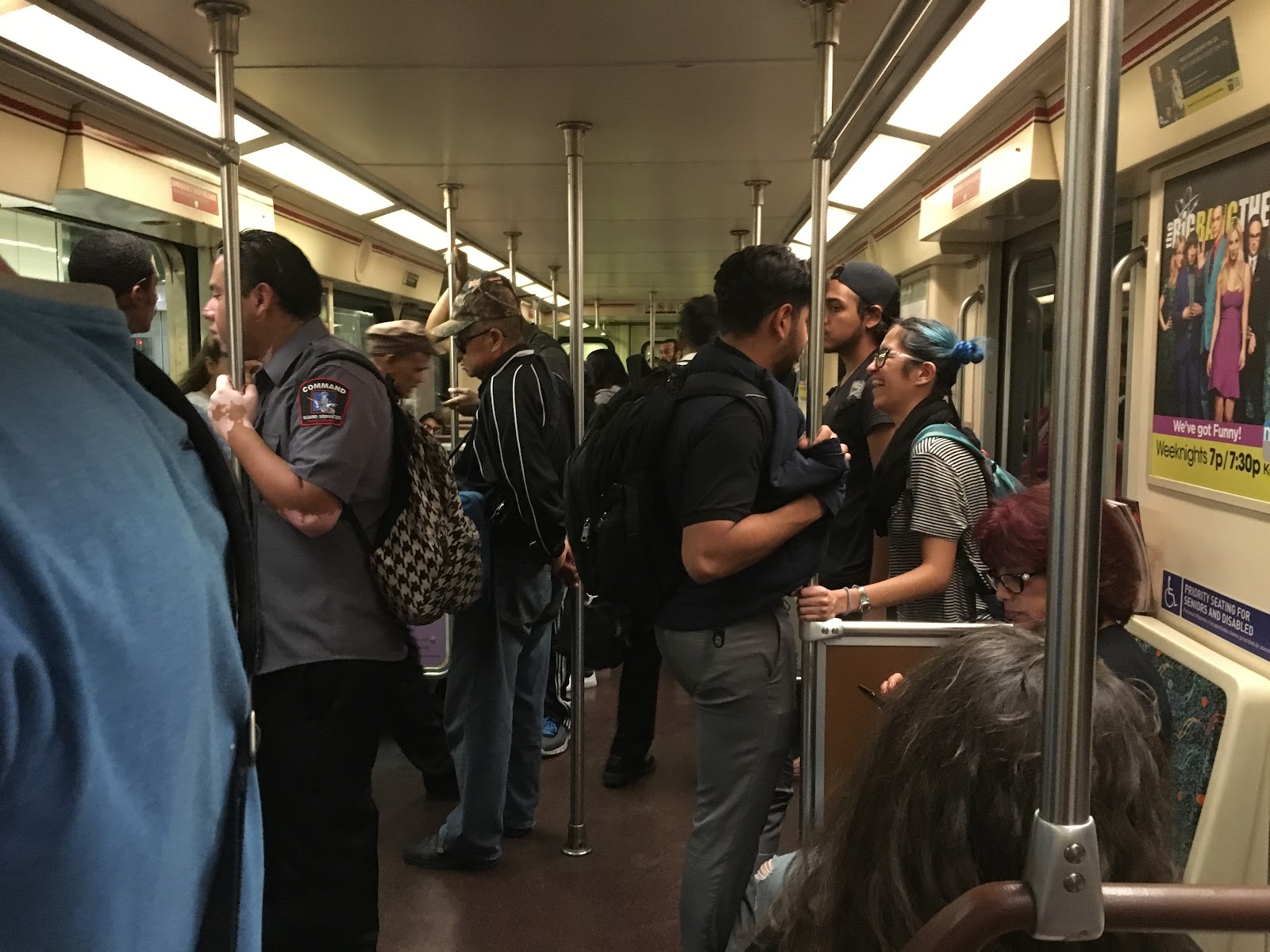
This affects public transportation greatly. It’s no stretch to imagine a lot of people simply won’t ride transit because they’ve had uncomfortable or even unpleasant run ins with mentally-ill people. They were sleeping in every station I visited and riding every train I took, and sometimes this can add to the appearance of dirty or unsafe trains and buses. And compared to many systems around the world, L.A.’s transit is indeed dirty.
Some of L.A.’s expansion of transit will need to address these issues to truly make a dent in car culture. As it stands, according to the L.A. DOT’s general manager Seleta Reynolds, “You can get to 12 times as many jobs in L.A. by car as you can by transit. Not having a car can be tough in L.A.”
How to make a mobility future happen in L.A.?
Perez-Estolano again made a great point: that people will need to almost be tricked into using “transportation options” without knowing they are having to do so.
“There’s power in allowing people to be engaged and participating in things when they don’t even know they’re being engaged,” she said, citing the CicLAvia events that close iconic and busy Wilshire Boulevard for hundreds of thousands of people only on bikes and foot.
And don’t forget about marketing. If there’s one thing we can count on L.A. doing well besides miserable traffic, it’s entertainment. The city is the best transit advertiser in the U.S. – albeit with a ridiculously low bar, but still notable.
“It’s really a lot about marketing,” agreed Gabe Klein, the former leader of both D.C. and Chicago’s DOTs. “In Copenhagen, you get off the plane and there’s a giant picture of a bike and how to use your transit card.”
All transit agencies could be better at making the case for whatever positive claims-to-fame they might have. Klein noted that it’s faster to use Divvy bikeshare for most trips in downtown Chicago than to use the train. Jay Walder of Motivate said the same is true for Citi Bike over yellow cabs in Manhattan. Those notable claims, along with many others, should be better publicized.
No matter where you live, one thing does remain the same. “People are lazy,” said Sean Rhodes of the design firm frog. “People bike in Copenhagen not because gas is $10 a gallon or for health. They bike because it’s the fastest way to get around. As that becomes the situation, you’ve still got to be safe and comfortable, and it’s got to be super easy. We’re energy conserving and lazy and that’s just the way it is. We’re not going to change that.”
Rhodes added another funny sidenote: “People in Denmark say they don’t exercise. But they ride eight miles to work. We need to make the healthy sustainable options the default.”
L.A. is no great transit city yet. The percent of people who take transit in L.A. is equivalent to the percent of people who do so in Buffalo, N.Y., said Gina Trombley from Bombardier Transportation.
But again, the city’s leaders may truly end up setting the agenda for the rest of the country on how to reimagine a world of transportation options that will align with the needs of young and future generations. Many of the speakers at LACoMotion expressed the right mindset – pretty simple stuff, really – as they get started.
“I hope there are mobility hubs where people congregate and create happy neighborhoods,” Reynolds said.
My Sunday in Los Angeles (see my Saturday on the Sunset Strip here) started with a nice little bike ride down to Chinatown from my hotel to get bánh mì sandwiches for breakfast. This is something I could probably do just about every breakfast, especially if it were as good as this restaurant in a back alley with a really friendly mom-and-pop working called Buu Dien at 642 N. Broadway. The owner said they make everything fresh and he took great pride in the two coffees he made for me.
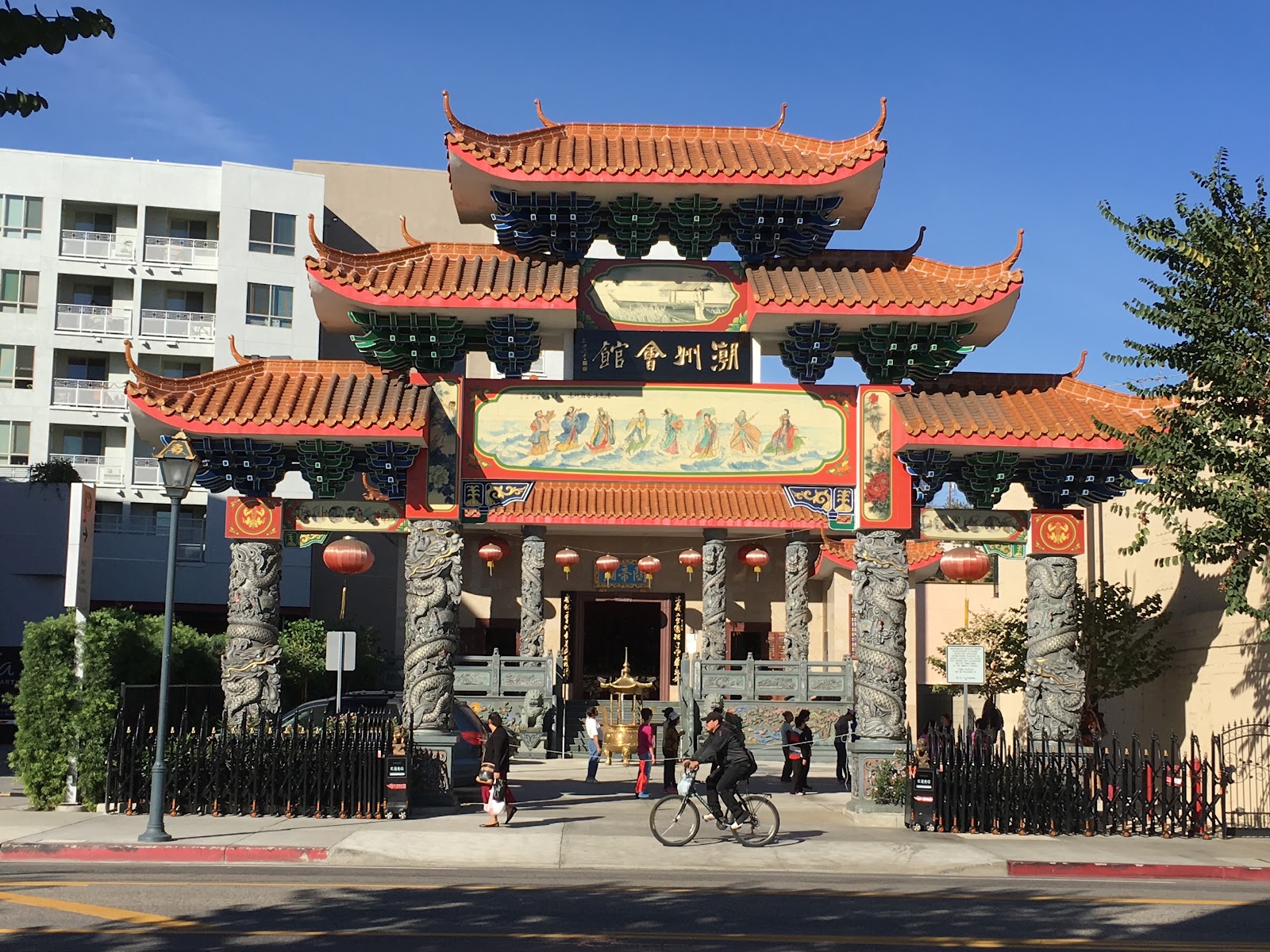
To walk off my full stomach, I strolled the 20-minute walk back to my hotel to catch a little football before going out for more adventures on the day. With the California sun shining brightly, I enjoyed looking at all the municipal buildings, some of which were made extra famous by the O.J. Simpson shenanigans of the 90s.
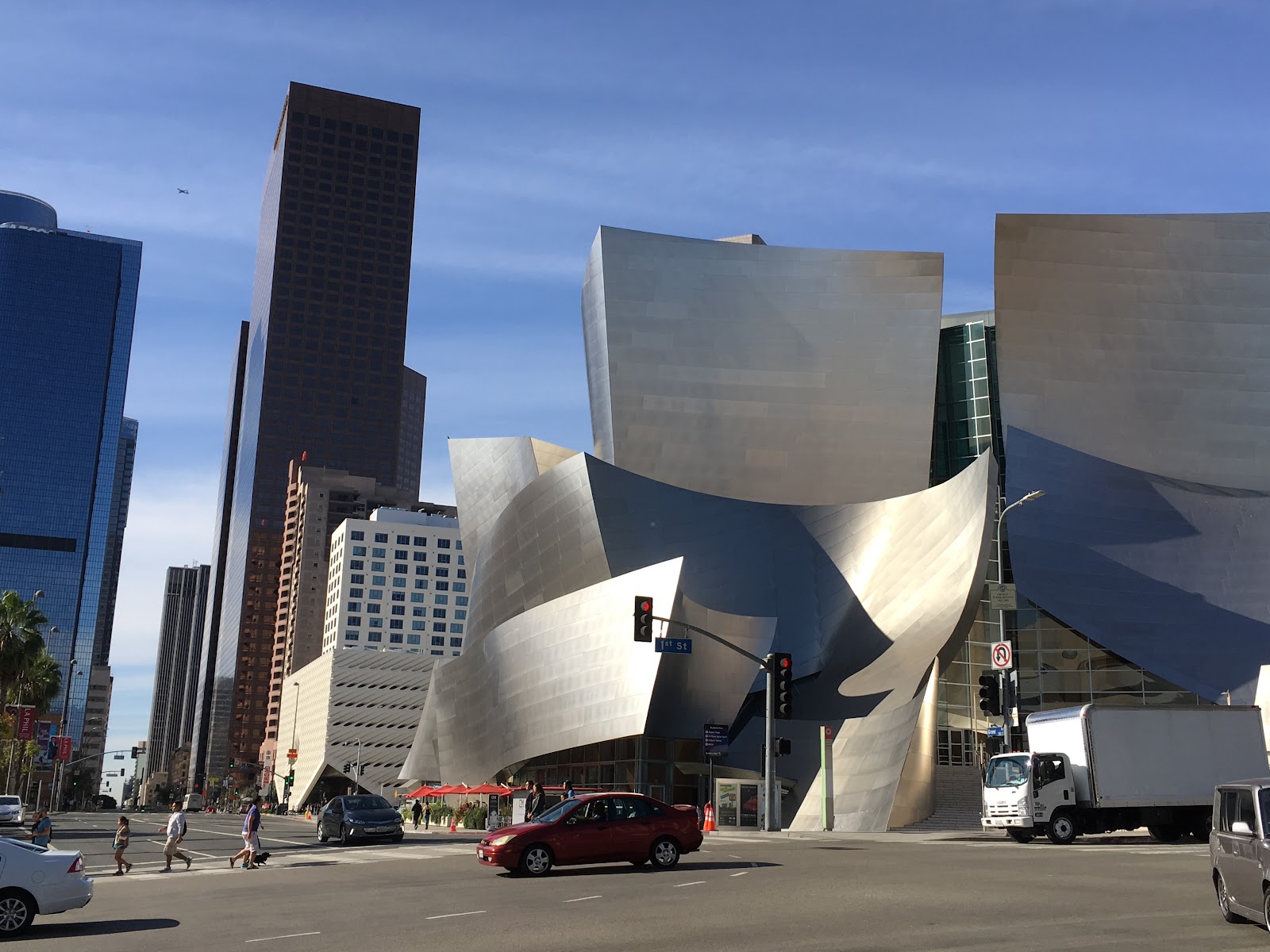
There were lots of other beautiful buildings in my hotel's district, on a high hill in downtown, such as the beautiful modern L.A. Philharmonic structure.
After watching some NFL action, I was off to explore the LA Metro subway, which is a pretty good option to at least some locations around the city. And it often beats staring at traffic or riding in the Uber and Lyft cars whose drivers here all seem to have not gotten the memo to lay off the man cologne.
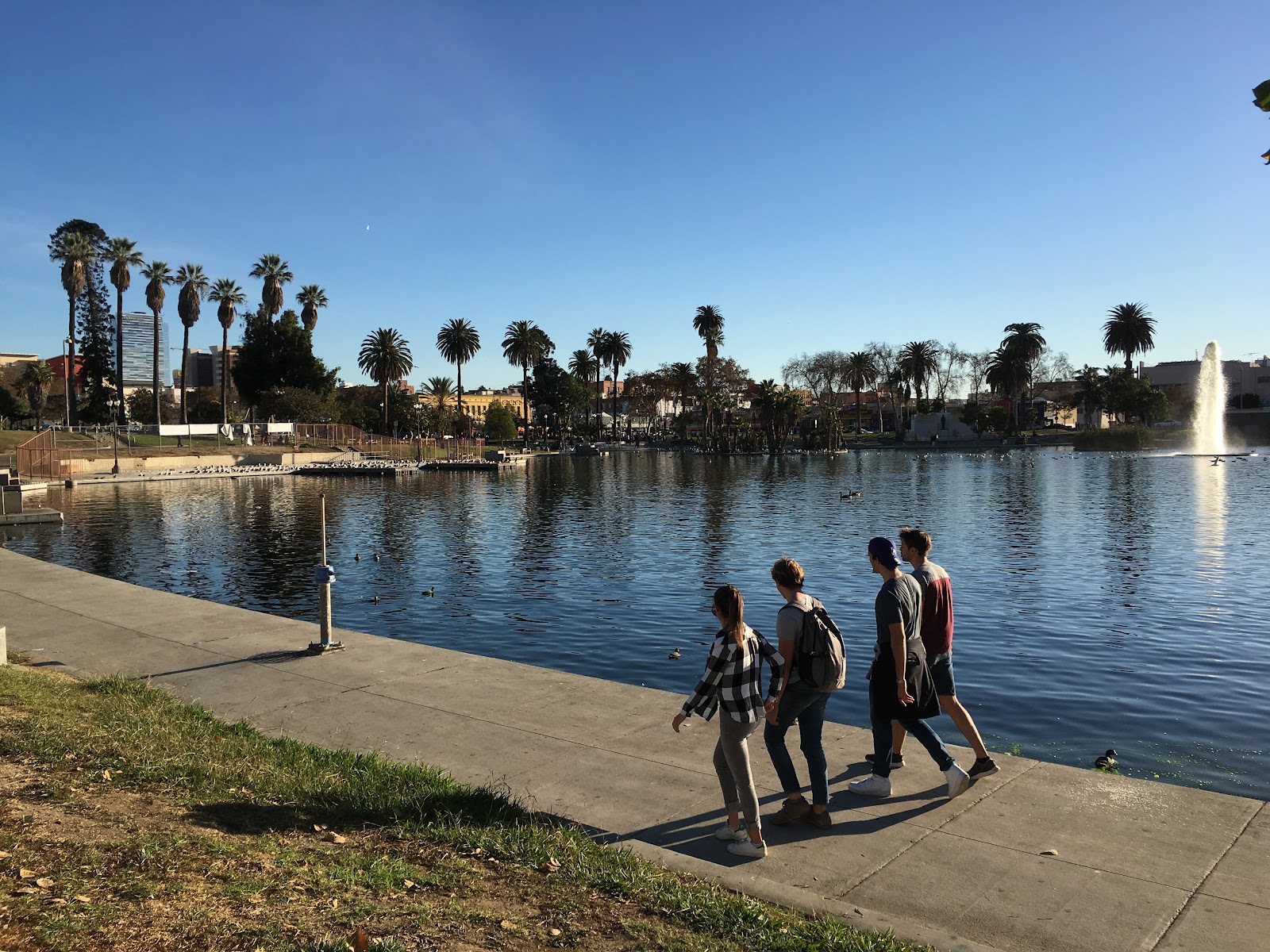
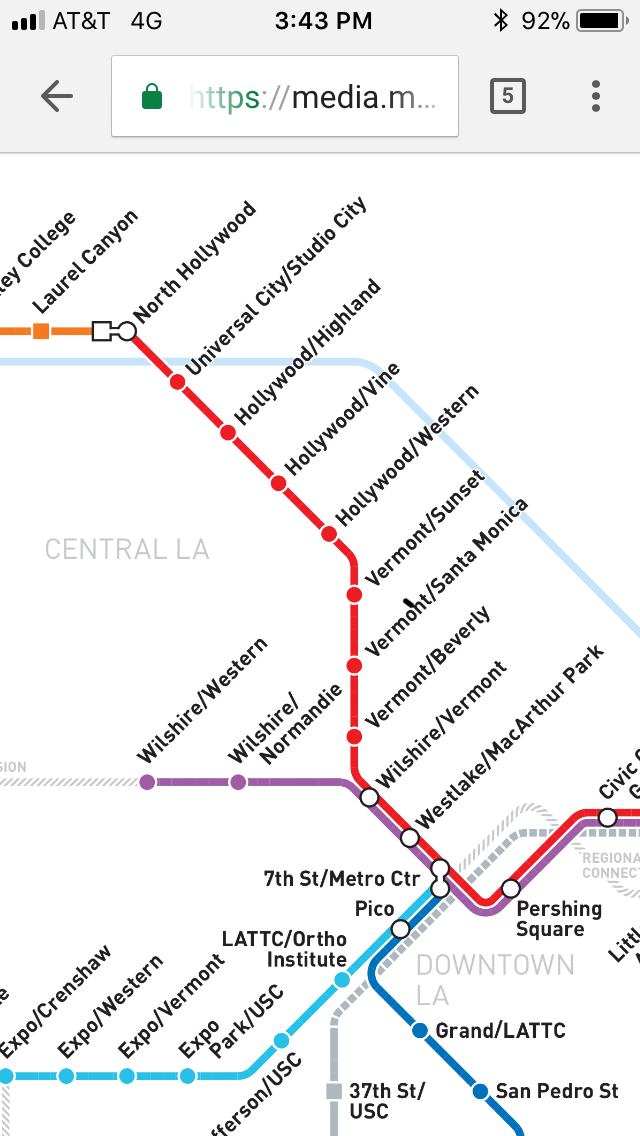
I took the Red Line two stops up from MacArthur’s Pershing Square to get out and walk at Wilshire/MacArthur Park. I didn’t know anything about MacArthur Park except for the Donna Summer song. But now I know that it’s a filthy place bathed in pigeons everywhere, dirty sidewalks, and at least one dude peeing very much in the wide open. That said, it’s well worth the walk, with the L.A. skyline in the background and the palm trees dotting the park and its large body of water.
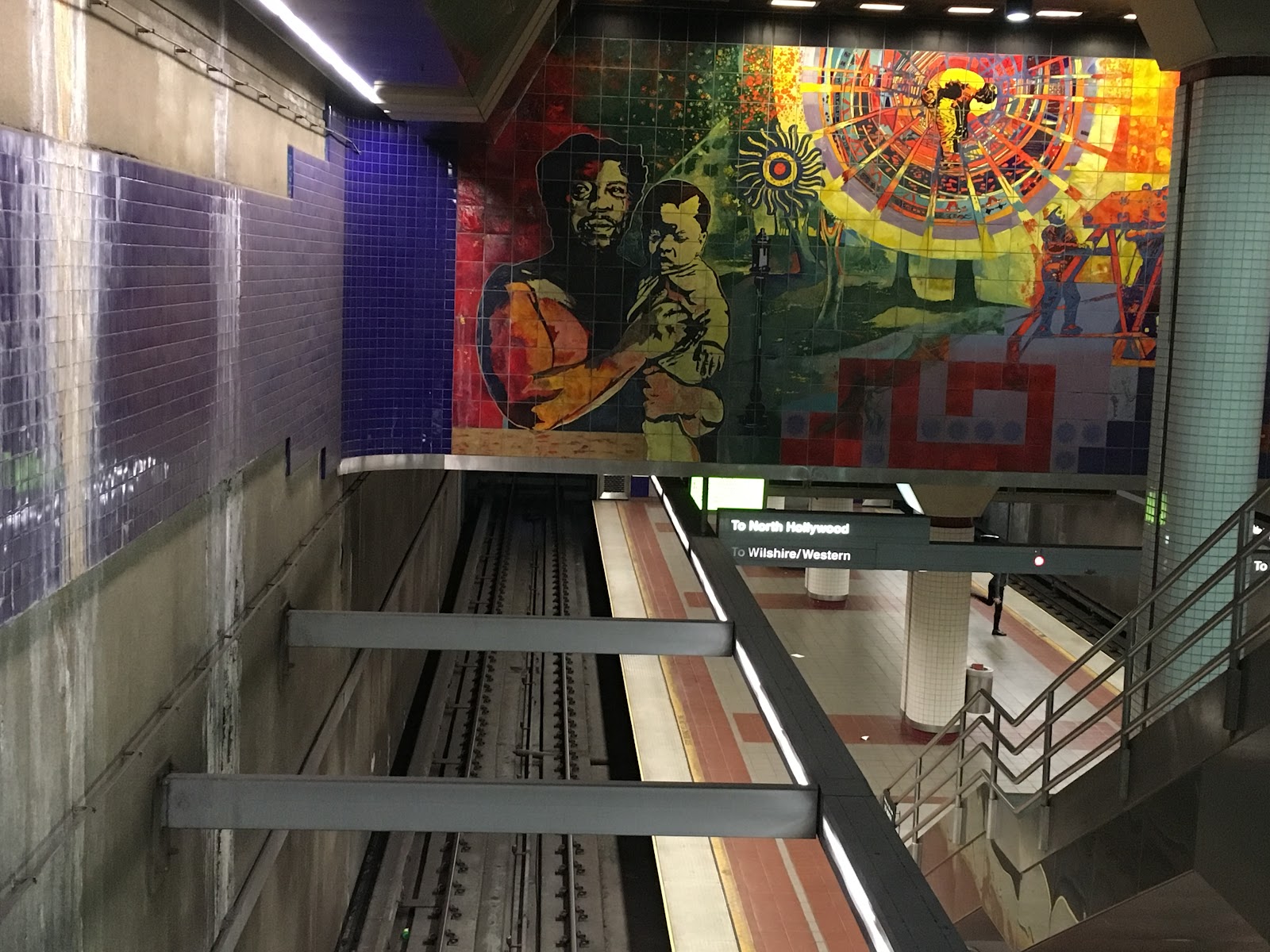
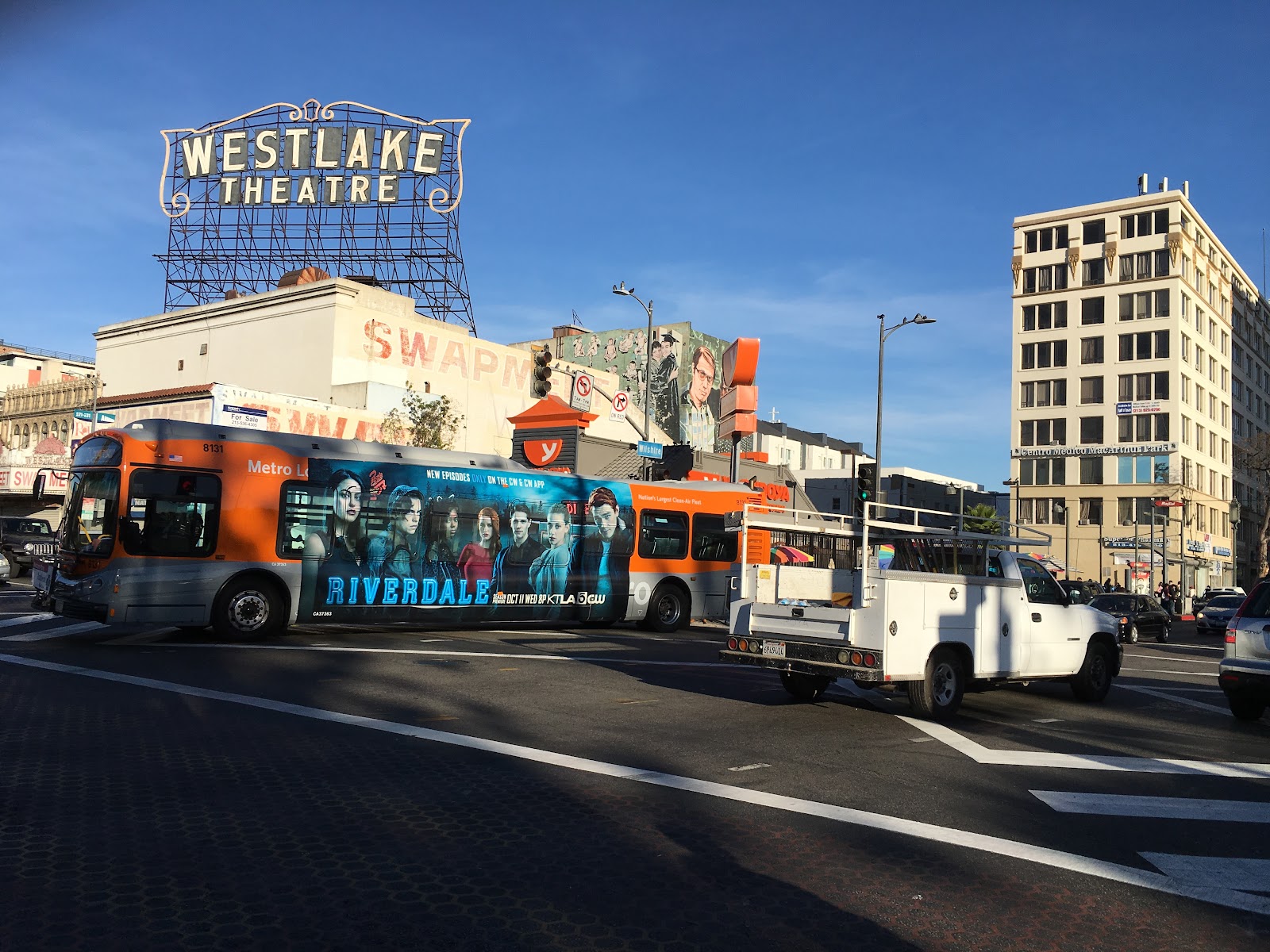
One reason why the Metro clearly becomes less of an option for people is that the stops are pretty darn far apart, even for someone in relatively good shape. My walk from the Westlake/MacArthur Park station to Wiltshire/Vermont took a solid 20 minutes, and the latter station itself is tucked back in a corner off the street and down a long elevator.
I recently read that this is one of the most walkable stretches in L.A., which is true, since there are wide sidewalks and good crosswalks. But I also sense the bar here for "walkable" is set rather low.
But the trains themselves, once they arrive and get going, other than the serious homeless problem everywhere, including at transit hubs, are really fast and pleasant.
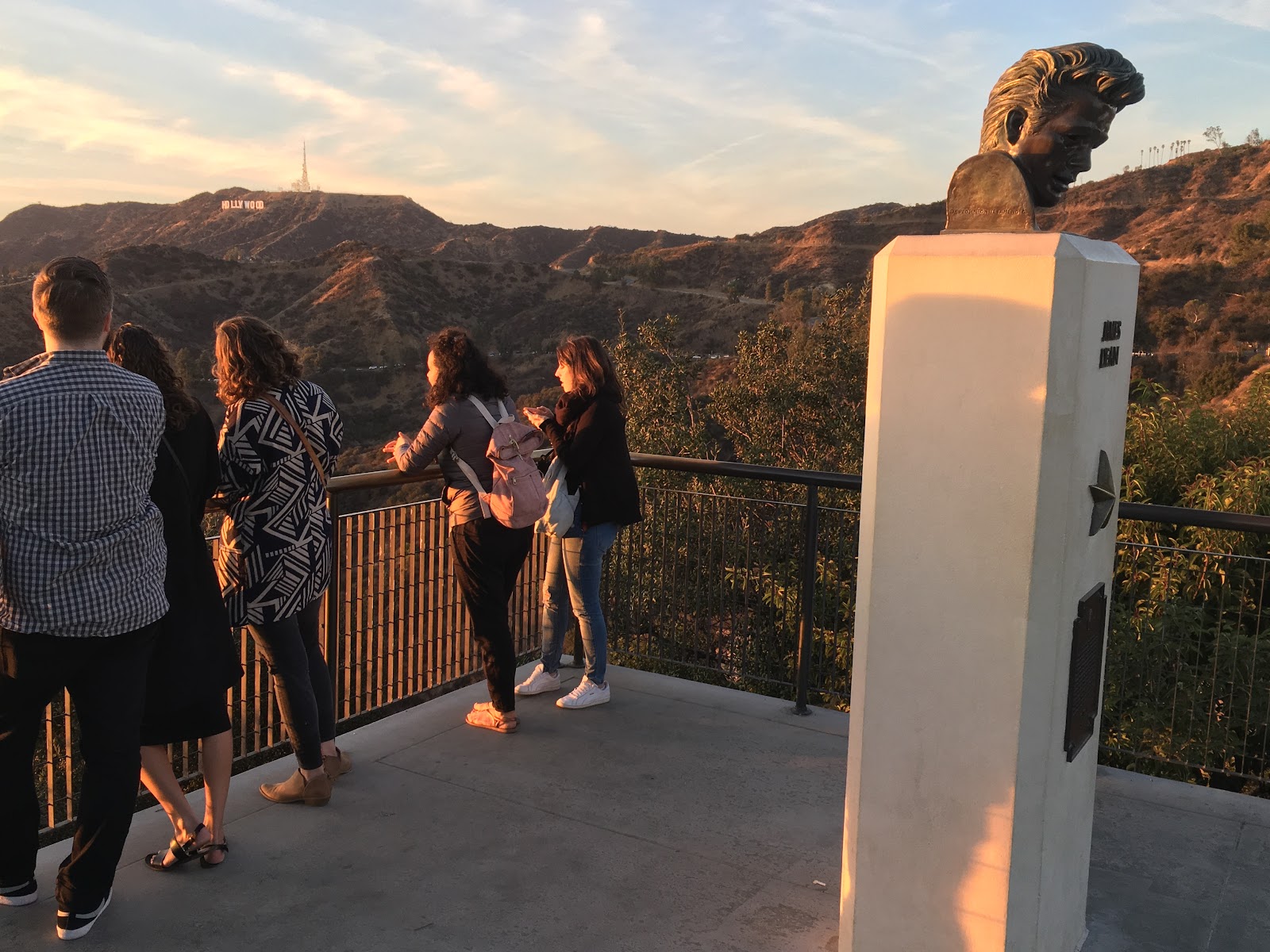
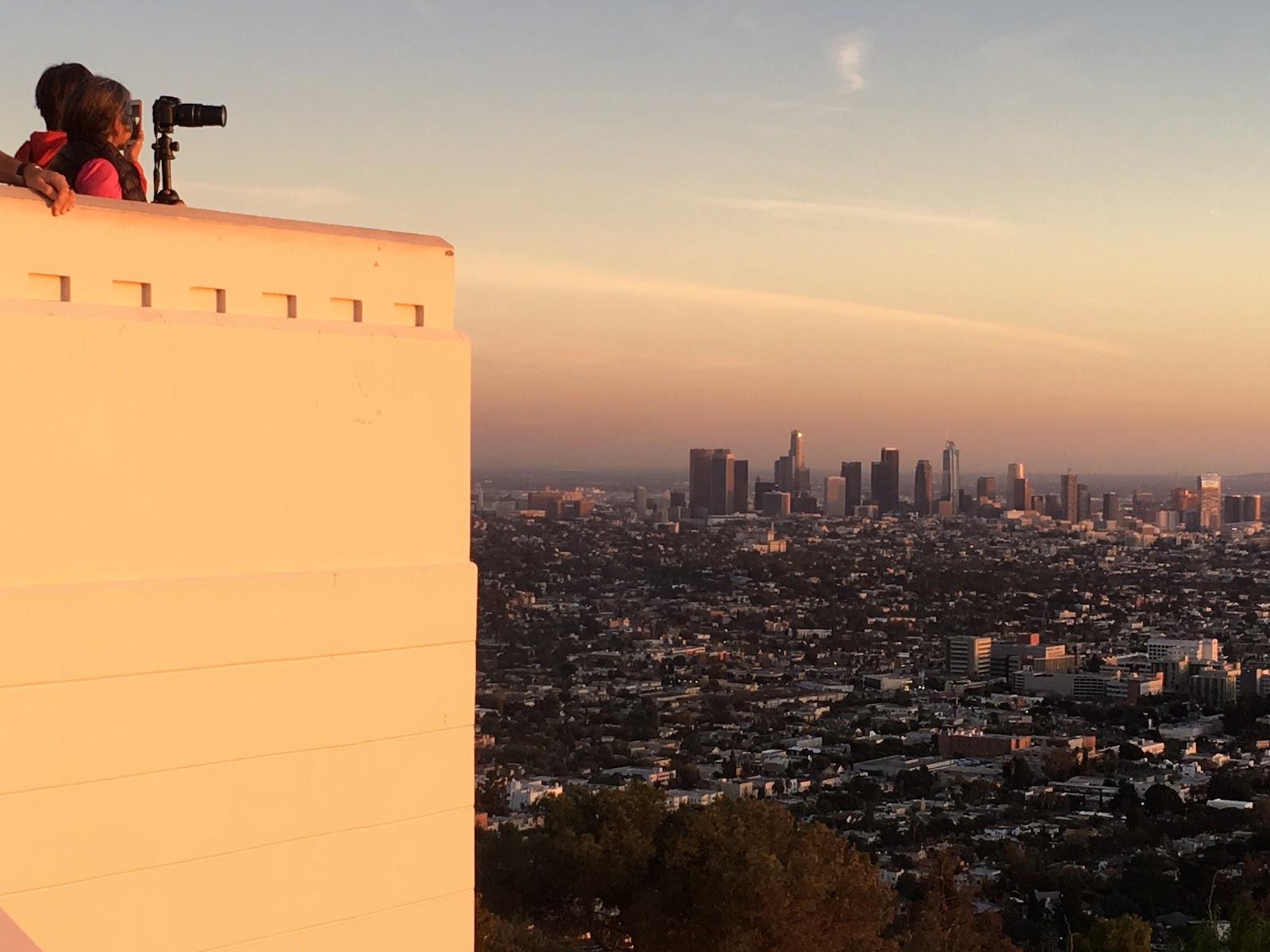
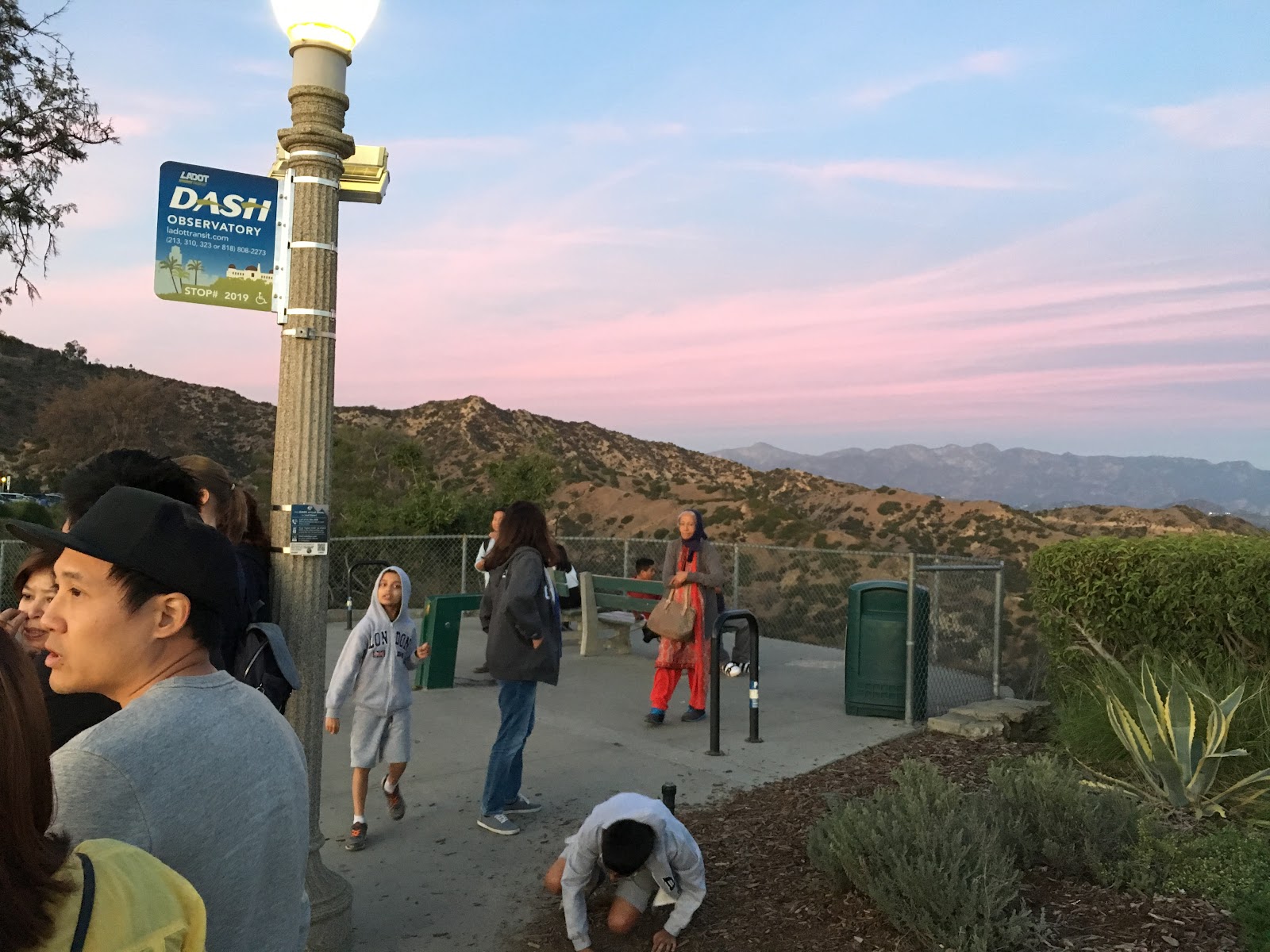
I decided I wasn’t going to miss the sun set and what better place to go than Sunset Boulevard? As I exited the Vermont/Sunset station, I noticed a sign for a 50-cent DASH bus to the Griffith Observatory and Hollywood sign, so I jumped on it (they run frequently).
The lines to and from the observatory are outrageous, but the public-transportation combo of train and bus was actually probably the best way to go. I was in and out in an hour or so. And then it was off to take the train back to my hotel to pack it in for the night on another action-packed day in L.A.
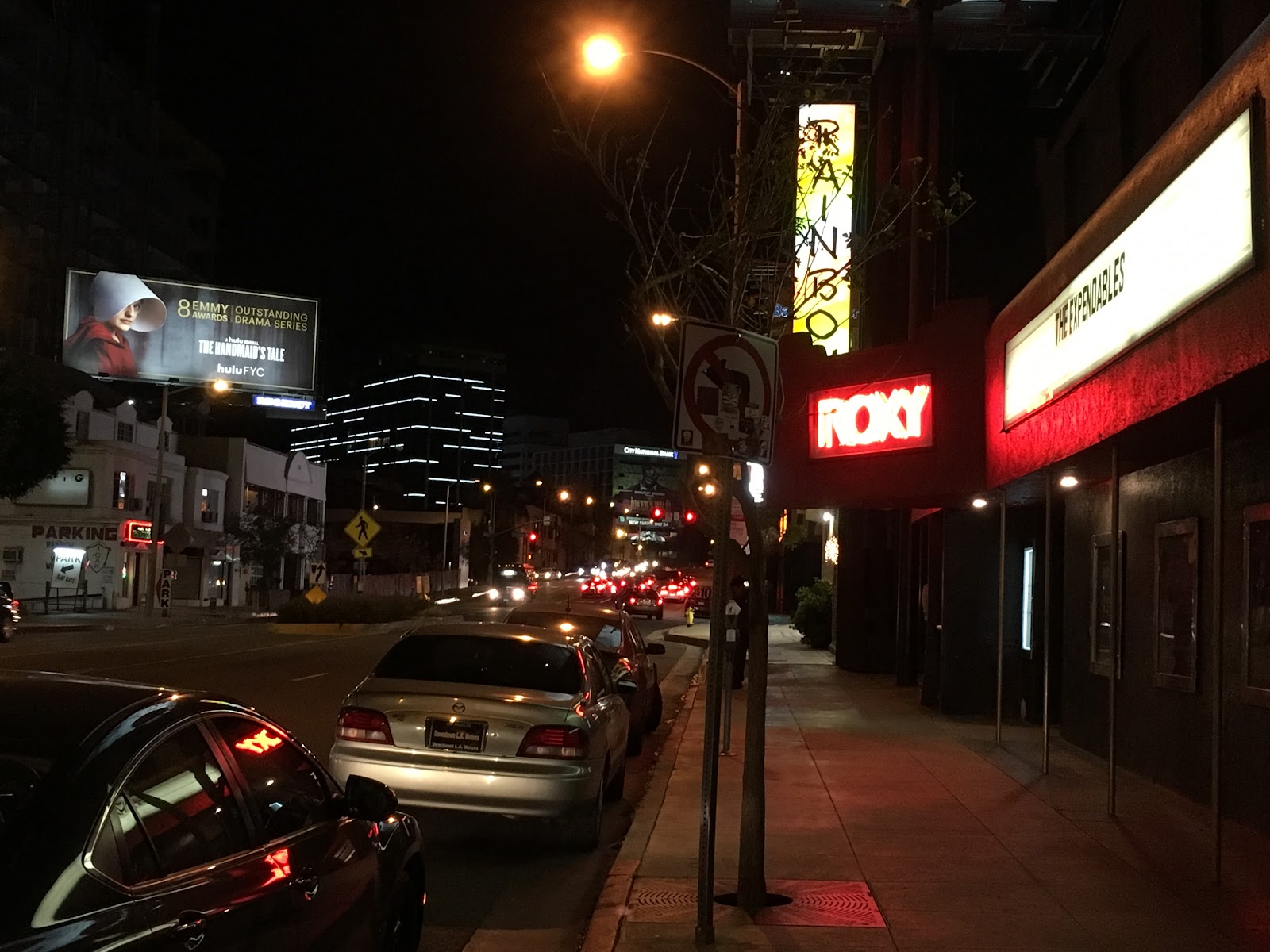
With most of the LACoMotion conference I was attending in the books, I started my Saturday night walk down the length of the Sunset Strip by getting dropped off in my Lyft at the Roxy, starting on pretty much the far west end of West Hollywood. The place is famous for many things (including the wacky Will Ferrell comedy Night at the Roxy), but mostly for giving Pee Wee Herman his start, serving as the home base of John Lennon's "lost weekend" of the early 1970s, and being madam Heidi Fleiss's hangout in the 1980s.
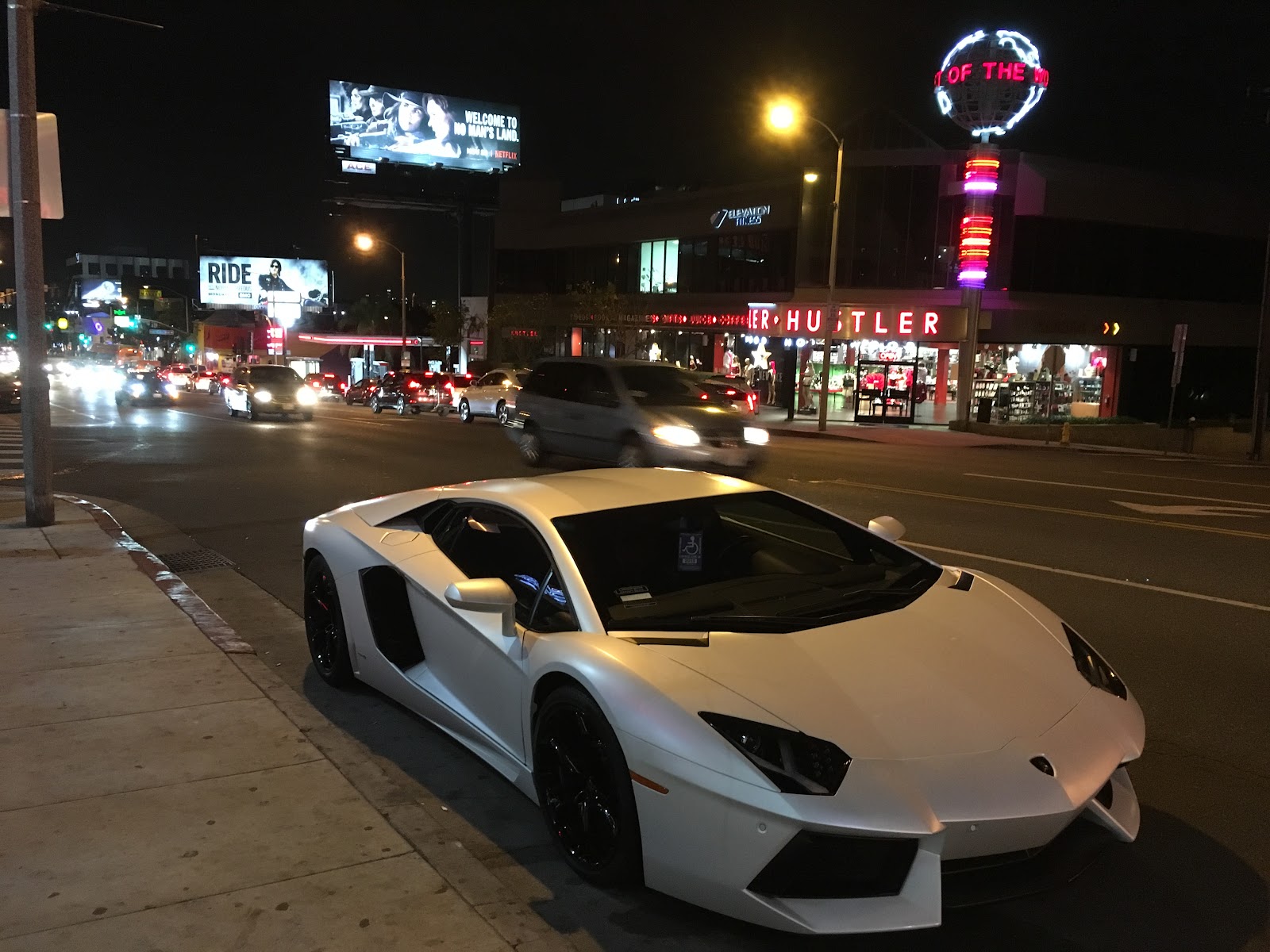
I had planned to take public transportation but it was just going to be too long on the bus, so I endured the infamous Los Angeles traffic, exemplified most by this kind of excess (fast cars and Hustler mega-shop).
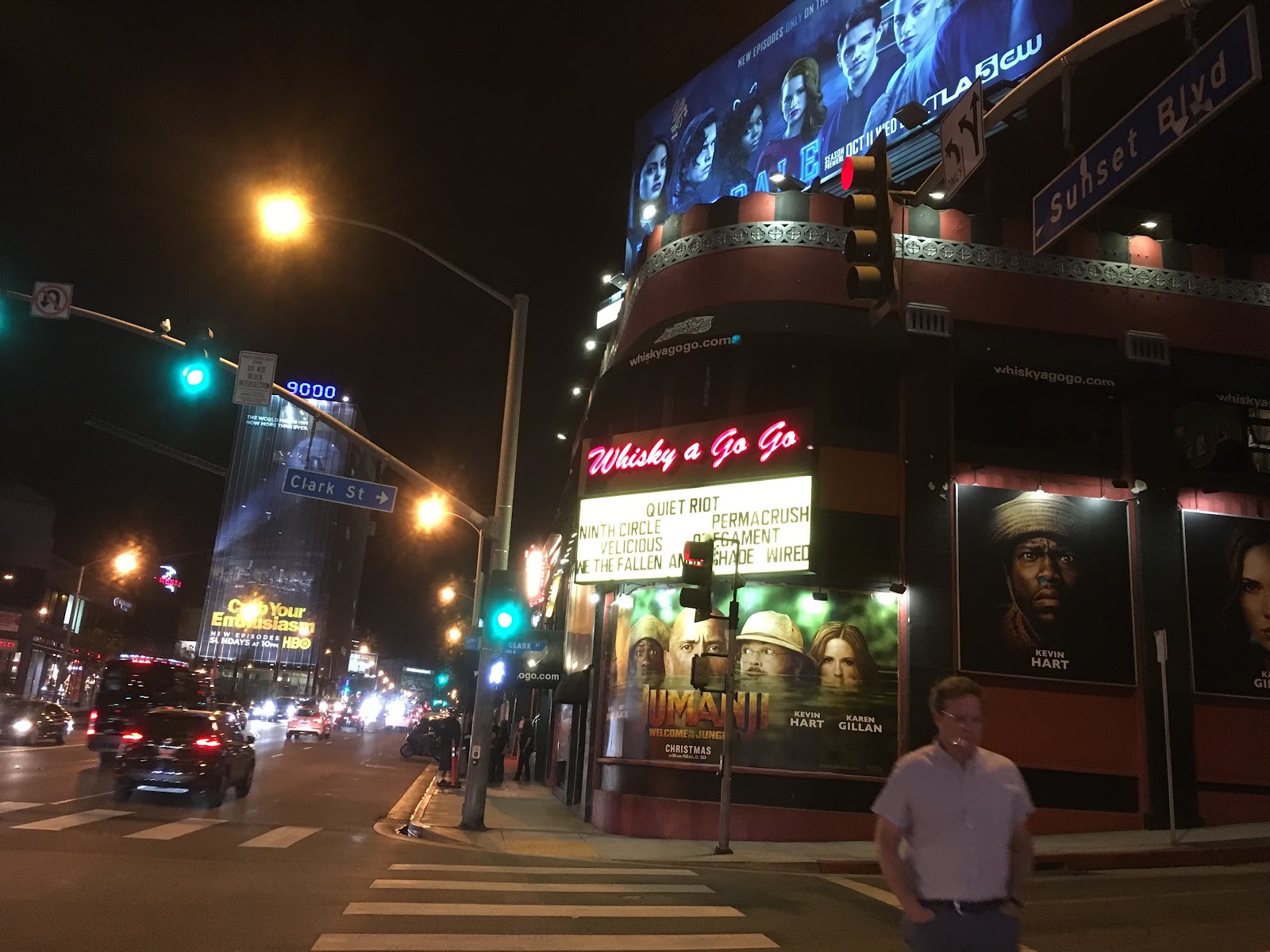
Next up, right down the street from the Roxy is the Whiskey a Go Go. Quiet Riot was on the bill this night, although such a show would be no match for previous ones, like when The Doors got fired as the house band after playing "The End." The Whiskey recently started a channel on Roku with lots of their best concerts available to view.
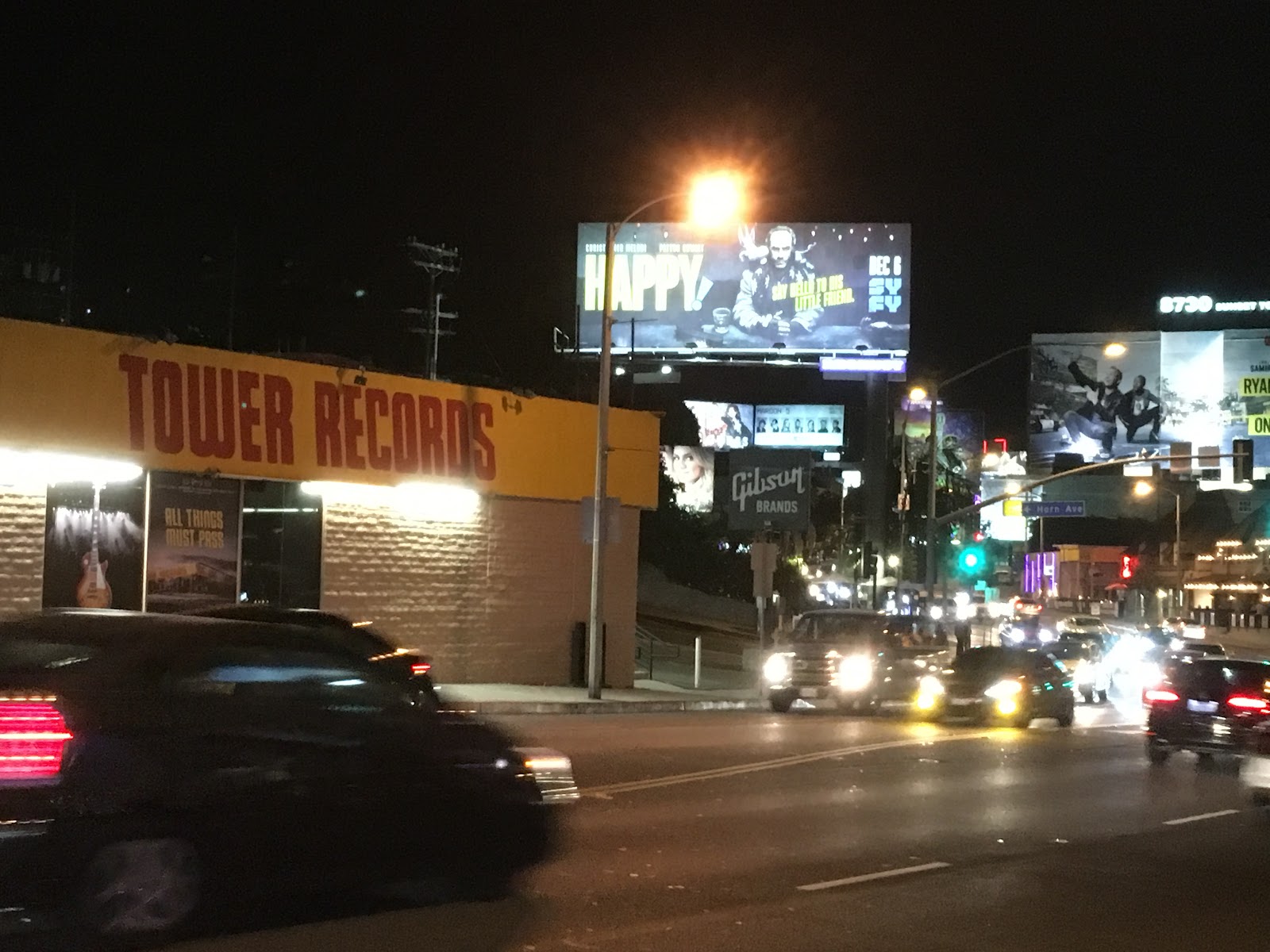
And then the old Tower Records, which, even though is sadly long closed, remains in place as an historical landmark.
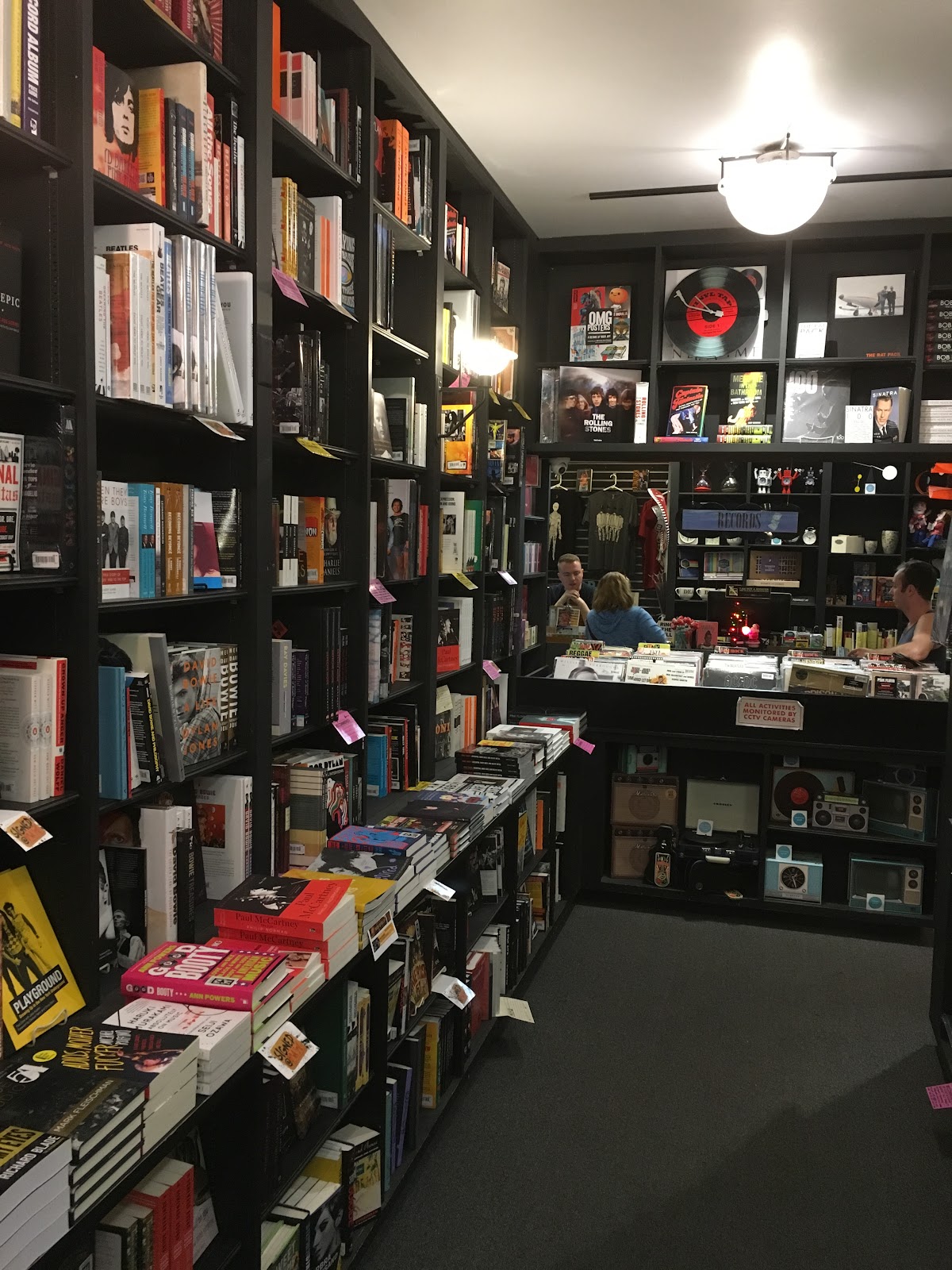
And right across the street, there’s Book Soup, billed as "the bookseller to the great and infamous." Fittingly, it has a pretty killer selection of music books and albums.
Up next, I walk through Sunset Plaza, which is a strip of upscale shops, with every other person looking like someone who might be famous. I have less interest in this than I do the area continuing on eastward that gets back to being a little grungier. It also starts to look pretty cool with houses pocked all over the hills above.
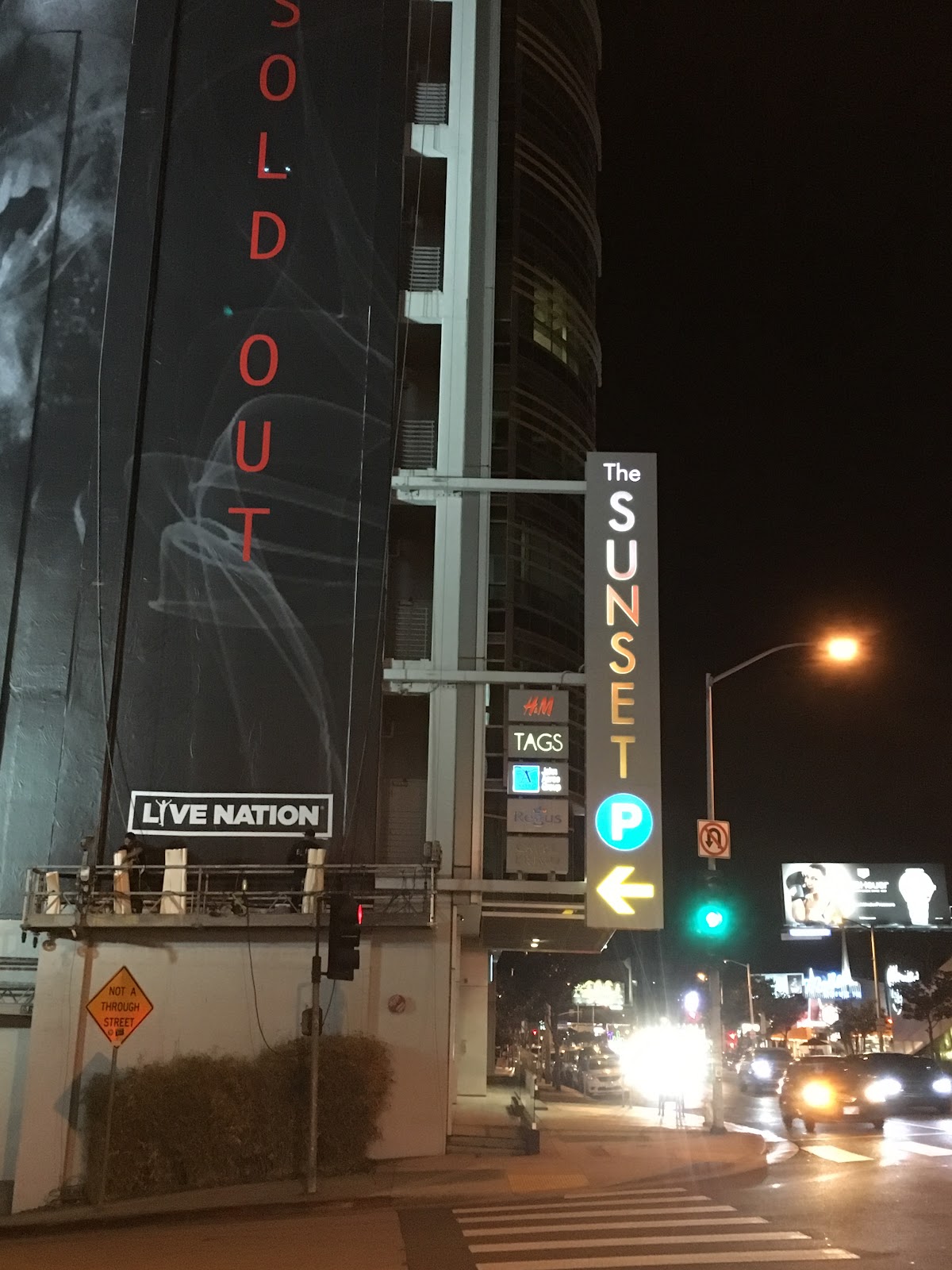
Oh, and by the way, this is how all those huge movie and entertainment signs get posted around town. These guys were pasting this one to the entire side of this building.
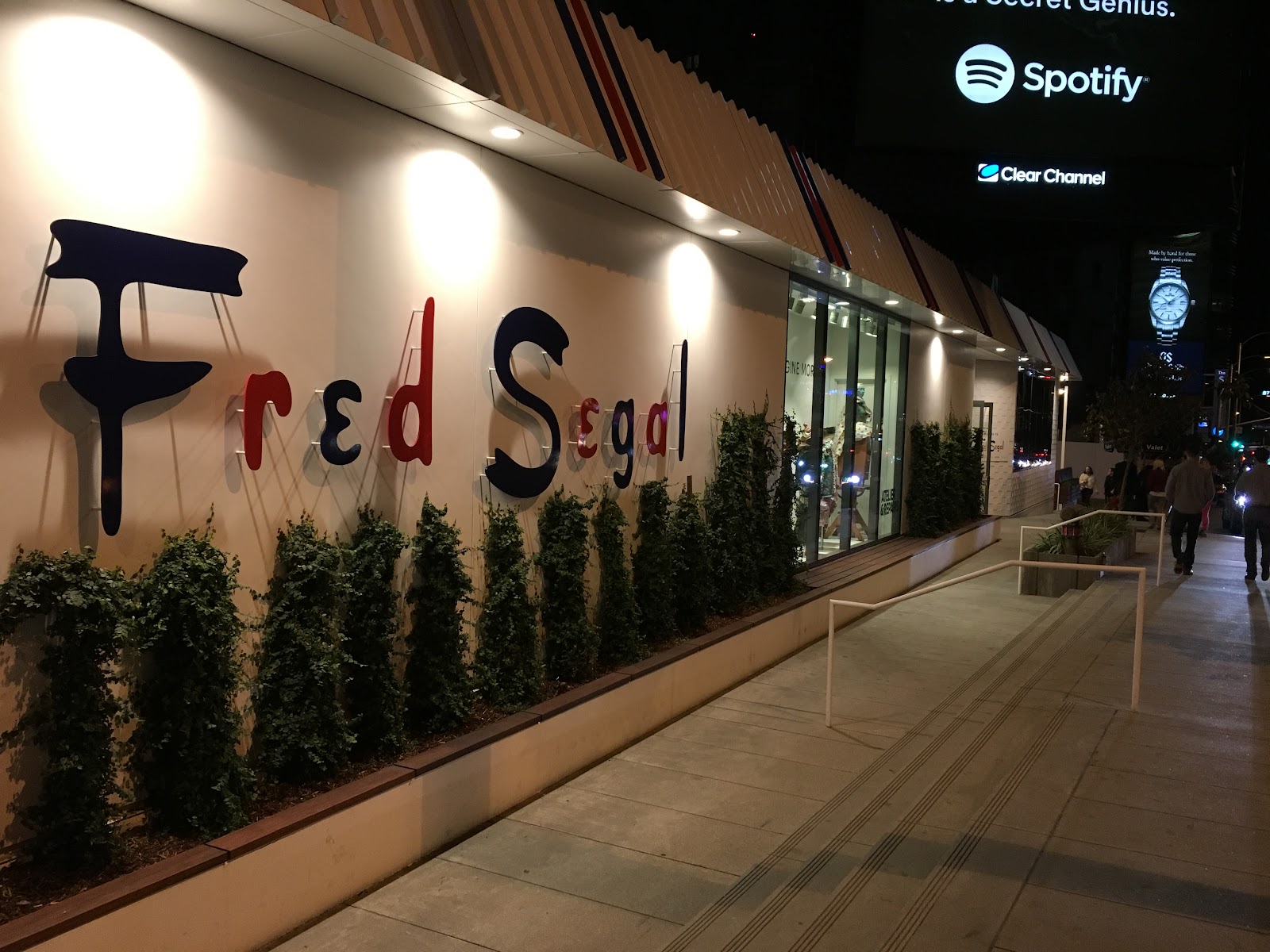
The Fred Segal is supposedly a hot place to spot the stars, but I had little action to report. Perhaps 7 pm on a Saturday night is not quite the ideal time to be walking past.
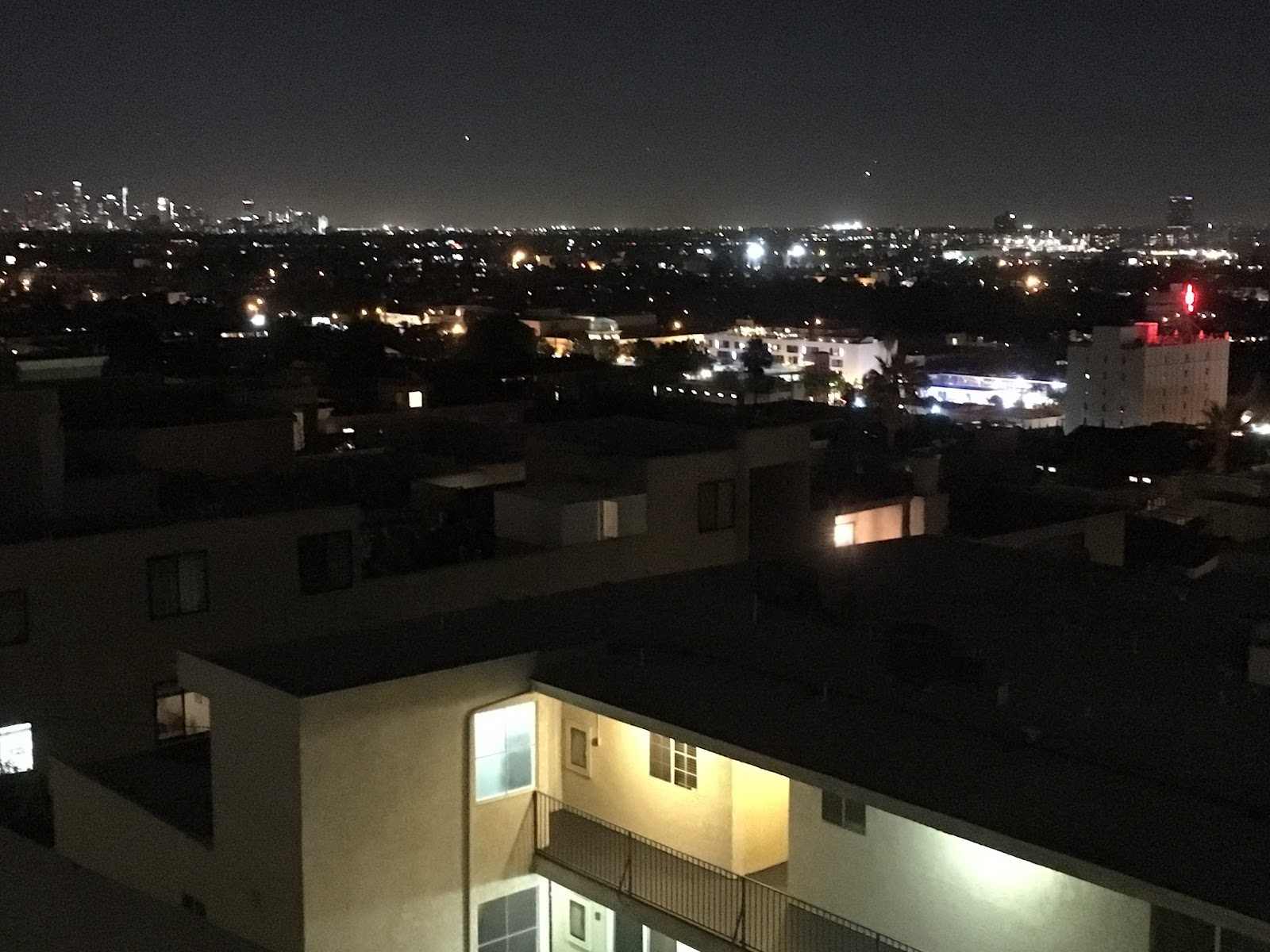
Then the highlight of the walk might just be an overlook nestled back behind some buildings just to the east of La Cienega Boulevard, which runs straight south for as far as the eye can see. Off to the west you can see the skyscrapers of West L.A. and the UCLA area. Continuing scanning onward towards the east, it’s amazing to see just how far downtown is. I think of how it will be an epic trip back there, as the plan is to continue walking on Sunset another two miles until Il get to the Metro Red line.
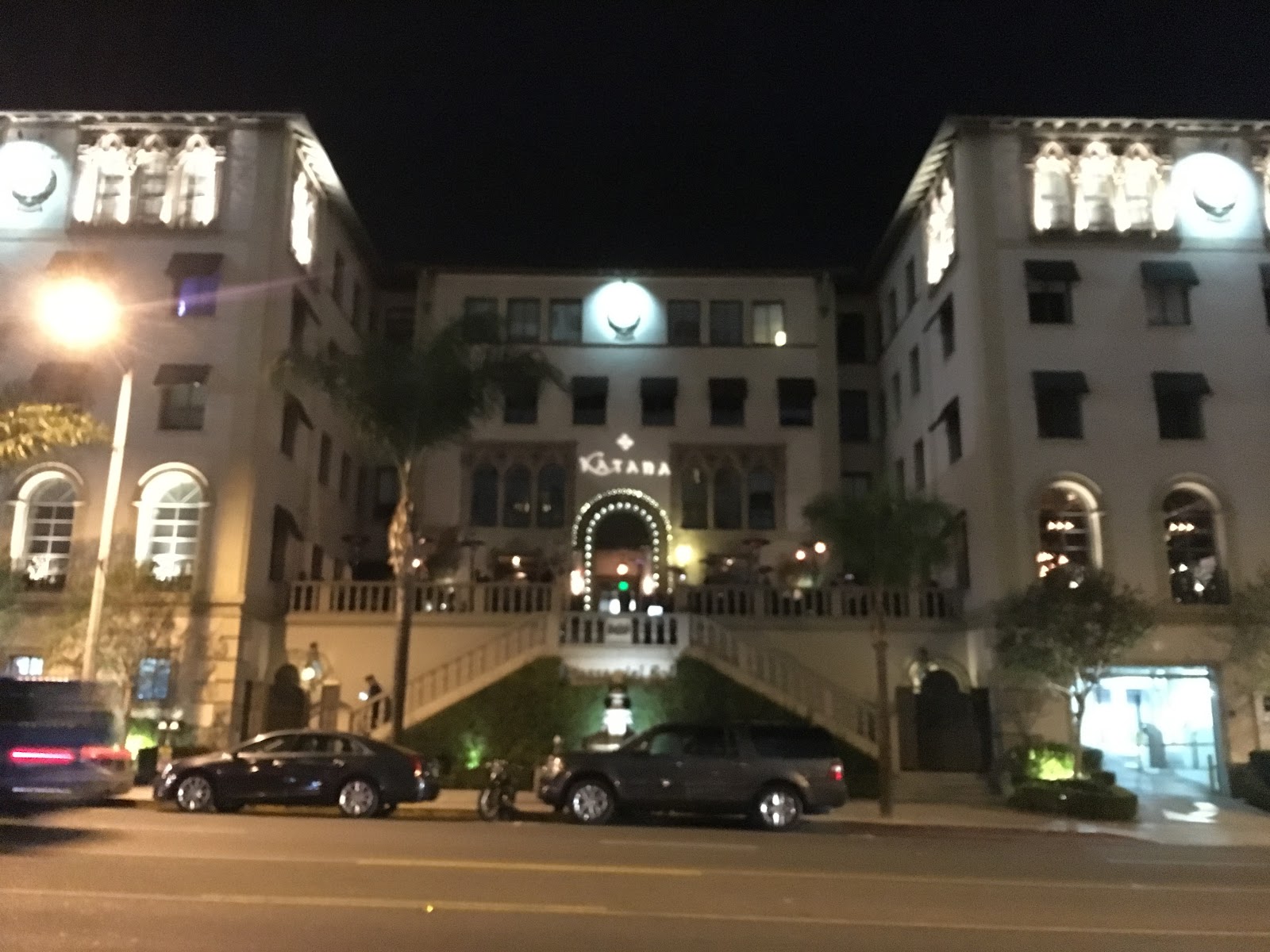
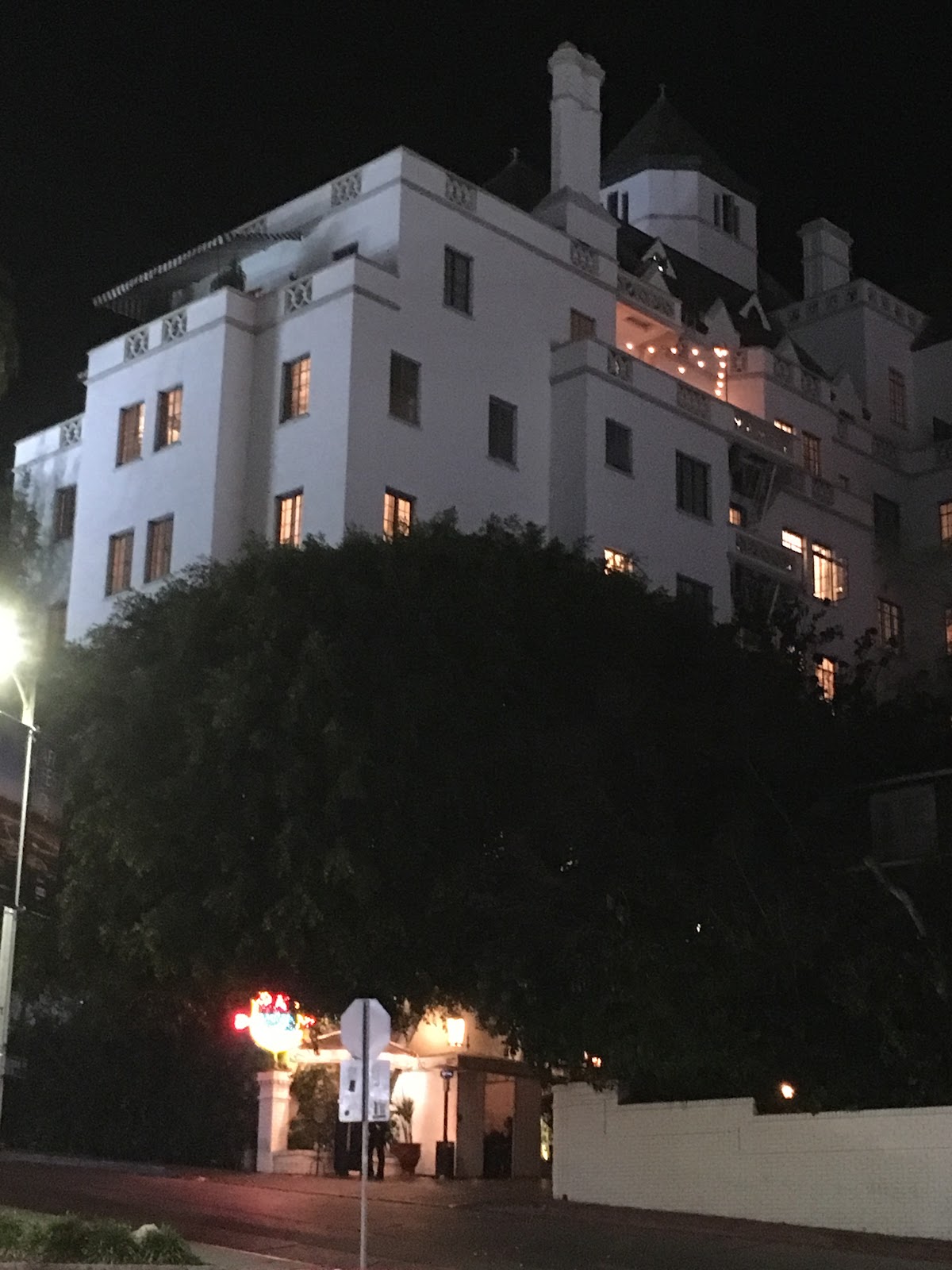
Continuing along, I get to some famous landmarks for lodging, with this ungodly hotel and then the famed Chateau Marmont, where John Belushi died of an overdose and which was featured in Oliver Stone's movie The Doors.
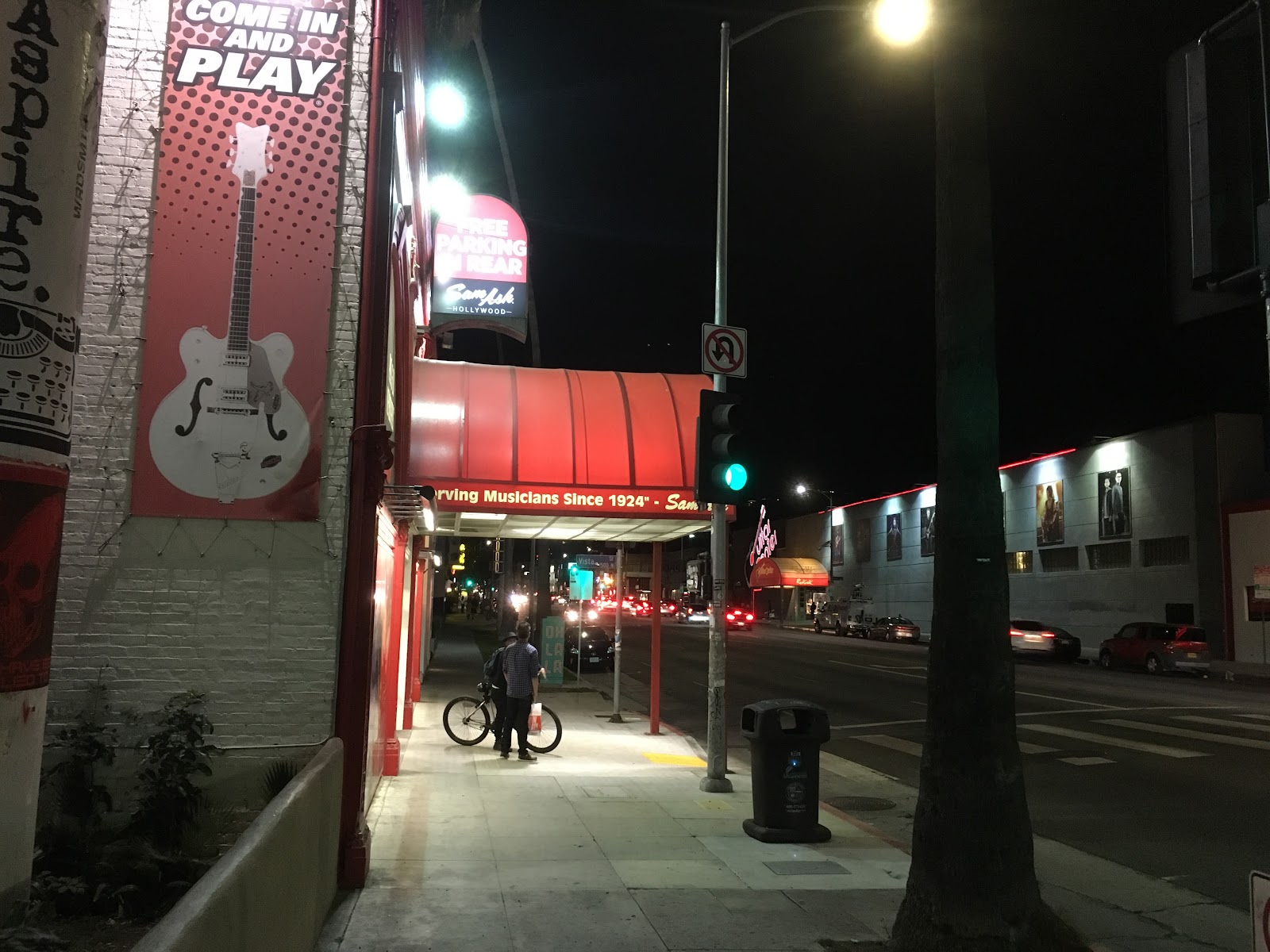
There’s a long stretch for a while with not a lot except for a nice cool breeze in my hair and palm trees. Then I came upon a stretch of music stores that I bit my tongue to keep from going in, worried I would get lost and never want to leave.
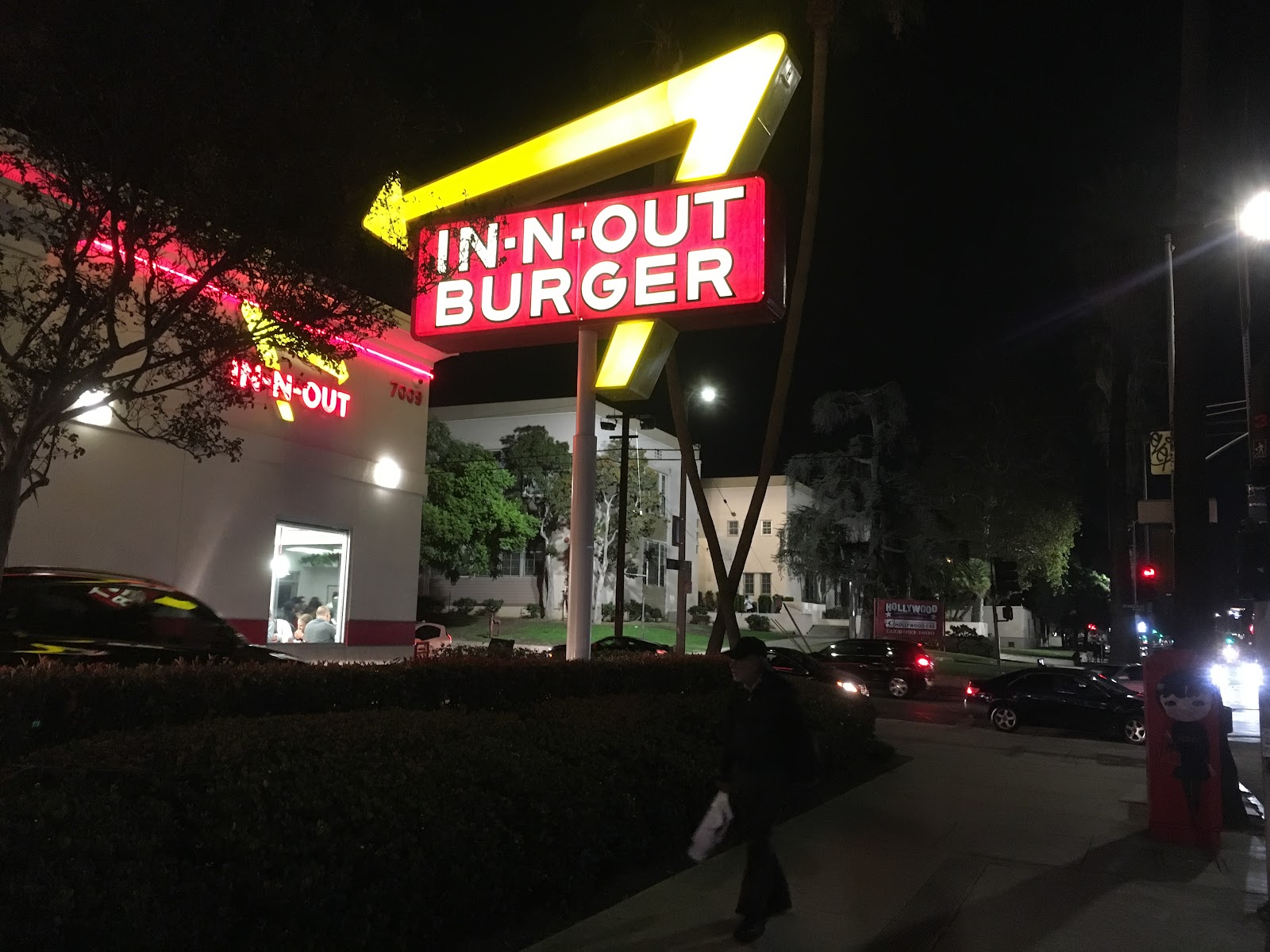
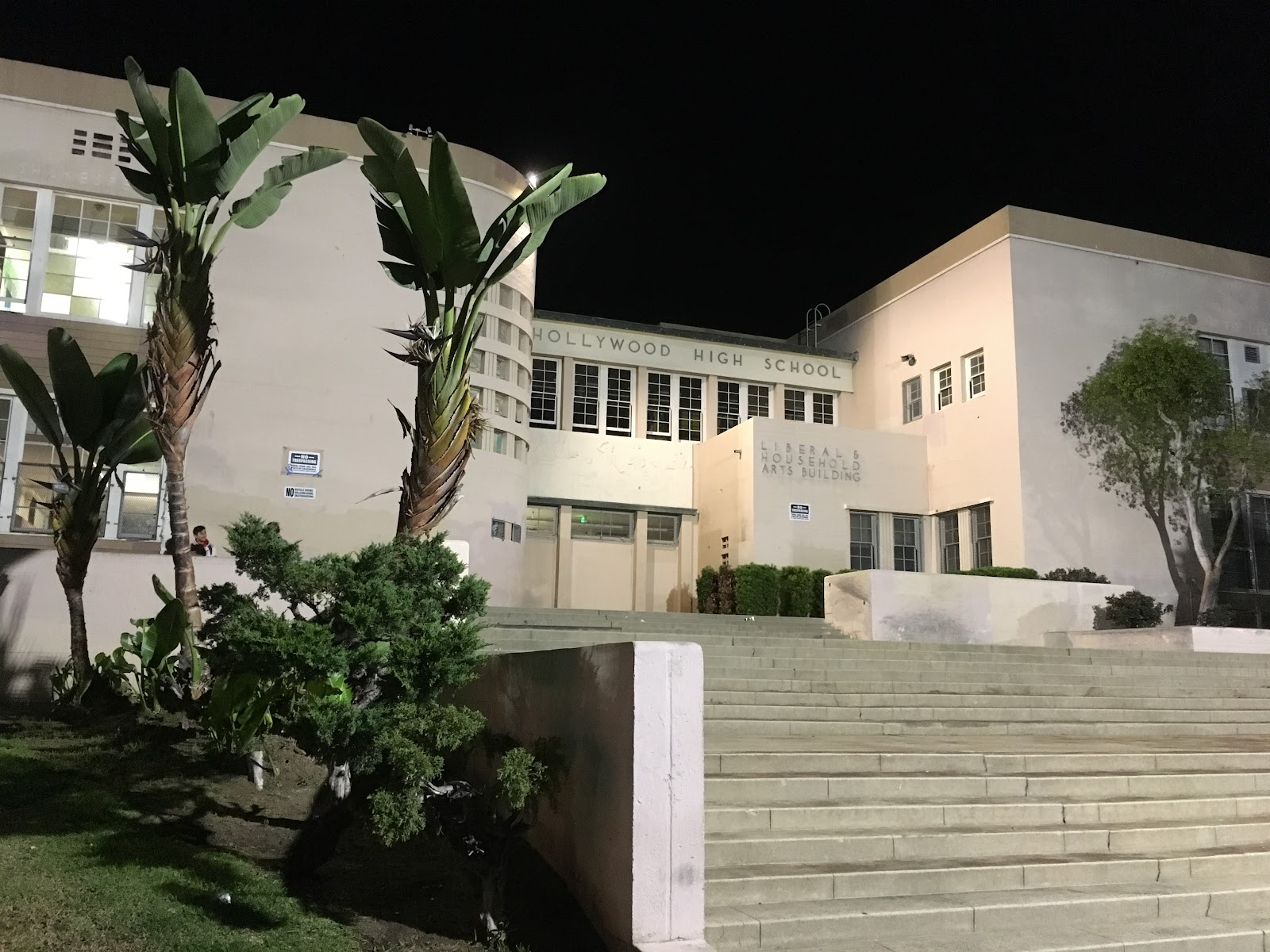
Coming towards the end portion of my walk, I bypass In-N-Out Burger next to Hollywood High School. I’m getting so hungry, but I keep walking.
I know I should go to the hotel Roosevelt, with its rooftop bar, but I can’t stomach paying $18 for a not-very-good drink that everybody online says I would be in for.
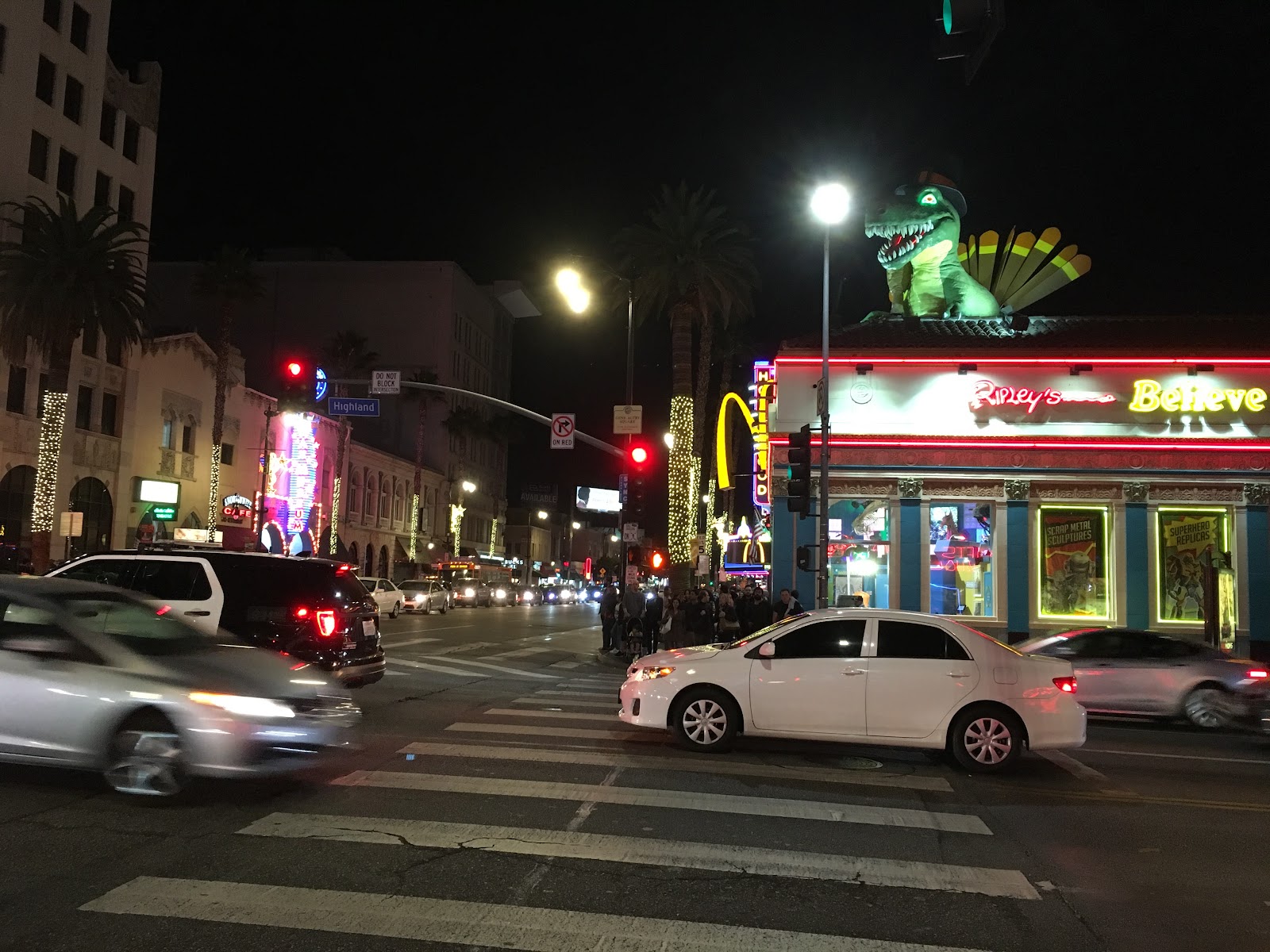
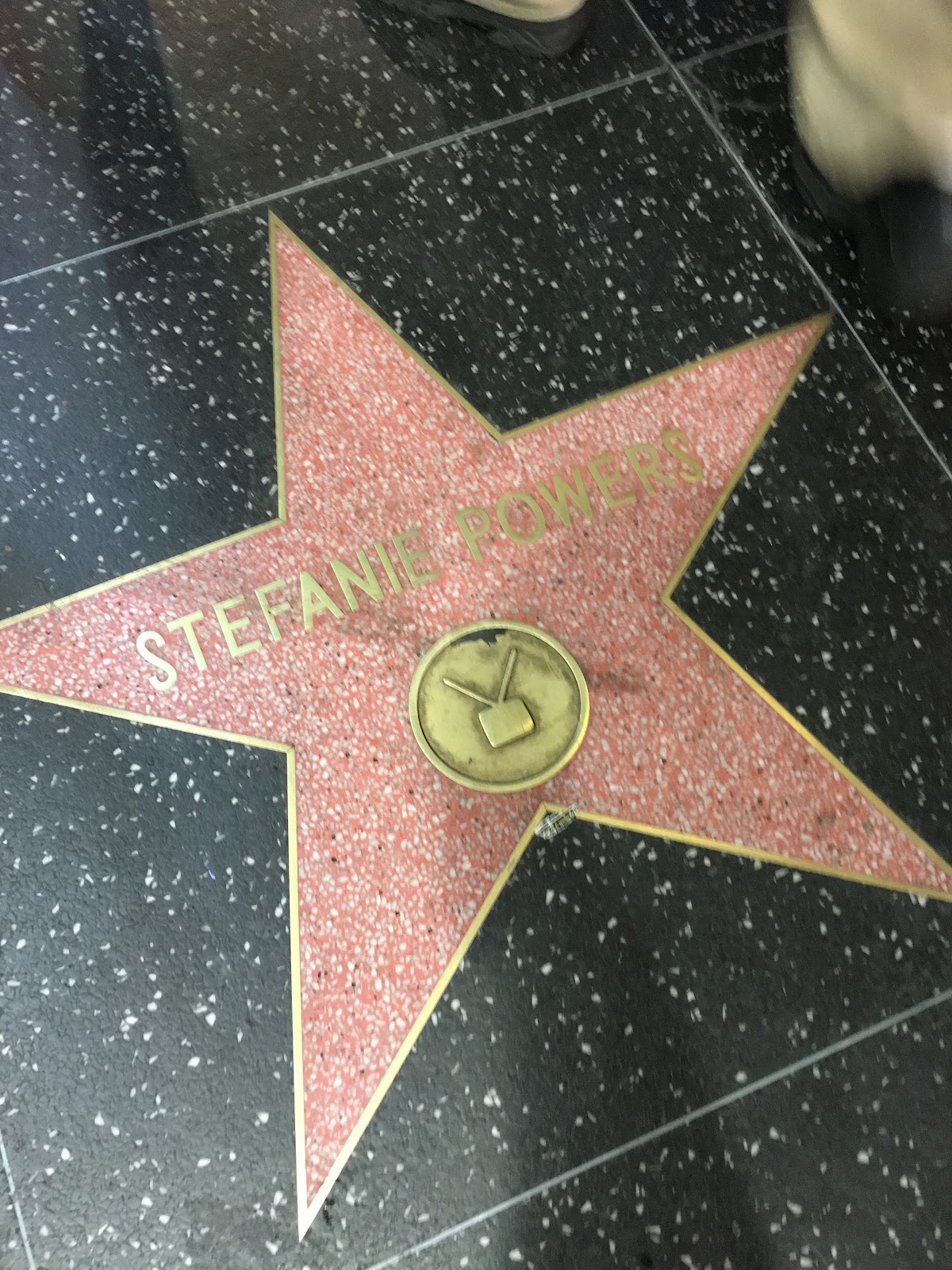
Going from the Sunset Strip over to Hollywood Boulevard, I enter a whole different world. I wasn't expecting such a mass of people at the intersection of Hollywood and Highland. And of course, the stars on the Walk of Fame cover nearly all the sidewalks. The historical society apparently gets about $30,000 a pop (pay to play) so they will take you if you apply. I was perhaps most impressed by Stephanie Powers, right in front of a McDonald’s. Jonathan Hart would be proud.
Risking all, I ate next to the homeless kids at the Hollywood and Vine Metro station at a place called Wood & Vine. Not a great choice, but it got my stomach filled for what is a pretty quick Metro ride back to downtown.
So weird, I was walking past the Church of Scientology tonight at the same time Charles Manson died. And had also been considering going to the Spahn Ranch before I came back to my senses.
This blog has made reference to Charles Manson no less than six times, now seven, since it began in 2009.
Her was nominated for best picture at the Oscars last year and rightfully lost to 12 Years a Slave.
Still, I really love the concept by music-video-director-examplar Spike Jonze. The classic sci-fi plot of machine overtaking man is taken to fascinating psychological extremes, with Scarlett Johansson's playful and sexy voice as the operating system that the weird and exotic Juaquin Phoenix falls for hard.
The two turn in wonderful performances, as does Juanquin's sympathetic friend played by Amy Adams and the hilariously clueless Chris Pratt as one of his colleagues.
The way we all stare at our cellphones as we walk down the street makes this story seem like a near-future possibility. The massive and futuristic Los Angeles setting is also captivating, as are the goofball 50s pants worn by most of the male characters. That Phoenix basically falls in love with his cell phone/desktop is endlessly sad, but it is indeed a bit of a stinging metaphor for our burgeoning relations with our technology over the past 20 years or so.
Her moves a little slowly in places and sometimes unfolds like a long music video. Luckily, Arcade Fire's soundtrack treatment is gorgeous. For fans of Jones' works like Being John Malkovich, Adaptation, Where the Wild Things Are, and for lovers of non-special-effects sci-fi, this flick is a can't miss.