Showing posts with label Media. Show all posts

Thursday, May 16, 2024

Fondly recalling “the trade” from my early-career journalism days, with Calvin Trillin

Even though I was a daily newspaper journalist for several years way back at the start of my career, I still love it when journalists open up about their day-to-day life and what the trade means to them. Therefore, esteemed writer Calvin Trillin's new compiliation, The Lede: Dispatches from a Life in the Press, is set up to be a page-turner for me. 

The book includes “disparate pieces from various places in various styles” and amounts “to a picture from multiple angles of what the press has been like over the years.” It’s true: Trillin has written stories for many outlets, including The New Yorker, The Nation, and one of my old favorites Brill’s Content. Broken into sections on the trade, reporters and reporting, big shots, R.I.P., controversies, niches, and closings. 

His first topic in the book is “the lede,” a term I still use often in my strategic-communications work and often feel apologetic for using, having to explain that "no, I haven’t misspelled something." Trillin calls himself a “collector of ledes.” Like many old-time journalists, he appreciates a story told grippingly from the start. It can be a one-word crime article that begins (and ends) with the word “Dead” or it can an obituary in The New York Times that packs an entire life into a first sentence.

When I started my first newspaper writing job out of college, I was paid $17,000 a year and worked incredibly hard and very long hours. I was a known entity in the community yet the people I was covering - coaches, judges, lawyers, politicians - were all making way more money. I never really thought much about this. I loved to write. I loved to report. If that's what it paid, I would have to be happy with that, even if Trillin points out that news people are odd members of society. Is it a job befitting a college graduate? About all you might be truly guaranteed is a “decent obituary.” 

I also always wanted to work at a magazine and never truly did (I freelanced for National Geographic and other magazine-like publications), but Trillin’s essay on the downfall of magazines is interesting. Time Magazine invented the genre in 1923, with Newsweek coming along 10 years later. It was originally designed like The Week (which is my favorite magazine these days, essentially an upgrade from Time and Newsweek), presenting “the week’s news succinctly to ‘busy men’ who were too involved in their important endeavors to spend time wading through a lot of newspapers.” Time started as “a rewrite operation” before moving into enterprising original reporting. The magazine’s founders invented a fact-checking system that pitted the all-male reporting staff against the all-female research staff with the thought that it “would create a sexual dynamic that could lend energy to the process.” This was in the era of “group journalism,” before bylines were introduced at Newsweek then Time. Columnists followed. 

Trillin himself left Time so he could work for The New Yorker and then, realizing that “the civil-rights struggle had been covered mostly in terms of organizations and court cases and disruptions,” he wanted to write a book all by himself telling the stories of people who had been involved. He has continued to write for The New Yorker and the rest of this book promises interesting stories about it, even if, as Trillin jokes, there hasn't been a person who has worked at The New Yorker who hasn't written a book about working at The New Yorker.

Sunday, January 21, 2024

Sports Illustrated, Pitchfork, and skiing provide great examples of the need to adapt to an always-changing world

News this week that Sports Illustrated has fired its entire staff and Pitchfork has been folded under GQ's operations is not exactly shocking, but it is very sad and yet another sign that mainstream, reliable journalism will get just a little bit harder to suss out. I had read SI since I was a little kid, always looking forward to the brilliant long-form journalism that "illustrated" so many compelling sports stories.  

The news reports have not been framed as total endings of these two esteemed publications, but the writing is clearly on the wall. And it's a big problem, especially because, for example, kids are getting their knowledge from often suspect social-media accounts and adults are internalizing and espousing information from their Facebook feeds and elsewhere that is from unknown or unreliable sources.

Those are examples of the many, many needs for the U.S. to implement media literacy in school curriculums so that, for example, we can all be spouting a lot less questionable misinformation to each other all day every day.

Another thing that is dying a bit in this country - like once-reliable media - is skiing, because snow has become so sporadic as weather patterns become different and more unpredictable. But that was not the case Saturday, when our family drive our kids and some of their friends to White Tail in Mercersburg, Pennsylvania near the Maryland border. It's about 90 minutes from home, and then it took us an hour in traffic for the last mile just to get to an over-full parking lot. I waited in the car for about another hour after that to wait for a parking spot to open up (and to deal with a dead battery in our friends' minivan that we borrowed) while the others got out and started skiing. The lift lines were nuts and it truly seemed that everyone in the D.C.-Maryland-Virginia-Pennsylvania area had shown up to hit the slopes. Once getting past the base lift, however, it was pretty fun on the side mountain with the shorter lift lines and the more difficult runs, especially as the afternoon wore on. The crowds thinned because it was bitter cold and the Baltimore Ravens were playing in the football playoffs. 

The world and humans evolve very slowly, and we've moved slowly in the face of many difficult changes. Ski resorts will look very different in 100 years because of climate change. There will no doubt be some difficult times in the years ahead as those industries figure out how to adapt to changes in snowfall patterns and locations. Likewise, media and journalism has gone through monumental change in recent decades and we as humans have not figured out how to consume a much faster, voluminous, and constant flow of information yet. 


Sunday, February 12, 2023

Chuck Klosterman takes us back to what the 1990s means, Part 1

Chuck Klosterman has become one of the icons of contemporary pop-culture commentary. His latest, The Nineties, is an essential and fairly massive tome to a decade worth remembering through his eyes. Here are some of my favorite takes from the first half of the book. To be continued here after I read the rest ...
  • It was perhaps the last decade in history “when personal and political engagement was still viewed as optional.”
  • The worst thing you could be was a sellout and you needed to be some kind of your own brand of cool.
  • Richard Linklater’s Slacker, Douglas Coupland’s Generation X, and Nirvana's Nevermind came together to form the general representation of young people in the 90s.
  • “It was a confusing time to care about things.” In Reality Bites, Gen Xers mostly wanted Winona Ryder to pick toxically masculine Ethan Hawke over beta male Ben Stiller, a choice that would have been reversed just about any other time in history. This was again a product of this time-specific fear of selling out.
  • Every generation is assigned a character. A difference for young people of the 90s is that it bothered them less than other generations.
  • Writers of their decade David Foster Wallace of Infinite Jest, Elizabeth Wirtzel of Prozac Nation, and Jon Leyner have mixed bodies of work, “as is the memory of why it mattered.”
  • Grunge was the most morbid genre in pop history, with too-early deaths by Kurt Cobain, Andrew Wood of Mother Love Bone, Mia Zapatista of the Gits, Layne Staley of Alice In Chains, Scott Weiland of Stone Temple Pilots, Chris Cornell, and now Mark Lanegan and Van Conner of Screaming Trees.
  • While the movie Kids introduced a way of looking at teens as they possibly actually are and In the Company of Men looked at toxic males as they possibly are, Pulp Fiction kicked Natural Born Killers’ butt in helping define where the movies were at (the result of video store nerd and movie expert Quentin Tarantino) in the decade.
  • In the lengthy section (fittingly) on the rise of the Internet and the dawn of portable phones, it's interesting to note that area codes originated in a way so the densest areas had the lowest numerical area codes so all those people situated in the region wouldn't get such sore fingers from dialing high numbers on the rotary phone dial.
  • People were always findable before the internet. In fact, phone customers were charged a monthly fee if they didn’t want their home numbers listed in the phone book.
  • The X Files in the ‘90s truly mainstreamed conspiracy theories, with many viewers identifying with Mulder’s want and need to believe. Conspiracy theorists began to think of themselves as curious, open-minded, and normal.
  • Michael Jordan’s habit of sticking his tongue out was because his father’s tongue used to stick out when he was at work fixing car engines.
  • In the 90s, there were some who thought dumbness was smart, like the creators of Zima and Pepsi Crystal.
  • The 90s ushered in “new country” music when Billy Ray Cyrus hit big with the awful “Achy Breaky Heart.” Then Garth Brooks ruled the decade and had completely inoffensive stadium tunes that championed working class and gay people and never talked down to anyone or irritated anyone. Think of how far Top 40 has come since then, when it’s ruled by divisive racists like Morgan Wallen.
  • The reason Seinfeld’s characters could pitch a show (within their own show, very meta) about nothing was very insightful. Think of all the shows, like Room for Two and Major Dad, that pulled in millions of viewers but have completely and rightfully been forgotten. George Costanza was correct, people would watch their show because it was “on TV.” By the 90s, TV was an appliance designed to waste peoples’ time and distract. Much of pop culture, like Garth Brooks from music, was working the same. The popular stuff doesn’t even merit an historical footnote. The same can almost be said about Friends. The characters weren’t particularly cool, and maybe not even that memorable, but the show was obviously monumentally popular.
  • Part of the country’s obsession with the O.J. Simpson trial was that he was obviously guilty but we wanted to see if his Dream Team of lawyers could get him off the hook.
  • MSNBC and FOX News launched a mere 12 months after the Simpson debacle. Nobody much took FOX seriously because it was clearly partisan from the start. MSNBC, on the other hand, was taken seriously, as a new kind of news that merged Microsoft’s grasp of the internet with NBC’s expertise in broadcast news. It was only later that MSNBC became the polar opposite of FOX, as the home of Democrat talking points. We were slowly learning that viewers of these channels watched purely for entertainment and emotional reassurance and didn’t want to hear things that were different from their own beliefs.

Saturday, February 5, 2022

How about some “fair and balanced” with these masked singers?

Many people in the heated worlds of social media and in conversation are questioning why a TV show would make Rudy Giuliani one of its stars? The show also starred Sarah Palin a while back.

I would add, why wouldn’t it?

It’s some mindless program called The Masked Singer. I watched 10 minutes of it once and it was painful to me, not my cup of tea. But to fans of it, it makes perfect sense that such a spectacle would seek guests who would enhance that spectacle.

Giuliani, the ex-mayor who used to say “9-11” every time someone questioned his morals or judgement, has fallen about as low as it gets. Even the large handful of people who believe his work as Trump’s lawyer and his direction of the January 6 Capitol takeover is righteous stuff have to admit that someone else in those roles could stand a pretty good chance of seeming less seedy. I mean, he’s like a very poor man’s version of the Wizard of Oz. Add glowing white, perfect fake teeth. Dripping hair dye. All around falling-apart-edness.

Not that anyone should be a judge based on his looks alone. But, I mean, did you see Giuliani in Borat? C’mon, the guy’s disgraceful and without morals. Can we all just agree on that, even though we mostly shouldn’t give it too much thought?

All that said, what I’ve written here should be totally unnecessary. 

I’m not one to harken to the olden days, but remember when we all watched the same TV shows and read the same news sources? Then, people knew that the Vietnam War or JFK’s assassination or Watergate were the big deals they were because they had huge headlines on the front pages. Something like Giuliani on The Masked Singer would have appeared in a very tiny blurb deep in the entertainment section of the newspaper (maybe only in the TV Guide listings, remember those?). Same with Whoopi Goldberg’s misinformation about the Holocaust or the Wild West commentaries of Tucker Carlson and other TV non-newscasting entertainers of all political stripes.

Tuesday, March 12, 2019

My quotes in the Washington Post about Metro failing to promote itself

The Washington Post's Kery Murakami decided to dig deeply into data about growth patterns of people moving into spaces within a half mile from Metro stations throughout the DC region.

He contacted me (representing Arlington's Mobility Lab) because our expertise is on how important initiatives other than infrastructure are to the transportation choices that people make. Sure, running safe, reliable trains on time is really important, but it straddles the line between infrastructure and the education aspect we focus on.

In places like DC where the transportation grid has been built out about as much as possible, the only way to go is to win people's admiration and loyalty to various ways of moving around. The good news is that it can often be effective (if done well, which it often isn't), and it's a heck of a lot less expensive than building new highways and train stations.

Anyway, this is a good article, with excellent reporting and (I think) some pretty great quotes from me! :-)
But even though that meant 38,000 more people were living near a station, ridership didn’t grow. According to Metro’s figures, it fell. Weekday boardings in the District dropped by 13 percent between May 2011 and May 2018 — or by an average of about 57,000 boardings daily — while all those people were moving in around stations.
That was “absolutely” a lost opportunity, said Paul Mackie, research director of Mobility Lab, the research arm of Arlington County Commuter Services. “It doesn’t help that the SafeTrack repair program has led to a general decline in both service and loyalty to Metro,” he said. “But Metro needs to promote itself harder, especially in light of competition from other options like Uber, Lyft, carpooling, e-scooters, bikes and bikeshare, and the rise in teleworking.”
Mackie also said Metro hasn’t done enough to reach out to all the additional people moving in around stations. 
“There is a huge TransitScreen on the marquee at Gallery Place/Chinatown that lists when the next trains are leaving,” he noted. “Why aren’t those signs in every neighborhood and bar and restaurant and library and hotel promoting transit?"
I was also quoted in a separate Post article titled, Data shows areas near Metro stations remain havens for the rich.
“We’re seeing the rich get richer – in both wealth and quality of life – and low-income people having to keep fighting to stay afloat with everyday tasks – like getting to work or daycare,” said Paul Mackie, research director for Mobility Lab, an Arlington transportation research center funded by local and federal governments.

Friday, November 16, 2018

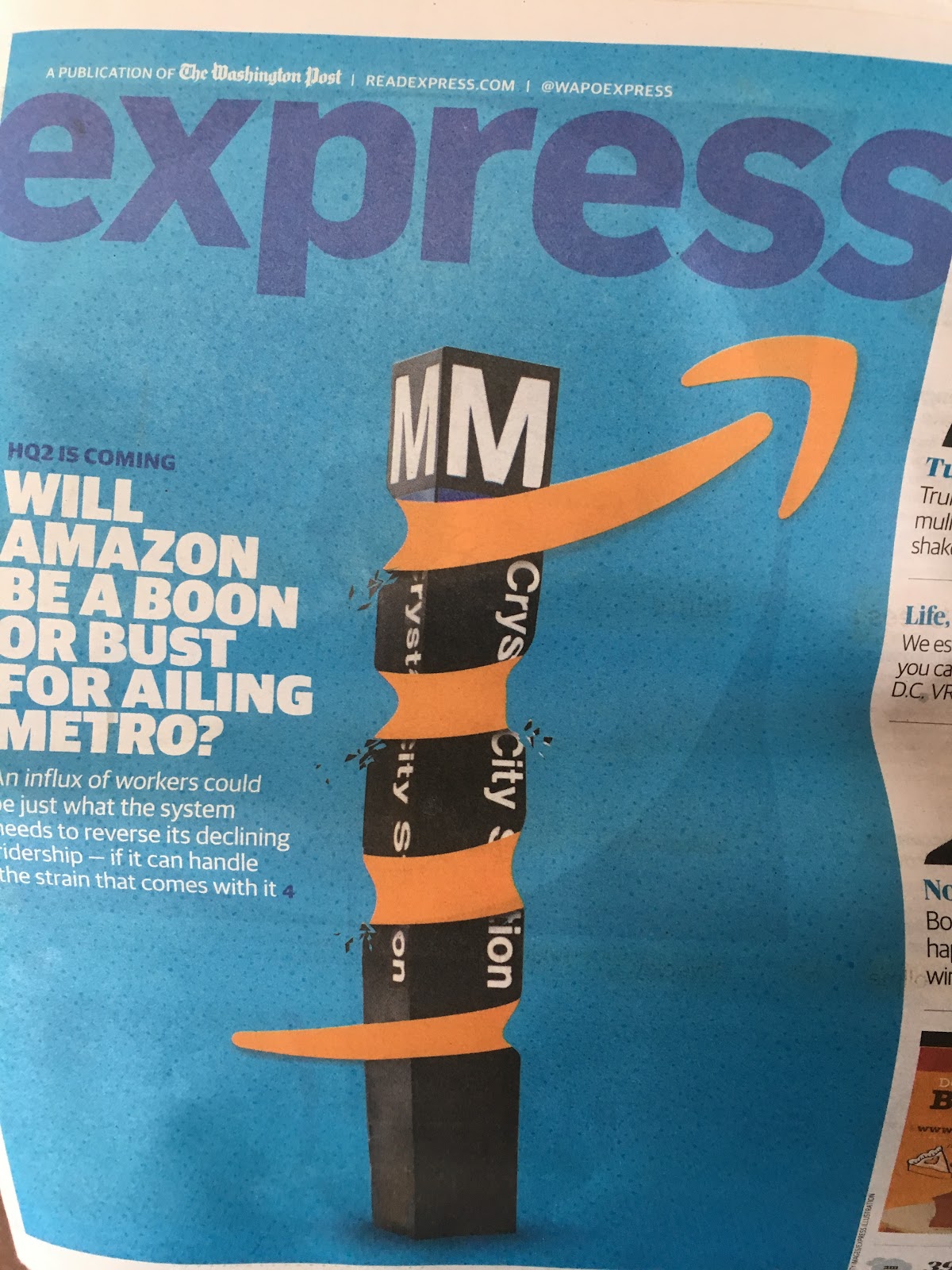
What will Amazon mean for Metro riders?

I was quoted in a Washington Post article (it was also the cover story in the Washington Post Express) about Amazon's announcement to open one of its second headquarters in the Washington DC region.
The article about it is excerpted from MobilityLab.org.
A key part of why Amazon, the world’s second trillion-dollar company, chose Crystal City in Arlington, Va., today as a second headquarters location is transportation.
The office-park neighborhood is supported by Metrorail, Metroway (the Washington, DC region’s only bus rapid transit route), plenty of bus routes, and National Airport.
This is a great opportunity for Metro to boost its declining ridership. But with Metro’s sometimes poor reliability and Uber and Lyft’s growing prominence, there’s no guarantee that Amazon employees and their families will choose Metro.
My quote in the article:
“Metro has to make itself really attractive to get [Amazon employees] to choose Metro over any of the other options perhaps people are finding more attractive at this point."
Some observers predict that Amazon will attract high-earning millennials to the DC region. This might not bode well for Metro, as this is the demographic reducing its ridership the most. 
Luckily, there’s a good chance that Amazon will provide unlimited transit passes to employees, as it does for employees at the Seattle headquarters. This strategy is known to both boost transit ridership and increase employee satisfaction.
Yet Amazon’s arrival means that many more people – not just Amazon employees – will be moving to the DC region. For Metro to win those riders too, the agency needs to up its game. That means improving service and making it easier for people to ride Metro, with better signage, real-time information, and marketing.
And for Amazon itself to help improve the quality of transportation options throughout the DC region, it can start by offering its own employees the very best corporate transportation incentives.
Photo of Arlington Cemetary Metro station by Sam Kittner for Mobility Lab. 

Friday, September 28, 2018

Do Uber and Lyft really care about being environmentally sustainable corporations?

In my role as director of Mobility Lab, I got interviewed for this CityLab article. Here are some tidbits:

For Paul Mackie, director of communication and research at Mobility Lab, which studies transportation behavior and policy, the announcements are another sign of how these companies are adopting roles as “societal partners” rather than just ride-hailing services—ones that can change the way public transit is marketed to the masses. In moving into the bike- and scooter-sharing markets, Uber and Lyft are also encouraging more people to ponder driving alternatives, and making it easier for them to change their behavior.

Lyft’s campaign resembles the new subscription service the firm is experimenting with in Salt Lake City, in which participants pay a flat $200 every month for 30 rides. But by integrating bikeshare and public transit, Lyft’s “Ditch Your Car” initiative goes one step further, potentially demonstrating how public transit agencies could benefit from a new payment model. “You think of these other smart industries—like Netflix or food recipe subscriptions—those are working and it's showing that it's what people want,” Mackie said. “Why is public transit so slow to have that model?”

 ... “It would be naive for anyone to think that Uber and Lyft aren't thinking about what’s best for their bottom line,” said Mackie. The two companies also want a seat at the policy-making table, with both ramping up their lobbying spending over the last few years. (Uber’s backing of congestion pricing, as CityLab previously reported, could be a win-win for both company and city.) Uber is still scrubbing its brand after the multiple scandals associated with former CEO Travis Kalanick, while its smaller competitor Lyft is sticking with its famous “better boyfriend” strategy, donating to the ACLU and giving voters free rides to the polls.

But the companies are still leaving out the one thing cities really want: data. Uber’s gift to SharedStreets may be a gesture toward handing over more of this precious resource, and Mackie thinks this could be another win-win for both sides. “Cities have curb space and parking—things that could really help Uber and Lyft,” he said. “We like to think that if they did share their data, then the governments can work with them to make cities much nicer working grounds.”

 And Mackie also credits Uber and Lyft with encouraging more people to consider sustainable transit options. Despite the rise of ride-hailing, Americans are largely still holding on to their private cars, and the concept of shared mobility remains novel to many.  “So it’s another thing to be a bit of cheerleader for Uber and Lyft because we want them to incorporate this sharing mindset in all of us,” he said. “It’s a noble experiment in behavioral change.”

E-bikes: An exciting alternative

This article originally appeared in the Sierra Club's newsletter.

It’s too early to tell if electric bicycles hold the secret to grand pronouncements such as “the
future of transportation.” But there’s definitely something interesting happening.

Anecdotally, I researched e-bikes for years before I felt comfortable enough to buy one as a
way to improve my mobility options in a ridiculously congested place like the Washington D.C.
region. There weren’t enough retailers who would also be able to make necessary repairs,
something this is more complicated than with traditional bicycles. The battery technology
wasn’t good enough to carry a charge decent enough to get back-and-forth across the city.

The first e-bike I bought ended up being too difficult to get repaired and I returned it,
thankfully (after lots of headaches), for a full refund from the German company, with a
California wholesaler and a D.C. retailer.

But earlier this year I tried again. After test riding many e-bikes and researching online (and,
despite the excellent Electric Bike Reviews site, with so many manufacturers and models, it’s
still an intimidating purchase decision), I purchased an excellent Magnum Metro from Hybrid
Pedals in Arlington, Va.

I’ve never met anyone who didn’t agree that, after riding an e-bike, it changed their life. The
problem is that so few people have actually ridden e-bikes. The U.S. market grew by 25
percent in 2017, to 263,000 e-bikes sold. At that rate, it will take a long time to make much of a
dent in the still-small percentage of people who bike for utilitarian purposes like getting to
work, going to eat, or meeting friends.

Some of the good news is that new and trendy options like Uber, Lyft, e-scooter shares,
dockless bikeshares, and soon autonomous shuttles may slowly be getting people out of their
century-long drive-alone mindset. In an increasingly crowded and polluted world, e-bikes could
play a valuable role in being a gateway to switch from this bad habit to these healthier, more
sustainable, more affordable, and just plain fun choices.

If all bikes today - every single bicycle in the entire world - were suddenly thrown away and
replaced with e-bikes, that wouldn’t be good for the environment. Obviously.
But e-bikes are good for the environment in a somewhat surprising way: because riding an ebike
is less physically demanding than a regular bike, making it easier to climb hills and go
longer distances, people might ditch cars for e-bikes.

Sounds far-fetched, but research says otherwise. An extensive survey of more than 1,800 ebike
users in the United States by the National Institute of Transportation and Communities
earlier this year found that most participants switched to e-bikes to reduce car use.

“What stood out, however, is how many motives involved eliminating driving hassles,”
Bicycling’s Selene Yeager wrote of the study. “Twenty-eight percent of respondents said they
bought an e-bike specifically to replace car trips. Others pointed to craving a more car-free
lifestyle, such as using e-bikes to carry cargo or kids, avoid parking and traffic woes, be more
environmentally minded, and have a more cost-effective form of transportation.”

But Americans are buying e-bikes at much lower rates than people in China and Europe. In fact,
the Wall Street Journal quoted a transit expert in 2016 claiming that 60 percent of all battery
production in China was for e-bikes. That’s a lot of batteries.

So how can we fix this? We can educate people on the benefits of e-bikes (and make sure they
know that riding an e-bike is still good for your health). We can advocate for better bike
infrastructure, which is proven to increase rates of bicycling across the board.

The research holds for me personally as well. I definitely bought my e-bike to maneuver more
easily and efficiently through D.C.’s stressful traffic. My car trips have gone way down, and
now my 17-mile roundtrip work commute is often the best part of my day.

Tuesday, July 31, 2018

Living better often means having calmer mobility options

Originally published at Mobility Lab.

It’s great when journalists dig down deeper into the core, fundamental meaning of the issues.
Alex Marshall of GOVERNING does a commendable job of digging deeper down into the word “mobility.” It is an imperfect word, but it actually gets about as close as possible to defining the way people move around.
Despite not giving an explanation as to why he finds the word mobility “pretentious,” the article lands on some pretty insightful conclusions, including this one, which begs to become a tagline for one of the gazillion new mobility startups:
Sometimes the slower you move, the farther you get.
He points out the communities with all the amenities located in a dense space, like his in Brooklyn, N.Y., have a good thing going, and that avoiding most instances of needing to get in a car (except when you just need that refreshing Sunday drive) creates a much better, happier standard of living.
Then he quotes me:
Paul Mackie … points out that we all have different spheres of mobility – including our neighborhood, our city, our region and the world beyond – and they vary in quality. “In your Brooklyn example, you might have great access to everything by foot in your walkable neighborhood, but your ability to access your doctor on the Upper West Side is limited because driving in the city is difficult and the subways are delayed,” he wrote in an email.
Although I find the term “mobility” pretentious, it may have come into favor because it takes in other options besides personal driving for getting around. And having more ways to travel improves your mobility, by my scorecard. “The mobility mix is getting really interesting now with Uber, Lyft, e-bikes, e-scooters, bikeshare, dockless bikeshare, hover boards, autonomous cars, autonomous shuttles, work shuttles,” Mackie wrote, and people are waking up to that. “They’re not simply sleepwalking into the cars in their driveways in the morning.”
Whatever one’s thoughts are about the term mobility, it’s heartening to know that more journalists are starting to get the memo that transportation and mobility aren’t always about driving and flying.
See our recent article on what mobility means.

Tuesday, June 26, 2018

How Uber and Lyft are scooting their way to global domination of transport

I got the last word in this solid roundup from the San Francisco Chronicle of the latest news on Uber and Lyft's plans heading into the future of transportation.
“Not many people in our country take bikes and scooters for utilitarian trips, for going to work, the grocery store, out at night even though it’s a low-cost healthy way to get around,” said Paul Mackie, director of research and communications at the Mobility Labs think tank. “It’s great that Uber and Lyft are putting money and publicity and building interest in these other great ways to travel. It lends credence to them as mobility companies, not just tech companies.”

Sunday, October 29, 2017

Best Magazine Reads: Beetle Bailey and Connecticut's "Cartoon County"


I've visited Fairfield, Connecticut before because some of my wife’s cousins live there. What I didn’t know about the outer New York City suburb is that it had been home to an inordinate number of famous daily-newspaper cartoonists.

Mort Walker (pictured to the right) is perhaps the most famous of the crew detailed in a fantastic article in the September issue of Vanity Fair. I rank his Beetle Bailey as one of my favorite dailies, up there with Archie, Garfield, Peanuts, and, actually, several other strips emanating from Cartoon County, including Hagar the Horrible, Blondie, Popeye, The Family Circus, and Hi and Lois. The place also has ties to Superman, Tarzan, Prince Valiant, and many others. It’s really pretty phenomenal.

The cartoonists lived different lives than the working men (and the cartoonists seem to have been all men) who headed into the city each day. They sat at home in their offices that smelled of sharpened pencils, tobacco, and whiskey, were pretty domesticated by their families, and only went into the city on Wednesdays to show off their latest works to various publishers and editors. Then sometimes they would go to gatherings with the other cartoonists to drink lots of Manhattans. And they played quite a bit of golf and took lots of naps. Pretty nice work if you can get it. Maybe that’s why “cartoonist” was always on my short list of potential professions!

The author, son of the Prince Valiant cartoon, notes that Cartoon County was a quirk in time. Cartoonists were rock stars, creating the most-read portions of the newspapers, up until the early 60s, when Hearst killed what the group considered its Mount Olympus, the New York Journal-American. Then later Wall Street further killed Fairfield County as an affordable place where cartoonists could live comfortably.

Even I remember a time when the newspaper would clunk down near the front door. I would run out to get it and grab the funny pages, and maybe sometimes the sports section, and throw the rest of it down wherever. At that point, I was a remnant of an earlier age, when just about every kid (and adult) couldn’t miss the cartoons each and every day, with the special, fuller, mostly-color Sunday editions being the highlight of each week.

Wednesday, June 28, 2017

I always wanted to be a professor, so here's maybe the next best thing

I served as an advisor (and even got to teach one class) for a project by George Mason University graduate students this spring semester.

It was really fun and, as a bonus, the report the students wrote is very good. Check it out here, read a Mobility Lab-published article I wrote about it here, and take a look at an article today on GMU.edu. My quotes include:
With deliveries expected to increase by nearly 30 percent in the next decade, it is an area that needs more consideration, said Paul Mackie, communications director for Mobility Lab. 
As Arlington County officials ponder the proposals, Jonathan Gifford, director of Mason’s Center for Transportation Public-Private Partnership Policy at Mason’s Schar School of Policy and Government, said Mobility Lab “was highly enthusiastic about the results. … While Arlington is widely recognized as a leader in multimodal mobility, there are clearly opportunities to do even more.” 
“The Mason recommendations are very practical and should be useful to Arlington, which is already pretty well-connected because of its many transportation options,” Mackie said. 


Wednesday, May 17, 2017

Should delivery robots be allowed on sidewalks?

I'm quoted today by the San Francisco Chronicle (and MSN, Market Watch, Government Technology, and others; also subsequently quoted two days later by CityLab) on a topic I've discussed before representing Mobility Lab: should delivery robots be allowed on city sidewalks?

San Francisco, of all places, is considering such a ban. While better city planning in most places is needed to examine the best ways these R2D2s can be helpful and not a nuisance, they also could be an answer to the growing army of Amazon and UPS and other bigger delivery vehicles that more and more constantly block my bicycle path and can make traffic jams much worse.

Here's what I said:
A San Francisco ban is a bad idea, said Paul Mackie, a spokesman for Virginia’s Mobility Lab, which researches advanced transportation.
“The space-saving R2D2s could fix a lot of our traffic headaches caused by the ever-growing number of delivery vans and trucks that have to park illegally and dangerously to make their dropoffs,” he said in an email. “It doesn’t make any sense for San Francisco leaders to be going backwards like this.” 
So far, three cities — San Carlos, Redwood City and Washington — have approved robot deliveries, Mackie said. Virginia and Idaho also allow them, and Wisconsin has passed legislation now awaiting the governor’s signature to allow delivery robots to use sidewalks and crosswalks.

Sunday, December 18, 2016

Washington Post quotes me on people who are making transit better

MetroHero, one of many unofficial DC Metro apps
It's been a good week for me getting quoted in major newspapers. First it was USA Today about Trump's pick for transportation secretary and now I'm in the Sunday edition of the Washington Post (Page 2 of the Metro section).

Reporter Faiz Siddiqui attended Mobility Lab's Transportation Techies this week and did a nice wrap-up of how everyday citizens are using data to figure out myriad ways to make Washington D.C.'s Metro subway better.

Here is an excerpt from "How developers are turning to Metro’s newest software tool to enhance their apps:"
The gathering at Metro’s headquarters, the latest in the series of monthly meetups sponsored by Mobility Lab, the research arm of Arlington County commuter services, was all about little fixes developers can make to improve riders’ experience, said Paul Mackie, a spokesman for Mobility Lab.
“This doesn’t need to be part of a 30-year-planning process or even a five-year process — a lot of these things can be incorporated immediately,” Mackie said. “It’s not only free labor, but it’s passionate and caring labor.”

Monday, August 29, 2016

Quoted this week by PBS Newshour, Pew Statelines, and Raleigh Agenda

An interview regarding my work with Mobility Lab while waiting for a plane in the Albany airport after our regular summer vacation at Sacandaga in the Adirondacks resulted in some nice coverage from a Pew Charitable Trusts reporter. The article ran in Pew's Stateline publication but was also reprinted by PBS Newshour.

I was asked if carpooling can make a comeback after dropping from its peak in the 1970s of 20 percent of work-commute trips to its current state of around 9 percent. And whether Uber and Lyft can help.

Paul Mackie with Mobility Lab, which advocates for sustainable transportation, said the ride-hailing services have started to change attitudes about carpooling by having gotten people “to get out of the mind frame that you have to drive alone.”
My plane ride was to Raleigh, North Carolina to speak to about 200 entrepreneur types in that bustling state capital. Raleigh Agenda ran an article that quoted me:
Paul Mackie, a longtime journalist and the communications director for transit advocacy nonprofit Mobility Lab in Arlington, Va., led the transportation discussion. Mackie’s overarching message —that a community can easily cut down on the number of cars on its roads without spending billions of dollars—is welcome in a city where commuter congestion only increases.
“We’re a car country. Cars are cool,” Mackie explained. “But while people love cars, they hate driving. And that’s an opportunity.”
In dense areas, transforming parking lots (not building more) into walkable corridors with shops, restaurants, and green space can make an immeasurable change. Improving the messaging around available public transportation options, so they’re seen as efficient and easy to use rather than dangerous and scary, is another approach. And local businesses can encourage their employees to commute to work on foot, by bike, or bus by providing transportation vouchers rather than parking spaces.
Raleigh is poised and overdue for such incremental improvements to its transportation system, as a panel of local and regional experts made clear. A network of buses already connects the city to the rest of the Triangle, and the R-Line works to make downtown feel compact. Dedicated bike lanes are on the rise, and a bike-share program is coming next year.
“It’s such a concise, could-be dense place,” Mackie said. “It’s like a playground to play with, if you’re a city planner.”
And before the event, Raleigh Agenda actually ran an event preview that interviewed me:
“[Government] cannot just do this alone,” says Paul Mackie, communications director for the transit advocacy nonprofit Mobility Lab. “You need collaborators to get the messages out—evidence as to why improving transit options is the right thing to do, stories so people can relate, talking to people face-to-face.”
Emphasizing expanded transit as “the right thing to do” may well be what tips the debate in Raleigh: Cities with more transit options typically have better long-term economic prospects. And removing mobility as a barrier enables people, potentially making for a city with people who are more fulfilled.  
Though the conference isn’t designed to address it specifically, the possible success of this fall’s county-wide transit referendum is at stake by having these conversations before November. A “yes” would significantly expand Wake county’s bus system and help craft a long-term vision for commuter rail.
“Inevitably there will be an anti-transit group out there that will have its ducks in a row,” says Mackie. “I have seen it before, where cities just are not prepared to deal with that kind of debate. This is not a country that is easily convinced that transit will work.”

Monday, July 11, 2016

Communicating transportation options, on “Talking Headways” podcast

My colleague Adam Russell wrote this up originally on Mobility Lab, about this 40-minute interview with me on the Talking Headways podcast that aired last week.


How can cities and transit agencies better reach out to commuters and guide them towards modes that aren't driving alone? How is the transportation landscape changing to include a greater breadth of transportation options?
TalkingHeadways
Mobility Lab's communications director Paul Mackie recently discussed these questions and more with host Jeff Wood on the transportation and urbanism podcast Talking Headways. Referencing a communications struggle raised by previous guest Peter Norton, in which automakers dominate the culture of transportation by making cars the default "cool" mode, Mackie said the transit and active transportation industry has its communications battle cut out for itself:
“Maybe public transportation can’t afford to have 20 Super Bowls [like the car companies], but it feels like we’re so defensive. [The industry] reinforces the idea that biking, walking, and taking transit are unsafe activities, maybe even unfriendly activities. Why don’t we tell more positive stories about public transportation?”
Catch this discussion on the below episode of Talking Headways:
Photo by Sam Kittner, for Mobility Lab (www.kittner.com).

Friday, June 3, 2016

USA Today asks me about how Uber and Lyft leaving Austin could play out

As I've become more of a transportation-expert spokesperson for Mobility Lab, it's been a pretty good run lately, including twice being quoted in America's biggest newspaper, USA Today.

In my latest commentary, I was asked by the paper's Austin beat reporter, Rick Jervis, about the national perspective on Uber and Lyft leaving the Texas city because of a conflict over whether or not their drivers should be fingerprinted like traditional taxi drivers (the companies contend they should not be fingerprinted).

Mobility Lab's take on it is that this is a very disruptive time in the transportation industry and we're still in the very early days of seeing all this play out.

  • Will the desire of Millennials for less car ownership (and ownership in general) than older generations translate into more carpooling, ridesharing, pickup services like transit, and quick-hop options like bikesharing? 
  • Will electric and autonomous vehicles create the possibility of less ownership and more flexible public-transportation fleets? 
  • And will others step in to provide the kinds of technology that have made Uber and Lyft so wildly successful, while playing more nicely with local governments?
When Uber and Lyft left Austin, a non-profit tech group called RideAustin was right there to take their place, within 15 to 20 days. That's pretty amazing, and my point that the USA Today author got across nicely was that other cities could very easily follow this lead if Uber and Lyft prove to be politically unpopular.

While it seems these options are every bit as safe as, if not safer than, traditional taxis, the public in Austin spoke through a vote that just being tracked on GPS is not enough and that drivers should be fingerprinted.

Here's the whole article, Austin hunted for solutions in run up to ride-hailing vote (it also ran in the Burlington Free Press and the Des Moines Register), and here's how I was quoted in the start of it:
Major cities such as Los Angeles and Philadelphia — where both companies currently operate — have faced similar clashes when trying to regulate the popular ride-hailing companies. But the Austin standoff is unique for the city’s resistance to the corporations and the innovative ideas spawned from the drama, said Paul Mackie of the Mobility Lab, an Arlington-based transportation think tank. 
“It’s kind of exposing Uber and Lyft,” he said. “It will show city leaders (across the USA) that there could be other options that could step in and do the same thing that Uber and Lyft can do.”

Thursday, May 5, 2016

Would you have sex in a driverless car?

I love getting contacted by journalists to be interviewed about slightly off-kilter stories.

Our specialty where I am communications director at Mobility Lab is how people think about their transportation options. Seems pretty straight-forward, right? But really, we've found that people are mostly sleepwalking through these decisions, accepting that they will climb into a car and drive alone somewhere without even thinking there could be options.

We think things like Uber, Lyft, electric and driverless vehicles, and even new trends like bikesharing, the return of carpooling, and working from home are starting to make changes in our societal sleepwalking.

At first glance, this article I was quoted in yesterday in The Daily Dot, a respectable online news source that has been around since 2011 and is mainly geared towards millennials, seems similarly off-kilter. But it looks pretty smartly at one issue policy-makers will surely consider in the years ahead: when we no longer need our hands on the steering wheel and our feet on the pedals, will we do new things while traveling in cars down the road? New things like having sex. And is that a good or bad thing?

For now, our take on it is this:
"Having sex in a driverless vehicle seems like a pretty wacky concern, but it’s actually good foresight by Barrie Kirk [the cofounder of a Canadian autonamated-vehicle research group]. After all, much of the reason car companies and governments are so hopeful about driverless cars is because distracted driving has made car travel so dangerous in the first place," Paul Mackie, communications director at the transportation research organization Mobility Lab, said in an email. "Once driverless cars are fully on the roads, there is no doubt many, many lives will be saved. And if that means more texting, sleeping, and having sex in those vehicles as they move down the highway, well, we as a society will be much better for it.”
The article goes on to poll a small sampling of 211 people. And 81 percent of them say they would "have sex while riding in a driverless car." I wonder if those numbers would be any different if we polled Mobility Lab's audience in comparison to The Daily Dot's readers. It seems pretty safe to say you could poll any group and the number would be high for any question that begins, "would you have sex while ______."

In the end, I again agree that this may seem like a wacky issue, but safety is a major focus of the U.S. federal government's $4 billion investment to bring driverless cars into the mainstream. So by the time fully autonomous vehicles are all over the road, it seems that laws will be in place to curtail distracted behavior.

One out of four accidents in the U.S. is caused by texting and driving, way more often than accidents from drunk driving. It’s a national epidemic that isn’t going to get any better as we love our devices more and more. And driverless cars are having an easier time being accepted into the mainstream because future generations are excited about being able to text and be productive while they get places in a car. Better still if it’s a shared car because you don’t have to park it, make monthly payments on it, or take it to the shop for repairs.

Photo by Simon Lefebvre in Flickr.

Friday, April 15, 2016

Storytelling has a direct result on building transit that could compete with cars


I recently wrote an article on Mobility Lab calling for transit agencies to launch a full-on effort to make commercials for transit that are as enticing as the many excellent car commercials that the auto industry has been pumping out for decades.

As a communications professional, it's often difficult to show exact influence and results of the blogs, videos, tweets, and other materials we create. But when The Rapidian, Grand Rapid's local citizen-run newspaper, published an article this week, Mobility Lab can be proud to see that our advocacy has had a direct success.

Brittany Schlacter leads off her article this way:
Paul Mackie, one of the nation’s foremost mass transit bloggers and the communications director of the Virginia-based nonprofit research organization Mobility Lab, recently posed this challenge to America’s public transportation industry’s leaders:
“Where are the Super Bowl-esque ads about public transportation? Where are all the transit ads representing freedom to explore and observe, safety, good health, cost savings, sustainability, community, patriotism, and happiness? Transit communications needs to catch up if transit and alternate modes ever hope to catch on.”
At The Rapid, we have embraced Mackie’s challenge. We are launching a new campaign that informs the Greater Grand Rapids region about the merits of public transportation through simple, powerful, consistent and, most importantly, positive messages about the experience.
Transit communications needs to catch up if transit ever hopes to catch on. The Rapid presents a start.

Thursday, April 7, 2016

R2D2-like robots are starting to deliver your mail

Wouldn't it be nice if service delivery vans and trucks weren't clogging up city streets, parking in bike lanes, and blasting through your neighborhood?

Not that the drivers aren't performing a great service and all. Who doesn't love to get an anticipated package in the mail?

But one way to solve a major source of traffic congestion may just be R2D2. Someone tweeted that the idea of using robots for mail delivery sounds "like a late April Fool's Day joke."

But it's no joke. The robots are on their way. A feature article on this topic appears on the front page of today's San Francisco Chronicle. The full article is here, and, representing Mobility Lab, I get the first and last quotes in the article:
“These R2D2-like drones ... make a lot of sense for particularly dense places, like city centers, where freight and delivery vehicles are simply running out of space on the roads during rush hours and lunchtimes,” said Paul Mackie, a spokesman for the Mobility Lab, which researches advanced transportation options.
“As cities reimagine themselves to become more walkable, livable places, sidewalks have a central role to play,” said Mackie, the transport futurist. “More and more, people are demanding outdoor living rooms like plazas, sidewalk benches, fountains, cafes and street trees. Frankly, these robots fit into such a landscape much better and much more attractively than the delivery vans and trucks of old.”