Tuesday, March 12, 2024

Mountain biking, hiking, and more await in Moab, Utah

I'll be soon headed to Copper Mountain, Colorado for what looks like the final ski trip of the season. We're very lucky to get to go there twice this winter of 2023-24. That part of the the trip is easy. No mapping out needed. Just ski every day and sleep every night. But I need to plan out the last five nights of the trip.

After skiing on the last day at Copper, a four-hour drive west on Interstate 70 to Moab, Utah sounds rough, so we'll break it up by staying an hour west of Copper at Glenwood Springs. Since we'll be travelling with kids, it's a toss up as to whether we'll head to the Glenwood Hot Springs Resort, which might be just what our bodies need after five days on the slopes, or Glenwood Springs Adventure Park, which includes a gondola ride, a cave tour, and several rollercoasters.

Then it's on to Moab, a place I've always wanted to visit. It's a small town surrounded by sandstone sculpted by wind, sand, and sun, much of which is in Canyonlands National Park and Arches National Park. I've mainly heard about it because mountain biking is one of my hobbies. Even though I haven't been doing it as much as usual lately, I'm pumped for the family adventure and I think the kids are going to love it. We have four nights planned there and really 4.5 days before we fly back out of the Grand Junction, Colorado airport.

Among Moab's most notable pop-culture touchstones: parts of 1989's Indiana Jones and the Last Crusade were filmed there and part of Edward Abbey's 1968 enviro classic novel Desert Solitaire was set there.

For our bike riding, since we'll have our 10-year-old with us, we'll be sure to mostly stay away from the daring and epic mountainous red-rock trails that I associate with Moab. That said, this blog has all kinds of great ideas to keep us busy for at least half of our stay. Here are some possibilities:

  • While our little one is pretty tough stuff, we'll probably want to check the barometer by starting with the Rowdy/Wrangler at Horsethief Campground, which is 1.5 miles and billed as "the best beginner bike trail in Moab for kids."
  • The Intrepid Loop Trail at Dead Horse Point State Park is a 1.1-mile mostly-flat trail with some rocky terrain and views of the Colorado River. After that initial stretch it gets tougher but turning back is an option.
  • Jurassic Trail looks like a cool 3-miler that "sits on the western side of the Klondike Bluffs" and includes "stunning views ... such as the nearby mountain ranges and overlooking various bluffs ... colorful clay that dates back to the Jurassic Era."
  • Mill Creek Parkway is a 2.5 miles out-and-back in town on a paved route. "There’s also a stunning stream that flows alongside the path that comes from the nearby La Sal Mountains."
  • Moab Canyon Pathway is another paved trail that runs for 8.8 miles "along the southernmost border of the Arches National Park." It offers "stunning and scenic sights that you’d be hard-pressed to find anywhere else or along any other bike path." But we should be aware that the whole trail can somehow take about three hours.
  • If we succeed at some of these, we may proceed with some more intermediate-level trails.
  • If we don't, and the weather is nice enough, we might have to do some whitewater rafting at Red River Adventures.

Key hikes to do in Moab include:

  • The Corona Arch Trail, a 3-mile moderately strenuous hike above the Colorado River Canyon to Corona Arch, which is less busy than some other spots in nearby Arches National Park and some say it's the most beautiful. The detour to Pinto Arch is said to be worth doing as well.
  • Dead Horse Point is said to be most stunning at sundown and a lot like looking out over the Grand Canyon. It's also near where Thelma and Louise drove along back in 1991. Same for Double Arch and Delicate Arch (which is the one on Utah centennial license plates; it's a mile-and-a-half hike in Arches).
  • "The Fisher Towers Trail explores the Fisher Towers, one of the Utah canyon country’s most bizarre landscapes. The area is a maze of soaring fins, pinnacles, minarets, gargoyles, spires, and strangely shaped rock formations east of Moab," notes Visit Utah and several other people.
  • If we want to explore for dinosaurs, we should hit either the Dinosaur Tracks Trail or the Mill Canyon Dinosaur Bone Trail.

When it comes time to imbibe:
  • The New York Times recommendations are La Hacienda ("a tasty pair of fried fish tacos"), World Famous Woody's Tavern ("cold $2 drafts ... some say the floor is painted red to cover up bloodstains from brawls"), and Milt's Stop & Eat ("fresh chili, mouthwatering double bacon cheeseburger, creamy chocolate malt"). In general, Moab's downtown area is "pretty darn cute."
Before flying back home out of Grand Junction, Colorado, hopefully we'll have time for a quick hike or at least walk around the downtown. Lands End Road up to Grand Mesa and the short hike behind the visitor center at Colorado National Monument are both possibilities.

Sunday, March 10, 2024

A little “green” tennis wisdom

The Little Green Book of Tennis Wisdom, edited by Julie Ganz, is a breezy quick read of great quotes about tennis. Here are my the ones I found most interesting.

From the section on the history of the game:

  • The word “tenes” went through 24 transformations before it became the word “tennis.”
  • Henry VIII was a world-class player.
  • Before the Open Era in the U.S., tennis was “hidden away from the great unwashed behind Ivy-covered walls,” according to Bud Collins.
  • Rod Laver had no show of emotion. He was “like a good plumber.” He won all four majors in one year - an almost-impossible accomplishment.
  • Bjorn Borg was bigger than the game. He was like Elvis.
  • The optic yellow ball of the early 1970s “helped transform tennis from a country club pastime to a billion-dollar sports enterprise.”
  • Andre Agassi brought in the MTV generation and the Hollywood elite.
  • France dominated tennis from 1925-1935, Australia in the 1960s, the U.S. In the 1990s, and Spain around the early 2010s.
From the section on advice:
  • John McEnroe says the most important quality of a winner is desire and the ability to keep at it when not playing that well.
  • Martina Navratilova says she prefers creative players way more than cookie-cutter players.
  • Lleyton Hewitt said many matches are won and lost in the locker room.
  • Rod Laver said the best volley is a short stiff jab, with almost no backstroke. “You’re blocking the ball, not stroking it.”
  • Serena Williams said she had never met a tennis player who hates sushi.
  • Author Timothy Gallwey noted that tennis can help you learn to trust yourself, which is far more valuable than learning how to hit a forceful forehand.
  • Tennis can be a little dull unless there is some pizzazz, Nick Bollettieri said.
  • Author David Foster Wallace called the sport the most beautiful one and the most demanding.
From the section on the Grand Slams:
  • It’s not right to compare the four slams. That’s why you don’t see pundits doing it. They are all great and valuable in their own ways.
  • Roger Federer said he thought players were the most inspired at the Australian Open, perhaps because it’s the start of a new year.
  • Navratilova said winning Wimbledon is like a drug that you just want to do again. Andre Agassi also said something along those lines. 
  • Andy Roddick said his footwork on the French Open clay was awful.
  • Novak Djokovic rightly noted that the U.S. Open is about the night session with the rowdy crowds interacting with the players.
  • Roddick said the adrenaline rush of the first 30 seconds after winning a match is like no other he experienced before starting to play tennis or that he expects he’ll ever feel again. 
  • Nadal said he plays every point like his life depends upon it.
  • Jim Courier said the dumber you are on court, the better you’ll play. 
In the section on doubles:
  • The masters make others feel foolish or simply tempt them to beat themselves.
  • It’s a game of subtlety, touch, and deft hands at the net.
  • One doctor said that you can tell if a couple should stay together when you watch them play mixed doubles.
  • Mixed double and regular doubles can make you better because you learn to relax a little. It’s  also a great way to polish net skills.
A worthy ending inspiration comes from the ping pong section: Keanu Reeves is, of course, apparently really good at it.

Saturday, March 9, 2024

Why E.T. always makes me cry

I would probably be considered an R.E.M. Relatively emotional male. I've known this since at least 1982, when I first saw E.T. The Extra Terrestrial. This movie - my fourth favorite of all time - has consistently made me heavily cry each of the 15 to 20 times I've seen it.

The stretch from when the "man on the moon" arrives at Elliot's house - in hazmat suits - through until the end of the film pretty much has me in a mess. And it did again this week, when I watched it with my kids.

Digging deep to try to understand myself, here are some of the spots in E.T. that seem to dig themselves into my heartstrings:

  • From the very start, E.T. is lost in a faraway land. He's scared and he's harmless. But people don't know that he's harmless, with even Elliot letting out a few good screams into the alien's face before becoming incredibly confortable with him. As we get to know E.T., we see his longing and pain to get reunited with his space buddies.
  • I could also relate to Elliot's world. He was the kid brother like myself who not only had to deal with his older brother but with his dad having run away to Mexico with his new girlfriend. My parents also got divorced when I was about the same age as Elliot. Director Steven Spielberg too says he created the movie based on the imaginary friend he had after his own parents' divorce.
  • The friendship between E.T. and Elliot is definitely heartwarming in and of itself, especially seeing how Elliot doesn't seem to have much of a network of friends for support like his older brother does.
  • E.T.'s growing ability to speak and communicate with Elliot and his brother and sister is part of it, and when the alien begins to rapidly blurt out phrases like "E.T. phone home," it's a mixture of hilarious and heartwarming.
  • It's odd that the government agents would contribute to my emotions, but they do add a layer of "bad guy" and some scariness to the story, as we have no idea what they might do to semi-defenseless little E.T.
  • Of course, in the scenes when we know Elliot must let go of his new friendship, it is probably the hardest to take, even if we know deep down that their relationship has to end somehow.
  • It can't be forgotten that all the bike riding by the kids harkens back to serious memories of childhood. Like the characters in the Valley outside Los Angeles, I rode everywhere around my town outside of St. Louis to get everywhere.
  • Finally, the music by John Williams is big, awesome symphonic stuff similar to Raiders of the Lost Ark and Star Wars, and I connected it a lot with the music in Alfred Hitchcock films, many of which are my very favorites in cinemal history.
There now, I've said it. Want to make me cry? E.T.'s got all the ingredients necessary.

Friday, March 8, 2024

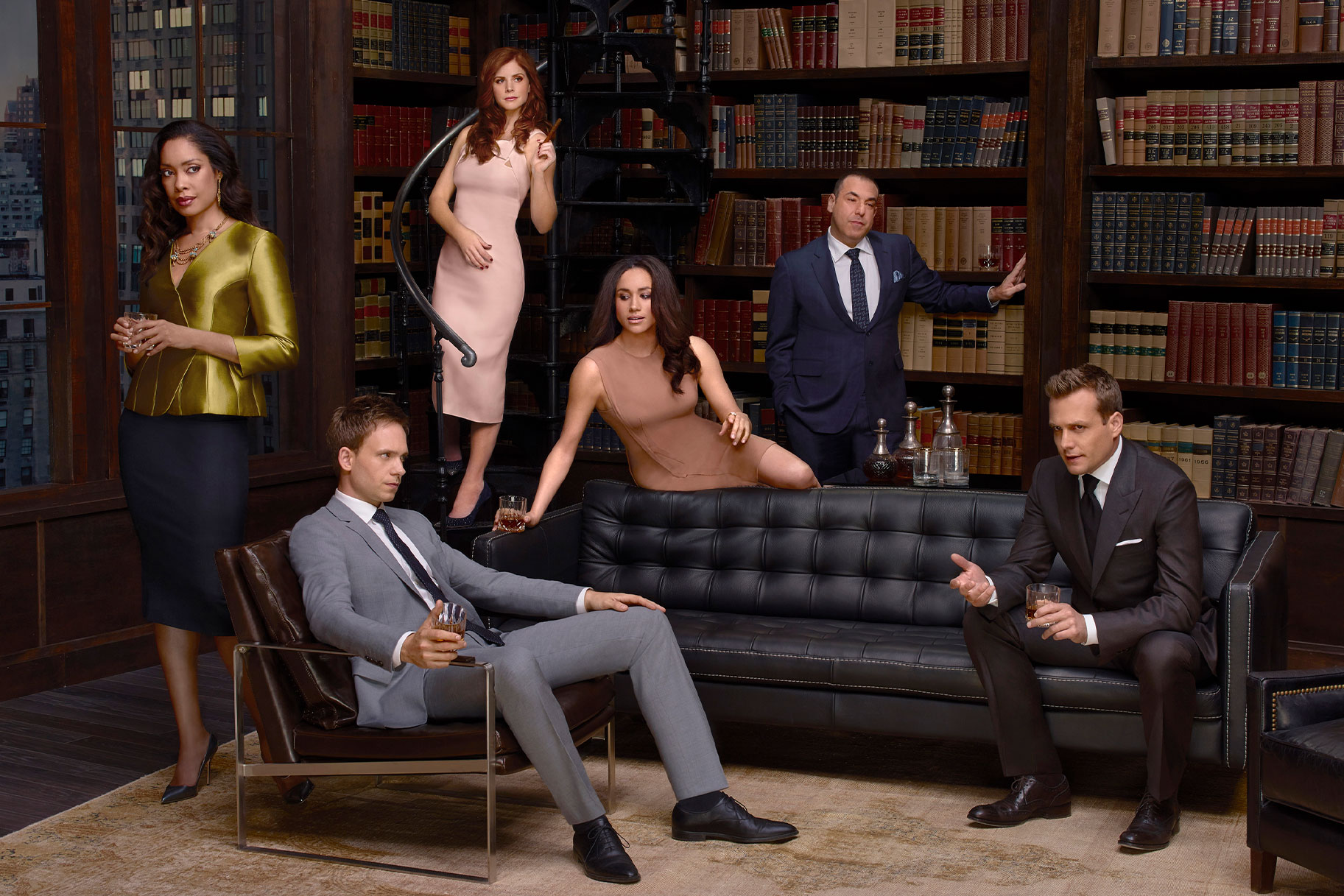
Suits Season 1 offers a poor man's Mad Men, but an oh-so-good one

I don't remember the last time I watched a lawyer-procedural TV series, but a lot of people had been recommending Suits and then it recently exploded in popularity when it moved to Netflix. And of course, even though I'm not that intrigued by the British royal family, there's the added allure of Meghan Markle, the pseudo-princess. So I figured I would try an episode or two. But do you know what? I binged the entire first season.

It's a poor man's Mad Men, but that's not a bad thing (you may recall Mad Men was named my favorite show of all time). The suits. The questionable morals and ethics. The beauty of everything from the characters to the office space to the New York City settings. The writing is sharp and witty. One such example is everything out of the mouth of Rick Hoffman's Louis, with his constant Paul Lynde-like sneer. It all adds up to being a lot of compelling eye candy.

Season 1 goes like this: Mike (played with youthful enthusiasm, street smarts, and photographic memory by Patrick J. Adams) is a dropout who accidentally gets hired at a prestigious law firm in the middle of running away from a drug deal. Even though he never attended law school, Mike intrigues Harvey Specter (played in star-making fashion by the smooth and magnetic Gabriel Macht) and the two work all season to hide the fact that Mike never attended Harvard like he claims and like everyone else at the firm.

Each episode tackles a legal situation, but office politics, romantic liaisons, and personal struggles are the parts that had me riveted. Some of my favorite storylines include: 

  • Rachel (played very enticingly - very smart and very cute and very underappreciated by the firm - by Markle) is accused of leaking some of the firm's confidential documents.
  • The love triangle (or is it simply tension?) between Rachel, Mike, and Mike's girlfriend Jenny simmers throughout the season.
  • Harvey's internal battles about his past ethical lapses, such as putting several people in jail who were innocent, is written and played in a cool-guy and airy manner, and
  • Again, I find all of Louis' smarmy blackmail attempts against his own firm teammates one of the most compelling elements of the show.
I would guess I won't live long enough to watch all nine (??!!) seasons, but I plan to watch at least a few more. We'll see how it goes.

Season 1 (from 2011) is 4.5 out of 5 stars.

Thursday, March 7, 2024

In Expanded Universe, Robert A. Heinlein is at his best when focused on sci-fi

Robert A. Heinlein’s Stranger in a Strange Land is my 10th favorite novel (as of 2014) and possibly my favorite sci-fi novel. I haven’t actually read much else by him, although his novels The Moon is a Harsh Mistress and Starship Troopers are high on my list. In the sci-fi genre especially, short stories are a great way to go because the premise is often the best thing about them, and that premise can sometimes ware thin over the course of a novel. Heinlein’s stories are surprisingly not presented in a lot of different ways. The Past Through Tomorrow is supposed to be a good collection. The only one I could find readily available online is Expanded Universe, available for free on the Hoopla library app. It includes short stories, essays, and novelettes.

Here are my summaries and reviews of only the five short stories from the collection:

"Life-Line" (1939): One Dr. Hugo Pinero gets invited by an associated insurance salesman to present information at the Academy of Science. Amidst jeers, he announces that he has discovered how to tell exactly how long each person will live. He proposes to a disbelieving group that he can figure out which one in the room will die soonest. He is forcibly removed, but several journalists f9low him and he invites them to come see his apparatus. He gets all the birth dates correct for the reporters. Then one named Luke asks him to predict a death. The doctor does the experiment but doesn’t want to say the results. Once it’s finally coaxed out of him, he reports Luke will die before tomorrow! A sign falls on him on Broadway while he’s headed back to the office to file his story. The story gets big and before we know it, Dr. Pinero is appearing in court, standing accused of being a common fortune teller by a life-insurance company that doesn’t like what he might do to its business. He convinces the court to let h8m carry out his experiments on a group from the Academy and the judge accepts. Back at his office, Pinero accepts a young couple planning to start a family and hoping to make the right decision. After testing them, he says his machine appears to not be working properly and detains them when they say they need to hurry to their next appointment. Eventually he can’t detain them any longer and he witnesses them getting run over by a speeding police car out his window. The Academy prepares to open the envelopes when they get news that Pinero has been murdered in his home and his machine destroyed at his office. They remember Pinero’s own envelope in in the batch, they open it, and it tells the exact correct time of his death. The Academy members then throw all their envelopes into a burning wastebasket, with the last words spoken being a concern that the tabletop has burned a bit. This is a fascinating take on the battle between powerful corporate interests and the unwanted truths that the scientific method can offer. 5 out of 5 stars.

"Successful Operation" (1940): This is an odd, very short story about a leader of the Nazis needing an operation. Nobody could perform it successfully other than a Dr. Lans. He and his family are imprisoned in the leader’s concentration camp. The doctor barters a deal of freedom and payment for doing the procedure. The leader finally agrees. The transplant patient is a young man from the camp. He thinks he will be awarded freedom somehow but ends up be8ng sent back to the camp. The doctor and his family survive. So too does the Nazi. But one of the stipulations is that the operation take place outside of the country. The doctor’s family is placed in a luxury hotel. Then several people of the unnamed country enter and kill the Nazi. I like the sentiment, but it is a pretty minor story, albeit clever. 4 out of 5 stars.

"Searchlight" (1962): This is another minor and very short piece “Blind Betsy, child genius of the piano,” getting lost in her ship while doing a USO tour of the Moon. The lunar command will do anything to find her, knowing it doesn’t have much time, so it turns a laser beam into sounds so Betsy can pinpoint which note she hears as they scan it over her location. She is discovered and rescued at the end, in this story Heinlein wrote to appear alongside a Hoffman Electronics ad in Scientific American and other magazines of the time. 3 out of 5 stars.

"A Bathroom of Her Own" (1980): This is more politics than the regular Heinlein sci fi. The war has ended and there’s a significant housing shortage. A woman decides to run for the local council because she’s sick of sharing one bathroom with a large house of family. A man running against her discovers she’s a real threat - even though she’s a one-issue candidate - because she’s backed by the local machine. The man is losing but the woman has been disillusioned, realizing she really is backed by the corrupt machine. The man decides he’s going to drop out and help her run for office without the machine. She wins and he becomes her field secretary. She gets married and moves out of the full house into one with two bathrooms. They unavoidably are the new machine in town. It may be accurate as to how politics works, and it may be correctly cynical on the topic, but the story isn’t very exciting. 2.5 out of 5 stars.

"On the Slopes of Vesuvius" (1980): This is a tidy little tale about a few scientists who walk into a bar in Manhattan. It is somewhat predictable but still left my jaw dropped at the end. [Spoiler alert] The men start talking about the atom bomb and it's revealed that one of them works on the bomb. Even though many years have passed since the Cold War began in earnest, it's still an issue, and these men tell the bartender that the bomb is very easy for any number of actors to launch, if they so choose. He sort of nervously laughs them off, as they talk about how easy New York City is as a target, but then leaves the bar suddenly and takes a train out of the city. He begins to think about how his ill cat needs to be fed and other everyday tasks that he needs to perform back at home and exits the train to head back, thinking that he has acted irrationally. As he starts to head back, a mushroom cloud blasts upward from where NYC used to be. 4 out of 5 stars.

Wednesday, March 6, 2024

Journeying to the center of psychedelic rock, with author Jim DeRogatis

The genre of psychedelic rock began in 1966 with the release of Pet Sounds by the Beach Boys and then Revolver by the Beatles, writes rock critic Jim DeRogatis in 1996’s Kaleidoscope Eyes: Psychedelic Rock from the '60s to the '90s. That said, it took a lot of cultural touchstones outside the world of music to get to that point.

Here are some of the more interesting moments from the early part of the book:

Albert Hoffman discovered LSD in 1943 in his lab in Switzerland. He took a bike ride home, which resulted in a really bad trip before he was calmed down by his physician and began to see unprecedented colors and shapes. In 1953, Aldous Huxley took LSD and wrote The Doors of Perception. Soon stars began to take the drug, including Jack Nicholson and Cary Grant. By 1957, New York City’s underground scene, including Ken Kesey and Timothy Leary, had gotten ahold of LSD and further documenting of the drug's effects happened with Kesey’s One Flew Over the Cuckoo‘s Nest and Tom Wolfe‘s Electric Kool-Aid Acid Test. 

Brian Wilson of the Beach Boys claims to have only taken acid three times, but it coincided with a really bad time in his life, when bandmate and cousin Mike Love was allegedly having an affair with his wife. The acid combined with that trauma scared the living daylights out of him and caused him to go into hiding. The Beatles started taking acid especially around the time of what DeRogatis calls their psychedelic masterpiece, 1966’s Revolver. The Rolling Stones' absorption into the drug was relatively short lived, mainly observable on Between the Buttons and Their Satanic Majesty’s Request. But they went back pretty quickly into a bluesy rock feel that fit more closely with the rest of their catalog.

Legendary writer Lester Bangs notes that great musicianship could often be, counterintuitively, a hindrance to creating great rock n’ roll. In the 1960s, as kids started clearing out their garages to jam with friends, many hadn’t taken LSD, but they started buying the first guitar pedal, a Gibson fuzztone, and playing with other sounds. Many of the best of these bands were far from great musicians and were captured on the Nuggets compilations.

One hilarious story DeRogatis relates from the 1960s is how “Journey to the Center of the Mind” by the Amboy Dukes was one of the one-hit wonder (more or less) megahits. But future gun-toting conservative poster boy Ted Nugent, a member of the band, had no idea it was a reference to drugs and also didn’t know that a huge collection of pipes on their album art had anything to do with drugs. I guess once-illusional, always disillusioned.

Although California bands like the Grateful Dead and The Jefferson Airplane are the kinds perhaps most associated with the term psychedelic rock - and there's a section in the book about them and the other folk rockers transitioning to psychedelic rock - Lou Reed once called them “the most untalented bores that ever came up." Reed's motley Velvet Underground could certainly be placed - at least partly - in the same genre, with their playing throughout the late 60s in Andy Warhol’s trippy ballroom concert evenings.

Also, while those early psych bands were male dominated, DeRogatis argues that psychedelic rockers were much more in touch with their sexuality and femininity, with bands like the Feelies and My Bloody Valentine including female members not because they wanted token woman rockers but because they wanted rockers and that these women could rock. 

Many psych rockers would later go on to become entrepreneurs, farmers, hippies, and environmentalists because they could never go back to a 9-to-5 lifestyle. 

I've also written about one of DeRogatis's other books, Milk It: Collected Musings on the Alternative Music Explosion of the '90s, and he is a co-host of Sound Opinions, my favorite music podcast. Even though I often disagree with his opinions, Kaleidoscope Eyes, like everything he is involved with, helps make a solid case that he is one of the finest living rock critics.

Tuesday, March 5, 2024

What America looked like as a very uncivil Civil War wound down

As the Civil War wound down in the spring of 1865, it had mostly closed the book on what is still to this day the deadliest war in terms of U.S. casualties. More than 600,000 died, which was more than the total of U.S. soldiers who died in World War I and World War II combined. The introduction of rapid-fire guns, lots of booby traps, and outdated strategies such as frontal assaults were the main reasons for such horrific and frankly unnecessary death counts.

While the North settled into a law-making and forward-facing geography, the South remained for many years as a total wasteland, with rotting and vacant houses and widows in Charleston and ruined factories in Tennessee and the lawlessness in Missouri that helped people like Frank and Jesse James go on a warpath of bank robberies. The cotton and tobacco crops would not recover for well over a decade. The sugar crop in Louisiana would take three decades to recover and many other crops like rice and hemp basically never did. 

Slavery ended, but Black people were still slaves to society. They had no money or property and had to work hard to find friends and even family. Congress established a “Freedmen’s Bureau” to offer land - “40 acres and a mule” - to former slaves, but this was a difficult process to administer. While new constitutional and legal rights had importantly been granted to former slaves, these were really only temporary relief, with all kinds of problems still existing regarding land use, such as how medical care and schools would work and also how the limited amount of land would truly be divided up. 

As noted in the excellent history textbook called America: A Narrative History, by former University of North Carolina history professor George Brown Tindall abd David E. Ski, President Abraham Lincoln was soon, “in the hour of victory,” shot by “a crazed actor who thought he was doing something for the South.” In a quirk, Lincolns’s murder catapulted Andrew Johnson, an unaffiliated politician from Tennessee, into the presidency. He declared reconstruction unnecessary because he claimed basically that the North and South were still one and that the South hadn’t seceded in any way. 

Despite the blatant racism of many in Congress representing the Southern states, Blacks were now at least holding property and could sue and be sued in the court system. But major hurdles remained, such as in Mississippi, where the penal code leaned heavily towards tough punishment for ex-slaves who got in the way of the law there. Johnson did the cause of freedom for former slaves no favors by becoming a bit of a drunk (although the degrees to which that’s true are still debatable). He took to touring the country to get people onboard with reconstruction, which proved harder than he had imagined. He was fairly renowned as an interesting speaker on the stump, but he was also quite a bit like later president Donald Trump in that most of the things he said were completely idiotic and he was ridiculed and labeled as a “drunken imbecile.” 

As Johnson became more and more ineffective through 1867, Congress began a campaign to impeach him for, in their eyes, not working well with Congress. It was close, but the impeachment effort failed and it contributed to making impeachment a very difficult thing to accomplish going forward. It did however make Johnson even less effective throughout the rest of his term which, in turn, helped reconstruction move forward again in a productive direction. This included the ratification of the Fifteenth Amendment in 1870, which gave former slaves the right to vote. For Black children, the opportunity to go to school under the new state school systems led to more than 600,000 attending schools in the South by 1877.

The Ku Klux Klan was established in 1866 in Pulaski, Tennessee by a group of men who started out pranking Blacks and Republicans who had invited Blacks into their political folds. But the group quickly became violent and other chapters rapidly sprung up throughout the South. When President Ulysses S. Grant was able to mass prosecute KKK members in nine counties throughout South Carolina, in 1871, it significantly halted the terrorist group’s more outrageous acts, although more subtle acts of racist terrorism obviously persisted.

Ulysses S. Grant
Grant was elected in 1868 and was wildly popular for his military record. He could have also run for any party since he had almost no political background but became a Republican mainly because he no longer liked President Johnson. The Radicals pushing to end slavery also admired him. While Grant dominated the electoral college vote, it was still surprisingly close in the popular vote, really taking the 500,000 newly ex-slave voters to push him to victory. A major reason his political record would never match his war one is because he made a series of bad cabinet appointments at the start of his run, failing to consult experts and picking wealthy men that he seemed to be in awe of and who happened to lack talent and integrity. 

Grant won a second term but it didn’t go well. Although he didn’t appear to be involved, his brother-in-law was part of a plan to falsely inflate the value of gold, which caused the market to burst and set back the economy. There were many other financial scandals happening, including one that took railroad funds away from shareholders to line the pockets of politicians, including future president James Garfield. Grant was not implicated in any of them, but his time in office was an exceptionally corrupt time for the country.

Thanks to the two-term limit being in place, Grant would not run for a third term. He probably could have won 10 terms based on his long-ago performance at Appomattox alone. But after a series of more scandals from potentially stronger candidates, Rutherford B. Hayes made it out as the next president. He was a three-time Ohio governor and strong on fiscal matters, despite being “a third-rate nonentity … obnoxious to no one.” Fittingly, he took the office by a measly one vote in the electoral college.

Sunday, March 3, 2024

One Love entertains, but isn't the place to start with Bob Marley

I was so inspired by Bob Marley that I journeyed to Jamaica to retrace his footsteps after high school. Admittedly, on that trip, I wasn’t very successful at going very far beyond the beach hotel I stayed at in Montego Bay (far from Trench Town) with two life-long buddies.

Likewise, the new movie Bob Marley: One Love doesn't go too far into telling the full story of the reggae legend. Perhaps I’ve read too much about him and expect too much, because when my son and I checked it out Saturday night, I felt a little let down. It drags in a few spots, but mainly it seems to tie together a bunch of events in Marley's life (his life-long love with his wife Rita, the gangs that keep coming after him for half-explained reasons, a European tour, debates about the direction of his album artwork with record execs) along a path that leads up to a big concert aimed at reunifying a divided Jamaica.

There are a lot of parts left out. The movie glosses the surface of Marley's Rastafarian beliefs, which eventually kill him too early since they keep him from getting his toe amputated. The filmmakers don't explain why he decides to leave the toe and let cancer spread through his body. They really don't explain why the gangs are after him. They don't explain the affairs that kept the tension so high between Rita and Bob.

I like the performances from Kingsley Ben-Adair as Bob (he was also in Barbie and the 2020 remake of High Fidelty) and Lashana Lynch as Rita. However, I don't think Ben-Adair is great in the music scenes. Perhaps it's too difficult to match Marley's vibrancy, but the actor didn't look that comfortable playing guitar and almost all of the music looked obviously lip synched and was also just pulled straight from the albums, so when a live performance would be happening on stage, it oddly would sound like a studio effort. Very sloppy.

When I could get past some of those distractions, I was able to enjoy much of the movie. It would be pretty difficult to completely destroy such a great life story. But still, much of that life remains a mystery in this version. If you really want to learn about Bob Marley, go with either the 2012 documentary Marley or Catch a Fire: The Life of Bob Marley by Timothy White. While you're at it, see my top 30 Marley songs.

3 out of 5 stars

Saturday, March 2, 2024

Ann Napolitano's Hello Beautiful shows how love flows through basketball, family, depression, and sorrow

Hello Beautiful is Ann Napolitano’s fourth novel (I haven't read the others, but the third one, Dear Edward, is now a show on Apple TV+) and it's a gorgeous epic told from the various perspectives of an interesting family living in Chicago and New York City from the 1960s through the 1980s.

William Waters is born in 1960 and we learn immediately that his sister dies when he is six days old. His parents never recover and William is left to grow up with almost no love at home. This childhood will haunt him throughout his life in the form of depression and sadness. It's gripping to watch him battle through that as he does indeed find love - through basketball and also through a group of four Chicago sisters named Padavano.

Spoilers from here: William is strikingly tall and he attends Northwestern on a hoops scholarship. His career is derailed by injury but he remains friends with some of his teammates after departing the team. During this time he falls in love with Julia, the eldest Padavano sister, but her perfectionism leads to him feeling like he'll never be able to do the things she's set out for him to accomplish. They get married and have a baby, but then William inexplicably decides he has to leave the family. He walks into Lake Michigan to kill himself but is saved by his basketball friends and Julia's more idealistic and romantic younger sister Sylvie. They then fall in love and get married. William becomes an expert on helping players avoid injuries and works for the Chicago Bulls. Julia moves with her baby to New York to become a striving, hard-working single mother. Despite their lifelong closeness, she doesn't talk to her sisters for the next 25 years and she tells her daughter Alice that her father is dead.

Alice's story takes center stage at the back of the novel. She is tall like her dad and the book leads up to Sylvie's death, which makes William tremendously sad but at the same time has the potential to make him and the Padavano family whole again. I loved the book, which is a deep character story, even if William is difficult to fully understand and the ability of the Padavanos to love him through much of his shifting allegiance to Julia and then Sylvie is bordeline unbelievable.

4.5 out of 5 stars

Friday, March 1, 2024

RIP Ali Hassan Mwinyi and remembering the good life in Tanzania

Mwinyi with Michael Jackson
Tanzania became independent from Great Britain in 1961 and Ali Hassan Mwinyi became the East African nation's second president, serving from 1985 to 1995. It was during that time that Tanzania made many of the reforms and economic leaps that made it possible for me to honeymoon for three weeks there in Fall 2005. For that, I'm thankful to Mwinyi, who has passed away from lung cancer at the age of 98 in Dar es Salaam.

He also led the effort to bring sanctions again South Africa for its apartheid and he called out the U.S. for being so weak on South Africa's dictatorial government of that time. Mwinyi had been president of Zanzibar and helped transition that island to be more fully integrated into the country. Before becoming the president of all of Tanzania, he had also serves as minister of tourism and helped transition the country into being a tourist destination His death got me thinking about that amazing 24-day trip-of-a-lifetime I got to take to Tanzania. Here are some excerpts from what I wrote about it nearly 20 years ago.

We landed at Kilimanjaro International Airport in northern Tanzania three days after our wedding. We had a welcome chance to recover from the weekend of festivities at Camp Greenkill, New York and the long flight with a three-night stay at Moivaro Coffee Lodge outside of Arusha, a town of about 300,000 residents that serves as the launching point of nearly all safari expeditions. We lounged by day at the lodge's pool and enjoyed Tanzania's fine selection of beers by night on the deck of the lodge, gazing out at the dark night and brilliant stars. When we weren't battling the huge brown spider that took up residence in our room, we were ingesting what would become the staples of our diet for the next three weeks: excellent coffee, rice and curries, eggs, and fruit. We also took a walk in a local village that is located in a crater and supplies fairly fertile ground for terrace farming of crops such as coffee and banana trees. Then we took a taxi into Arusha and walked around the markets, which sell items ranging from spices to Masaii medicine to crafts and carvings to dried fish.

After finally being rested up, we got picked up and traveled by Land Rover through many dusty villages and over bumpy roads to Kibo Hotel, at the base of Mt. Kilimanjaro. We met the eight people who would join us on the climb: Thomas from Switzerland, Eva from Germany, Jen from Nottingham (UK), Mike and Steve from Manchester (UK), Jeremy from Scotland, Matt from Portsmouth (UK), and Claire from Dublin (Ireland). Kili is 19,800 feet tall, is Africa's highest point, and is the tallest free-standing mountain in the world, so we knew it wouldn't be easy. And it wasn't. Kili also features five different ecosystems, so each day, the views and terrain were very different. We started our six-day climb in the tropical rainforest, and we hadn't been hiking for 10 minutes when we spotted several blueface monkeys (similar to baboons) in the trees above the trail. Even though we carried our own daypacks, there were 33 porters, guides and cooks to carry our supplies, such as tents, water, outhouse-cleaning supplies, and buckets of meat. The food was really good and plentiful. The porters set up our mess tent each morning and evening, and the 10 of us enjoyed instant coffee, fruits, bacon and eggs, soup, breads, fish, potatoes, meat curries, and veggie curries. Our three main guides were great – Pashion, Danny, and Strato. Their four rules for a successful climb into the high altitude: be positive, acclimatize by hiking further up the mountain before going back down to sleep each night, walk slowly slowly ("poley poley") behind the guides, and drink at least five liters of water each day. The climb was more or less an easy hike each day, until the summit day. After a five-hour walk across alpine desert (very Star Wars-like), we ate and had three hours to sleep. We woke at 11 p.m. and started the 5,000-foot ascent straight up Kili's peak. At 6 a.m., we reached Gilman's Point to watch the sunrise, and continued on around the volcano's crater rim for another two-plus hours to Uhuru Peak, the top of Africa. It was beautiful and well worth it, despite the rapidly growing blisters on my feet and my sunburned, windswept, frosted-over face. Rachel was dehydrated and hearing echoes every time I spoke, but we made it back down the summit in one piece at noon. We napped for an hour, then ate and hiked back across the desert for six more hours to camp. We took a different route down on the last day, a rapid and sublime hike through the mountain's lush eastern rainforest, where we saw monkeys, a dik dik (mini deer), and a civet (wild cat). Eight of the 10 of us made it to the peak, and we celebrated with lots of Safari and Tusker beer the night we returned to Kibo Hotel, not to mention some long, hot showers.

The next morning, the two of us said farewell to our crew and rode with our driver back to Arusha to meet up with our safari guide. Cyst, a member of the Barabiac tribe, must be the most knowledgeable and friendly guide in all of Tanzania. He supplied us with endless knowledge about the dozens of animals we viewed during our six-day safari. We saw two very rare animals: the black rhino and two leopards. However, we probably enjoyed the elephants, giraffes, and lions the most. They were plentiful and would often walk right past our Land Rover. The bush of the Serengeti and the vast wildlife of the Ngorongoro Crater were endlessly fascinating and emotion-stirring. For example, one group of elephants had some fun with us by pretending to charge our vehicle and moments later, we spotted an elephant that had hurt itself and was dying in a pond with a crocodile circling it ready for some lunch. The animals we saw included ostriches, baboons, vervet monkeys, jackals, badgers, hyenas, genets, mongoose, hyraxes, zebras, warthogs, hippos, cape buffaloes, hartebeests, wildebeests, topis, Grant's gazelles, Thomson's gazelles, impalas, waterbucks, and bushbucks. The only major animals we didn't see were the cheetah and the python. The lodgings were great too. We knew we were staying in tents, but we had no idea tents could be so nice. The Masaii warriors were our hosts each night. They wear all red, have big piercings in their ears, and have a strict diet of milk, blood, and meat from the cows and goats that they herd. Another nice treat: our company booked a really couple from L.A., Jill and Aaron, in nearly all the same lodgings each night for the last two weeks of our honeymoon. Not only were they also on their honeymoon, but Aaron plays in a rock band that I know and like. Small world.

The last seven nights of our trip were spent on the island of Zanzibar, right off the coast of Tanzania. Considering that the guidebooks noted how this is one of the most exotic places on Earth, it was pretty surprising to leave the airport and see trash everywhere for miles and miles. On the other hand, we got to the east side of the island and stayed for four nights in the thatched-roof huts of Matemwe Beach, a gorgeous stretch of white sand, blue/green water surrounded by coral reefs along the Indian Ocean. One day we snorkeled with a group of scuba divers next to "Tom Cruise and Brad Pitt's private island" and saw plenty of striking and unusually colored and shaped fish among the reefs. After three nights of beach bumming, we headed back across the island to Stone Town, a small touristy area along the Zanzibar Sound in the 400,000-population (and 95 percent Muslim) Zanzibar Town. We saw a house that Dr. Livingston "I presume" lived in, and we visited a spice farm. We spent most days wandering through the markets in the narrow alleyways of Stone Town, which Rachel said reminded her of the Arab Quarter of the Old City in Jerusalem. Each night, we met up with our honeymooning friends and even dared to eat at the risky fish market along the water one evening. The hotel workers had told us to stay away. They had a point. After a couple of bites of my shrimp and lobster on skewers, I set the food down and watched as the street kids of the area made a beeline to my plate. This was certainly the low-point of the African meals, the rest was pretty good, but we were still more than happy to find a couple of pizza places in Stone Town. That's all we ate for the last two days of our time there. There was also a nice coffee shop that afforded us a view of the water and the dangerous road crossing at the center of town. We ended our trip with 30-plus-hours of flights. And, more importantly, we were malaria and yellow fever and typhoid free, and more happily married than ever!