"I think art is the thing that fixes culture, moment by moment." - Author Ottessa Moshfegh
Showing posts with label The New Yorker. Show all posts
Sunday, March 15, 2020
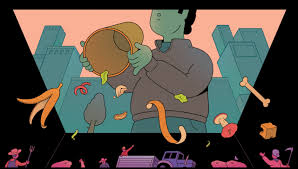
Best Magazine Reads: Trash is new, and so are ways of composting it
Tuesday, September 29, 2015
Jennifer Egan's Goon Squad Rocks, Until It Stumbles to a Close
I loved Jennifer Egan's The Keep and wrote about it back in 2010. It's amazing how the same strengths and weaknesses of that novel are repeated in her recent Pulitzer winner A Visit From the Goon Squad.
The strengths are that it involves a storyline that really interests me. The Keep was a dark gothic tale, in the style of Poe about a mysterious castle. The Goon Squad is about a bunch of people mixed up somehow or another in the music and publicity businesses.
The weaknesses are that my favorite characters get really established and then go away for long periods in favor of less-interesting players and storylines. It bugs me a lot more in this book because it had happened before.
In fact, I'm beginning to think Egan's short stories, which have been some of the best pieces in the past decade in The New Yorker, represent a much better path for readers.
Regardless, the story starts strong with the relationship between music executive Bennie Salazar and his young assistant and petty-thief Sasha. The part of their story that takes place on safari in Kenya, and was featured as an excerpt in The New Yorker, is intriguing, as are a lot of the early scenes in New York. But detours to Naples and with the story of a kid obsessed with the pauses in rock 'n' roll songs are missteps that never resolve themselves or reveal why they are there in the first place.
We never really find out what happens to most of the characters. We're left to assume that the pursuit of fame and living in what Egan portrays as a toxic industry simply swallows up people like Scotty (who finally and kind of inexplicably becomes a successful musician when he gets old), Stephanie (Benny's first wife, who likes to play tennis at the country club), Dolly and Lulu (a failed publicist and her daughter, who eventually replaces Sasha as Bennie's assistant), and Alex and his whole family (Alex is apparently haunted by a one-night stand with Sasha that he had initially forgotten for many years).
I just don't know what this all adds up to. Much of it doesn't seem to mean anything or provide morals to the story. The Goon Squad is no doubt a page turner up until about the page-250 mark, but the last 100 pages are a letdown and even make it puzzling why the Pulitzer committee made this choice (other than they simply picked the book for the fiction prize because it uses some interesting techniques, notably in those last 100 pages).
***1/2 out of ***** stars
The strengths are that it involves a storyline that really interests me. The Keep was a dark gothic tale, in the style of Poe about a mysterious castle. The Goon Squad is about a bunch of people mixed up somehow or another in the music and publicity businesses.
The weaknesses are that my favorite characters get really established and then go away for long periods in favor of less-interesting players and storylines. It bugs me a lot more in this book because it had happened before.
In fact, I'm beginning to think Egan's short stories, which have been some of the best pieces in the past decade in The New Yorker, represent a much better path for readers.
Regardless, the story starts strong with the relationship between music executive Bennie Salazar and his young assistant and petty-thief Sasha. The part of their story that takes place on safari in Kenya, and was featured as an excerpt in The New Yorker, is intriguing, as are a lot of the early scenes in New York. But detours to Naples and with the story of a kid obsessed with the pauses in rock 'n' roll songs are missteps that never resolve themselves or reveal why they are there in the first place.
We never really find out what happens to most of the characters. We're left to assume that the pursuit of fame and living in what Egan portrays as a toxic industry simply swallows up people like Scotty (who finally and kind of inexplicably becomes a successful musician when he gets old), Stephanie (Benny's first wife, who likes to play tennis at the country club), Dolly and Lulu (a failed publicist and her daughter, who eventually replaces Sasha as Bennie's assistant), and Alex and his whole family (Alex is apparently haunted by a one-night stand with Sasha that he had initially forgotten for many years).
I just don't know what this all adds up to. Much of it doesn't seem to mean anything or provide morals to the story. The Goon Squad is no doubt a page turner up until about the page-250 mark, but the last 100 pages are a letdown and even make it puzzling why the Pulitzer committee made this choice (other than they simply picked the book for the fiction prize because it uses some interesting techniques, notably in those last 100 pages).
***1/2 out of ***** stars
Wednesday, February 5, 2014
Best Magazine Reads: William S. Burroughs is the King of "Gentleman-Junkie Cool"
Today is the anniversary of William S. Burroughs’ 100th
birthday.
Here are seven interesting things to know about the beatnik
rebel, from an excellent
essay by Peter Schjeldahl in last week’s issue of The New Yorker.
Schjeldahl reviews the new biography Call Me Burroughs, by one of my favorite
writers, Barry Miles,
who has written books on The Beatles, Pink Floyd, The Jam, Jack Kerouac, and
Frank Zappa.
- Burroughs and I both grew up in St. Louis, so that’s an automatic point for awesomeness. He played alongside the “polluted River des Peres.”
- His most famous book, Naked Lunch, was mostly written in Tangiers with the help of Kerouac and Allen Ginsberg and was released in 1959 in Paris was banned in the prudish U.S. until 1962 – and not allowed to be sold in Boston until 1965.
- Ginsberg came up with the title, having misread the phrase “naked lust” in one of Burroughs’ manuscripts.
- Kerouac’s Old Bull Lee character in On the Road was based on Burroughs.
- Burroughs’ anxiety about his homosexuality traces back to when he was four years old and “his nanny forced him to perform oral sex on her boyfriend.”
- Hw was always high on something while writing, and his “hollow voice” greatly influenced J.G. Ballard, William Gibson, and Kathy Acker.
- Burroughs died in 1997 of a heart attack at the age of 83, living his last 16 years in – oddly – Lawrence, Kansas.
Saturday, September 29, 2012
Junot Diaz Writes Another Dominican Winner in The New Yorker
I have no doubt that Junot Diaz is one of the top contemporary fiction writers. His Dominican street-smart casanova language makes me feel like I'm back on the streets of that country, where I had such a great visit a year-and-a-half ago.
The Brief Wonderous Life of Oscar Wao is a modern classic, and Diaz's latest short story in The New Yorker, "The Cheater's Guide to Love," is a similar tale. It's about a guy named Yunior (a thinly disguised confessional story, it's been rumored), who lives in Boston and is suffering from years of depression after a breakup with the love of his life, whom he had cheated on about 50 times while they were dating and engaged.
Yunior tries running, yoga, dating other girls, and other pursuits as he tries to forget her. Nothing much works, and it's a sad and hopeless story. But the way Diaz writes makes the pages turn rapidly and I really couldn't wait to discover what would happen next.
****1/2 out of ***** stars
The Brief Wonderous Life of Oscar Wao is a modern classic, and Diaz's latest short story in The New Yorker, "The Cheater's Guide to Love," is a similar tale. It's about a guy named Yunior (a thinly disguised confessional story, it's been rumored), who lives in Boston and is suffering from years of depression after a breakup with the love of his life, whom he had cheated on about 50 times while they were dating and engaged.
Yunior tries running, yoga, dating other girls, and other pursuits as he tries to forget her. Nothing much works, and it's a sad and hopeless story. But the way Diaz writes makes the pages turn rapidly and I really couldn't wait to discover what would happen next.
****1/2 out of ***** stars
Sunday, July 24, 2011
July is For Family Fun
July has been filled with some nice family time. The month started off in the Adirondacks at Rachel's grandmother's lake house. The picture to the left is Jackson (wearing devil's horns) and his cousin Julia ganging up on their older cousin Hannah.
We also went to Fairfield, Connecticut last weekend for our cousin Stanton's 60th birthday. The party was on the beach there and we stayed at our cousins James and Ellen's beautiful house in Pound Ridge, New York. This is an area we could really live. It's got the more mountainous feeling area around James and Ellen's place (which Rachel would like) and the beach (which is more my style).
This was also a chance for me to narrow down the number of states I need to get to. Connecticut was a new one for me. So now the list is five: North Dakota, Hawaii, Alaska, New Mexico, and Rhode Island.While in Connecticut, we took Jackson to his first amusement park, Rye Playland in Westchester. He gave it thumb's up, as you can see in the photo. And it was a good warmup for me, as the little rollercoaters hopefully got me back into shape for the big ones that are sure to be headed my way as soon as Jackson gets a little taller.
Thursday, June 9, 2011
Is Jonathan Franzen Truly the Great American Novelist?
I always wanted to like famed author Jonathan Franzen, but something about his upturned-nose style of writing has bugged me. He, like I, is from St. Louis, so I kind of enjoyed his first novel, 1988's The Twenty-Seventh City. It's about people from India in that city, the corrupt police force, and St. Louis' fall from having been the country's "fourth city" in the 1870s.But I progressively liked his writings for The New Yorker less and less over the years, so much so that I refused to even read his much-acclaimed novel, The Corrections. Franzen drew me back in when I heard his latest, Freedom, featured a protagonist employed by The Nature Conservancy, where I've now worked for the past 11 months.
Walter Berglund is that character. Walter loves birds so much that it eventually drives him significantly cuckoo. It doesn't necessarily paint TNC in the greatest of lights, in that Walter seems to truly love animals more than people, not something the Conservancy seeks as its image. Luckily, there is enough love of people (mainly his wife Patty and his eventual mistress Lalitha) in Walter's life, that the animal part arguably doesn't win out. But it's close, and much of the novel's suspense teeters upon that line in the sand between bliss and madness. The Economist even calls the book a modern-day Paradise Lost.Walter and Patty have two kids. Joey is a handsome wealthy young Republican, which drives Walter batty. Jessica is a good kid who tries to help her parents from killing each other. The wildcard in the novel is Richard Katz, a rock star who learned quite a bit of what he knows from Walter when the two were college roommates. Patty learns a lot from Richard too, and it drives a wedge into their marriage.
The scope of the novel is epic, and Franzen really nails it. His ability to build character and compelling dialogue nearly matches one of my favorite (yet less heralded) writers, Ethan Canin. It's a true page-turner, understandably an Oprah-endorsed modern classic, and there isn't a boring part within the tome (although the section in which Patty tries to help divide her father's estate between her spoiled siblings seems to get in the way a bit at the end).
I don't know if Franzen quite lives up to Time Magazine's claim as "the great American novelist," but he's close enough and I'm going to try to like him more after reading Freedom. His tone is still a little condescending and cloyingly intellectual, but he has definitely worked hard to improve himself in that category over the years.
****1/2 out of ***** stars
Subscribe to:
Posts (Atom)